
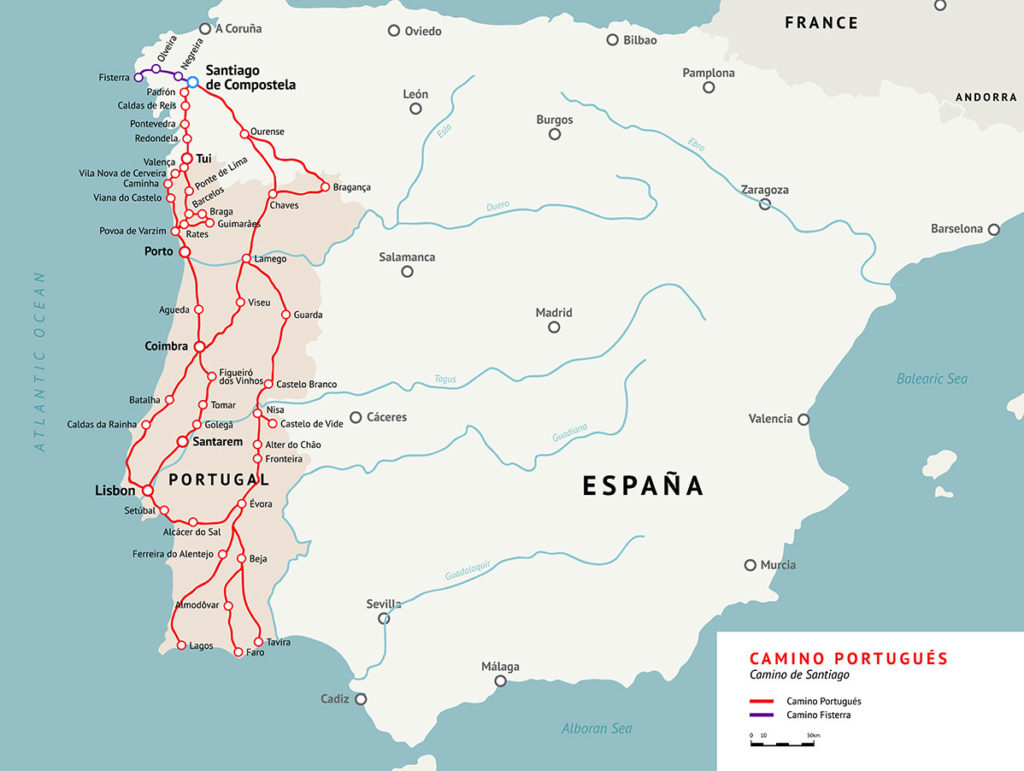
I am planning another Camino, the Camino Portuguese. I’ll be walking from Lisbon to Santiago de Compostela, almost 400 miles. Here is some history and legend associated with the Camino de Santiago.
According to church legends of St. James, St. James was beheaded in Jerusalem in 44 CE. Some of his companions take his stone sarcophagus to Spain after his death. There is some disagreement. Armenians believe that after he was beheaded, James the “brother” of Jesus took James’ head and buried it in his garden. That garden is now the Armenian Cathedral of St James.
Returning to the legend of St James and Spain, tradition explains that this heavy stone sarcophagus was placed on a wagon and transported from the coast inland. When the oxen could go no further, the body was buried. Centuries pass. Finally, in 813 CE the tomb and relics are “discovered”. During these centuries and the succeeding centuries, the “cult of saints” develops. The Roman Catholic Church attributes relics of these saints as having the power to make God’s power and grace especially present. Thus, individuals who undertook pilgrimages would find God’s grace especially available, whether for seeking penance or a miracle.
There were numerous pilgrimage destinations. The four major European destinations were Rome, Santiago, Canterbury, and Cologne. There were also 19 minor destinations, all in France. Of course, Jerusalem was the major destination; however, except for 1099-1244, pilgrims found it dangerous to travel to Jerusalem.
Along with this increase in pilgrimages, the Church began to attend to these pilgrims. The Cathedral was begun in 1060 and completed in 1211 completed. In 1122 Santiago received Papal permission to grant indulgences. By the 12th Century the Benedictines offered hospitality and the Knights Templar and the Order of Santiago offered protection.
As I mention, the pilgrims went for penance and hopes of a miracle. In The Miracles of Saint James, an incident is recalled whereby a hanged boy revives when his father returns from his pilgrimage to Santiago de Compostela. This miracle story is one of twenty-two narrated in that work. Many pilgrims went for penitential purposes. Penance as a “second baptism” could involve public or private sins. In The Miracles of Saint James, we read “Whoever goes truly penitent to St. James and asks for his help with all his heart, will certainly have all his sins expunged” For medieval Christians, the language is quite clear!
The history of Santiago continued. In 1366 King of Castille had the Archbishop and Cathedral Dean murdered. Ouch! Ferdinand and Isabella were themselves pilgrims in 1488. As a sign of devotion, they built the Reyes Catolica in 1509. For years it was a pilgrim hospice; now, it is a five star hotel. In 1589 the relics were hidden from English pirates. In 1590 the King prohibited pilgrims from wearing pilgrim garb!
More recently, in1878-9 the relics are “rediscovered.” Only a few people carryout a pilgrimage though. In 1982 John Paul II visits Santiago and declares: “From Santiago, I launch an appeal: old Europe, discover yourself.” Within a few years, in 1987, Santiago becomes the first European Cultural Route (Council of Europe) and a UNESCO World Cultural Site.
The number of pilgrims has changed through the years.
Year Number of Pilgrims
•1985 690
•2019 347,578
•2020 53, 800
It is predicted that with a cautious resumption of global traveling, there will be three times the number of pilgrims in 2021 as in 2020. The good Lord willing, I will be one of them!
 Journeys: Explorations in Body, Mind, and Spirit