

Besides being quite small, the Picardy villages are very, very quiet. As I lived in two rural Illinois villages with barely 400 folks in each village (one had a very active co-op grain elevator and the other had a relatively busy restaurant) I know small, quiet villages.

In France, I know that I’m approaching a village when I see a church spire or farm machinery. I have to imagine that these villagers either work on the surrounding fields, work in a nearby town, or are elderly and not leaving the town where they’ve lived their lives and friends whom they’ve known for decades. Many of these villages were rebuilt after WW1 (and then some again after WW2). In all of France, officials estimated that 300,00 homes were destroyed, 1500 schools, and 1200 churches. Much of what made the Picardy area livable was eliminated. In fact, to this day, The province of Picardy is one of the poorest in France.

Although I took 2-3 photos of village houses, I can’t find the photographs so I’ll describe the buildings. Often there is one or two substantial stone building, often a taverne, in the village. The typical houses are all a variant shade of red brick without any wood or stone structures. Similar to American home building trends post-WW1, the French also simplified their rebuilt houses. Americans turned away from ornamental Victorian homes or expensive and intricate Craftsman style homes to simple and boxlike American Minimal tradition houses. The French villages went from some large provincial style homes, maybe even a few, very few Second Empire houses (think mansard roof) to very simple, small brick homes. I certainly haven’t seen a single large chateau while walking. Even with their second half-floor, these French homes are probably half-the-size of our Decatur ranch-style house. These French homes are generally attractive with small front gardens and gravel driveways.
Post-World War II, there are towns which certainly display wealth as reflected in the rebuilt homes.


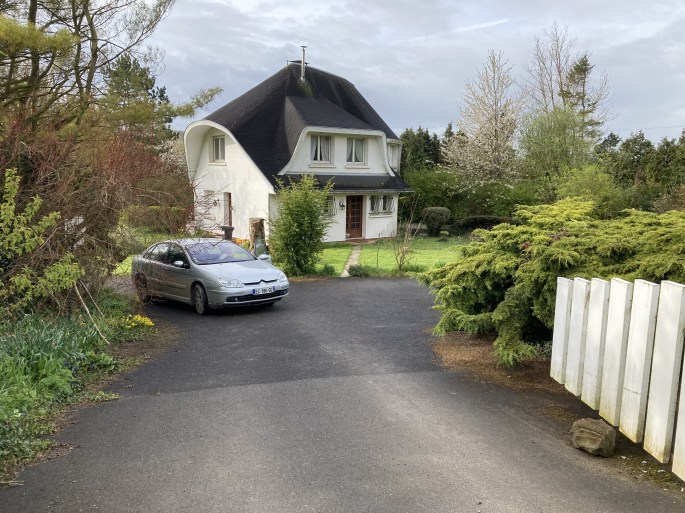
I also saw several modernist houses. Two houses would fit well with the boxy houses being built in Decatur. The other modernist house had roofs with large eaves that curved toward the ground. Really neat! Like the imagined Seven Dwarfs house in the forest! I kick myself that I can’t find that photo!
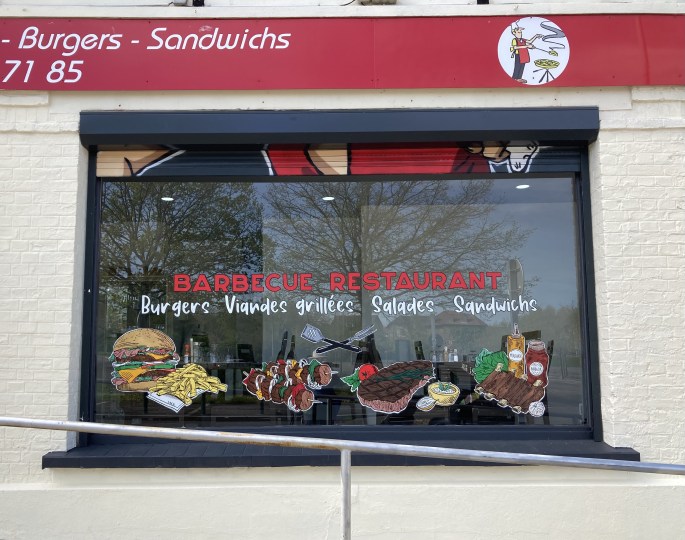
Food must be an issue in the very small villages. Some villages had no restaurant or grocery stores. Arghhh! The larger villages and towns had their restaurants. While international cuisine was generally not available, I would have loved to have tried this one Barbeque restaurant.
Every village has a church. The church architecture differs from Spain and Portugal. In France, older and newer rebuilt churches have very tall pointed steeples. Almost always, I have found them locked.

Some of the churches simply grab your attention.

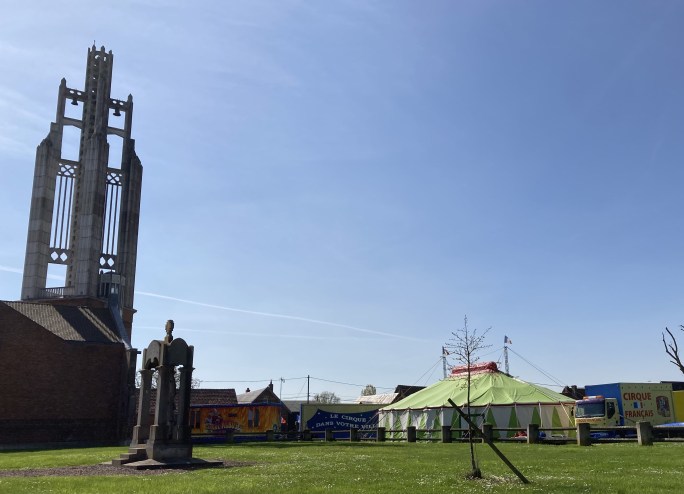
I’ve never seen a church with it’s door blocked by a porto-potty. . Another church I passed had a steeple like a NASA launch tower; another church from a photo looked like a large, narrow artillery shell. The French are creative!
I know immediately that I am in a country with a Roman Catholic past. There are obvious signs. I have seen dozens of very large crucifixes. These crucifixes aren’t the stone crosses of Spain or Italy, these are crosses with much more lifelike representations of Jesus on the cross. Another sign that I’m in a country with a Roman Catholic past is that I have not seen a single Protestant church.
I find that it is fascinating how folks physically create their world. While I certainly don’t want to romanticize these small villages, I find them intriguing as I see folks trying to create their lives in these villages. One village even had human-like figures welcoming me and inviting me to a tea or espresso!

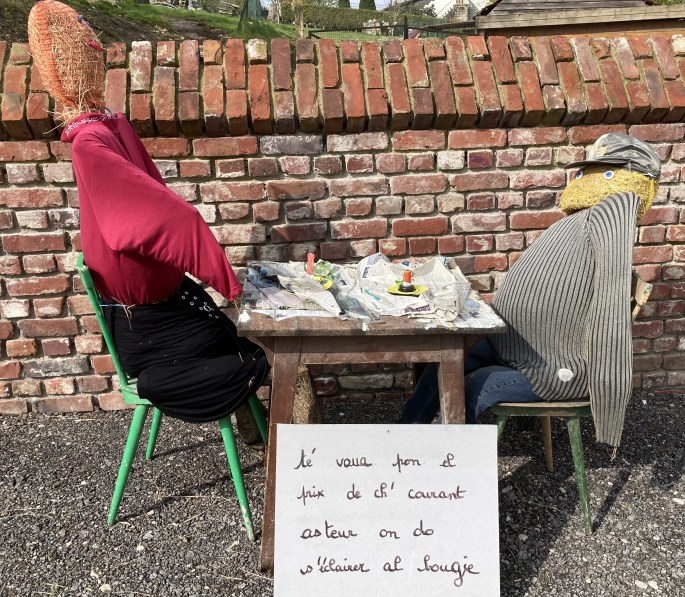
Needless to say, there is a charm, and an occasional surprise, to the villages of Picardy.
 Journeys: Explorations in Body, Mind, and Spirit