I’m feeling better. Thanks for thinking of me. Others have gone and are going through so much more, I’m rather self-conscious about writing about the food poisoning; however, that problem has been part of the journey. It is also part of life’s perennial question of how do we acknowledge our own situation without becoming obsessed by that situation. A never ending question!
I also have to mention my getting ticked off today. I’m annoyed twice today. At breakfast, I could barely hear and talk to Mary because, in the small breakfast room, at least 15-20 elderly German-speaking tourists could only communicate by shouting. Yikes! Then, I talk to a British hiker. I mention that I’m wanting to see the St Bernard statue, he exclaims “Why that bastard?” Ouch again!
My annoyance signals that I’m in transition. Part of being a slow traveler is a sort of immunity from most situations like these two. I spend breakfast with only a few known folks, or maybe with nobody, so I don’t get annoyed; I see statues or memorials with other walkers who savor statues commemorating somebody’s life. Not today. Like everybody else, I get annoyed; I judge others; I dismiss others. Welcome back to ordinary life in our real world Lindquist!
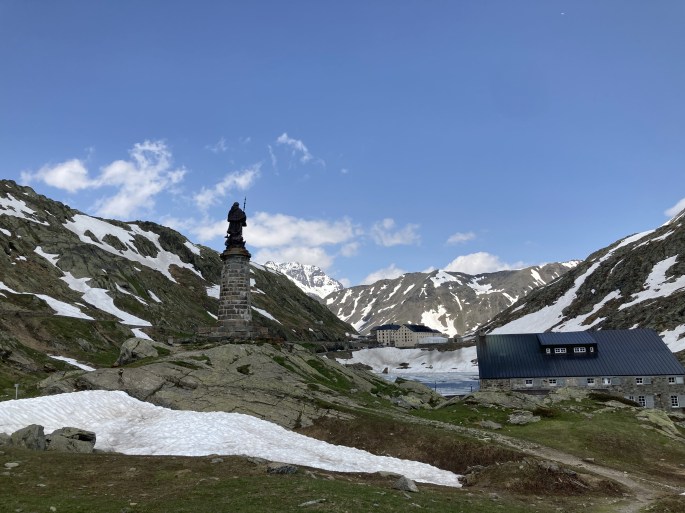
Time for change of topic. I really want to mention the amazing history of a narrow 50-75 meters of flat rock that expands into a larger area still only a couple hundred meters wide and deep, the area which is the actual pass between two mountains and two river valleys. This area, the Great Saint Bernard Pass, has an elevation of 8100 feet. One of two passes connecting Switzerland and the north with Italy.
The history of this Pass is so multi-layered. Bronze Age (800 BCE) objects left by travelers. Later, Celtic people lived in high valleys and left objects of their mountain god. Rome, first under Caesar in 57 BCE, and more successfully under Augustus in 12CE, established a garrison outpost with a temple to Jupiter. Around 801, the pope asks Emperor Charlemagne to give protection to the hospices along the Alpine road, “so that the monks who dwell there may continue to serve God by prayer and giving aid to pilgrims”. He is successful. Later rulers are not. During the 900’s, Saracens (Muslim Moors) control the pass only to be driven out later that century.
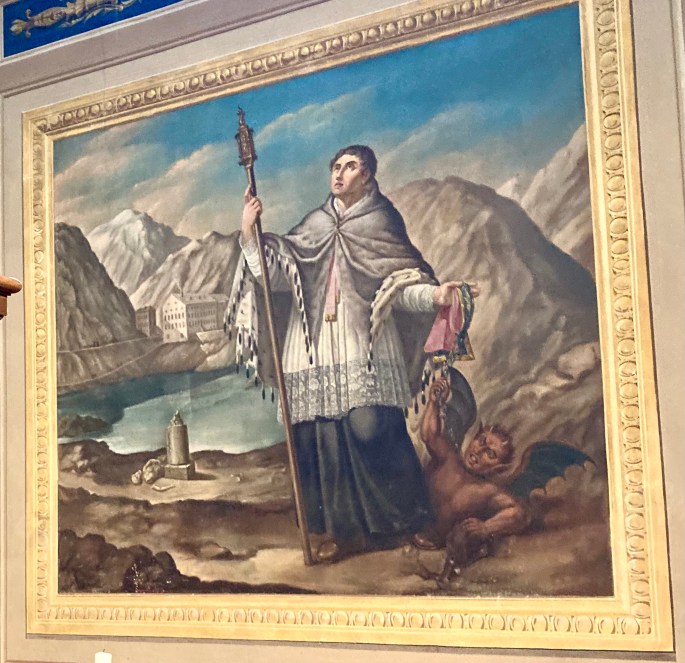

Enter Bernard of Menthon. Born into a wealthy Burgandy family in 1020, he becomes a priest and eventually the Archdeacon of Aosta (the closest major Italian town to the Pass and later birthplace of St. Anselm). Before he dies in 1081, he has asked and been given Papal permission to found a new hospice and order to assist travelers in 1049. This hospice grows and expands its work in other regions with support of numerous donations.
I wanted to see the 1923 bronze statue of St Bernard on a pedestal above the road on the Italian side. In 1923, Pope Pious XI declared St. Bernard patron saint of the Alps. The brothers have maintained the Hospice as a place of devotion; they have shown hospitality to anybody and everybody. Their purpose of helping individuals caught in the snow of the pass required them to learn all sorts of skills.
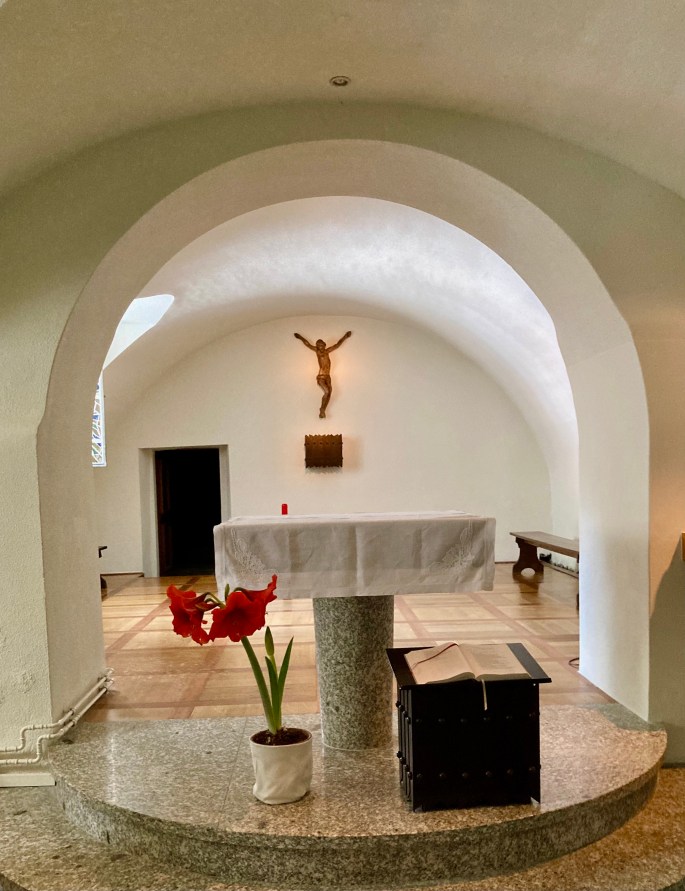
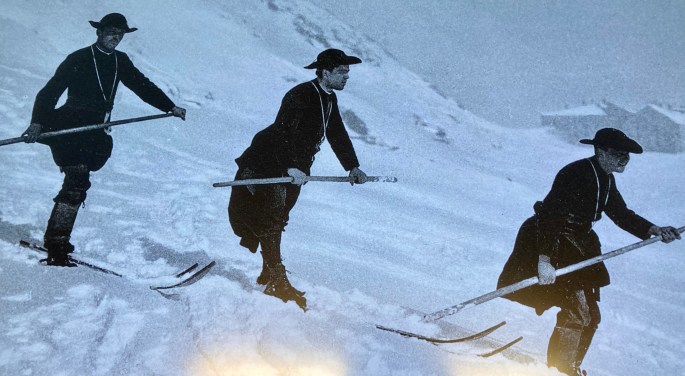
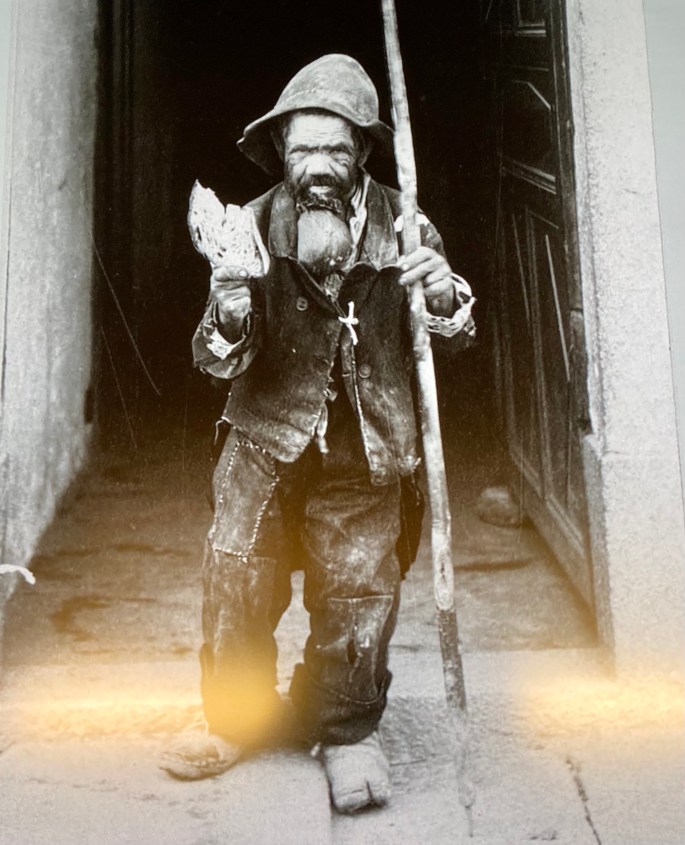
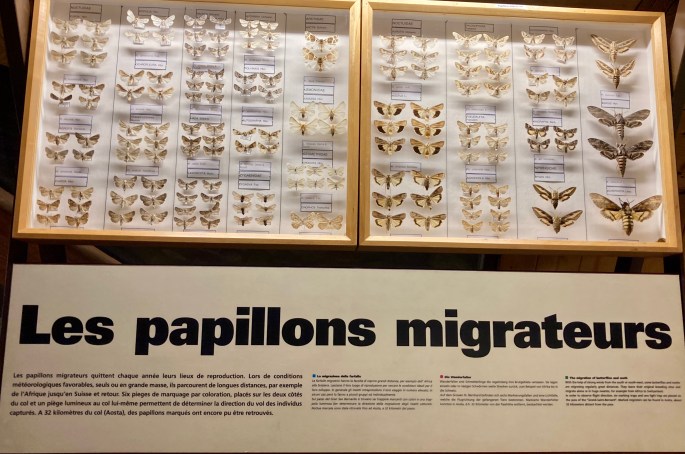
While helping and showing hospitality to travelers and maintaining a life of prayer have been their main purposes, the resident canons have been active in other ways. They’ve collected weather data, studied the fauna of the alpine region, noted the migration of butterflies, investigated the geology of the area. Quite an active and devoted group of men. For over 1000 years!
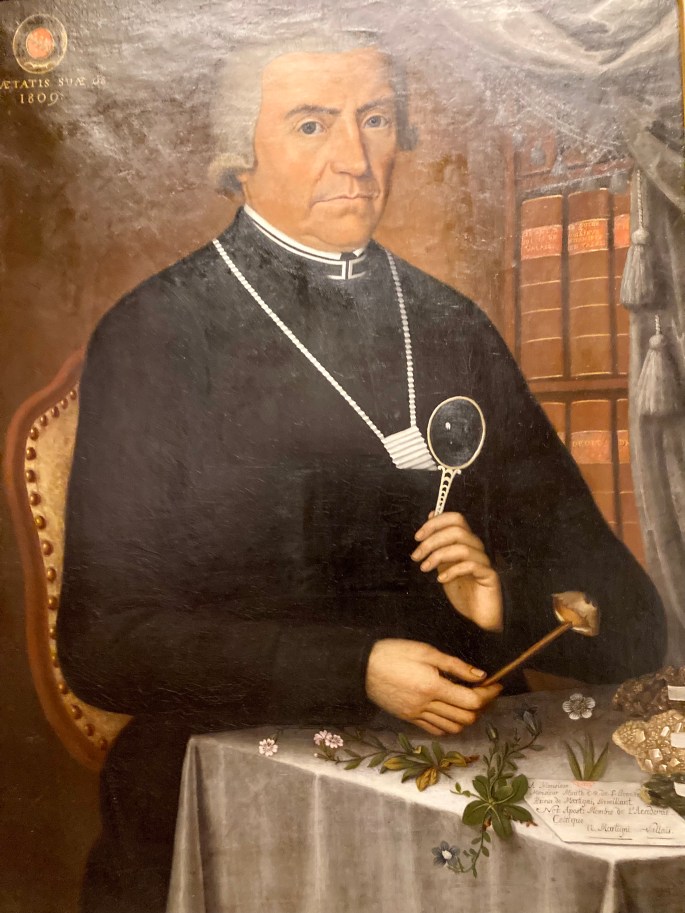
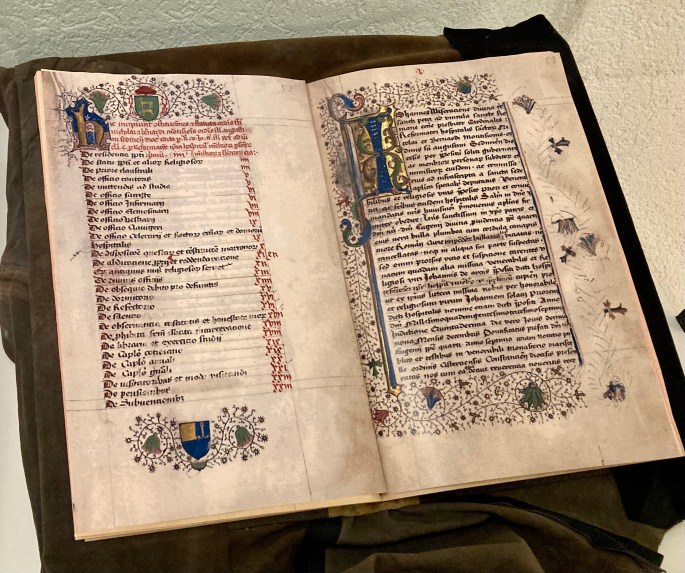



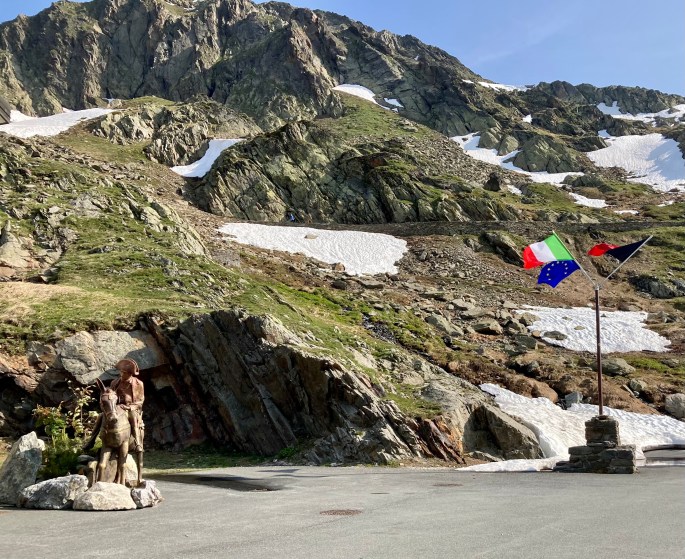
But there is more. Everybody knows the story of Napoleon’s crossing the Pass as the last one behind his 40,000 soldiers. And fearlessly he did it on a rearing white horse as heroically painted by Jacques-Louis David only a few years later. Not so. He crossed on a mule carefully led by a local guide. There is a striking contrast only feet from the Swiss-Italian border. A Statue of Napoleon on the mule and the European Union flag, along with the Swiss and Italian flags. Napoleon’s temporary European empire created by conquest; the European Union created voluntarily. With the UK’s withdrawal, the European Union is not perfect, but it sure seems better than one forced upon a continent by one militarily strong country.

Of course, the history of the Pass must include the St. Bernard dogs. Such adorable, slobbering, gentle creatures. Like the bison and bears of Yellowstone, the St. Bernard dogs attract photo hungry tourists, including me.

One can’t get enough photos! Rightly so, the original dogs were bred in the 1700’s because of strength and human compatibility. In their museum at the pass, it was claimed that the dogs had 100,000 times the sense of human smell. Amazing! Barry the original service dog is credited with saving over 40 lives. Barry III is admiringly preserved in the Hospice museum. Nice touch!
With all the cyclists struggling to gain the pass, I’m not surprised to learn that the Tour de France has had a stage here 5 different times.
While I don’t mean to overwhelm you with historical information, I do want to convey the dense, concentrated history within this small area of land. Think about an area similar in size to Lakeside High School, or most high school campuses. So many historical layers in such a small area.
Sometimes these dense historical spaces immediately overwhelm us. We are there. We know the story. The impact is instantaneous. These places are often woven into National narratives such as Plymouth and the Pilgrims, Valley Forge and Washington, Normandy and D-Day. For me, the layers of the St Bernard Pass came out-of-the-blue. I had no idea of all that has transpired here. In this pocket-park size piece of rock. Significant in so many historical, political, social, and religious ways. I’m so grateful that I could spend two nights absorbing parts of that history.

 Journeys: Explorations in Body, Mind, and Spirit