
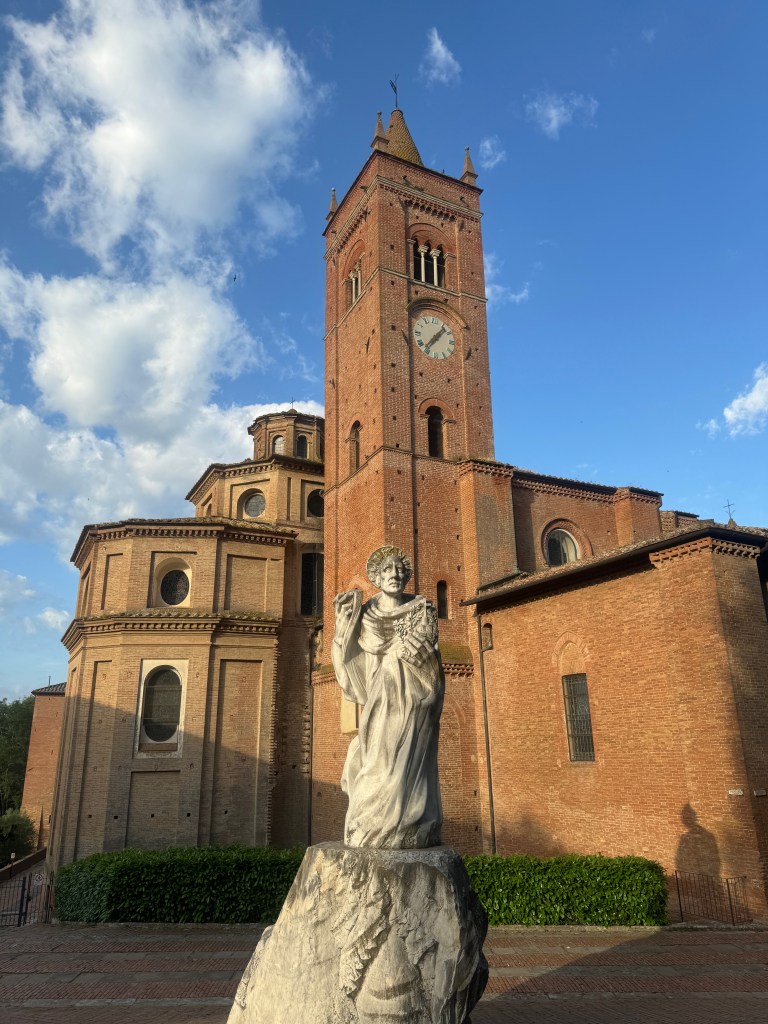
I arrive at Abbey Mt. Olivetti Maggori. Six miles from Asciano. A Benedictine monastery founded by Sienese nobleman turned monk Bernardo Tolomei in 1319. I am here to rest and reflect on my pilgrimage.
Although I have stayed at several monasteries, I am disoriented at first. I am aware that there is a restaurant close to the abbey which guests use since they can’t eat in the abbey refectory. When I arrive at a restaurant, I hear a waiter taking an order and people chatting over wine, but don’t see the monastery. Is the abbey down this brick pathway? How far down this brick pathway? Where should I wait until my check-in at 4PM? When I find the guest lodging, how do I enter?

I take the old brick pathway leading to the abbey. After three or four minutes, I see the abbey a couple hundred meters down the path. I hear sounds. With each step, the sounds get louder and louder. The sounds are the dreaded noise of running and shouting middle-age kids. Can’t they read one of the languages in the multi-language sign “Silence.”

In groups of 4-5, they sit on benches and chase each other on brick pavement next to the brick guest lodging. All this brick magnifies and amplifies their shouting. Conveying the sense that they’ve done this many times already, two middle-aged women both go “Shsh…shsh.” Of course, their half-pleading scolding results in silence, for maybe 30 seconds. My anger is growing. Am I going to be spending the night with twenty overly excited kids, loud kids? Oh, please no!


At 4 PM, I walk to the guest lodging entry door. I stand. I wait. I notice the beautiful flowers. The door remains shut and locked. It is 4:15. An elderly monk carrying a blooming red rose kindly sees my patient confusion as I stand in front of the locked door. He quietly says “Ring the bell.” Buzz. Click. The door unlocks.

I follow the sound of an Italian voice. A younger monk is on the phone, several pages of printed spreadsheet in front of him. A quick “Bojourno” and he returns to the phone conversation. He finishes the phone conversation. “Un momento” as he thumbs through the spreadsheets, finally making several notations on one page. He smiles and turns to me “senior Lindquist?” Surprised, I say “Si.” As it turns out, I and another couple are the only guests tonight.
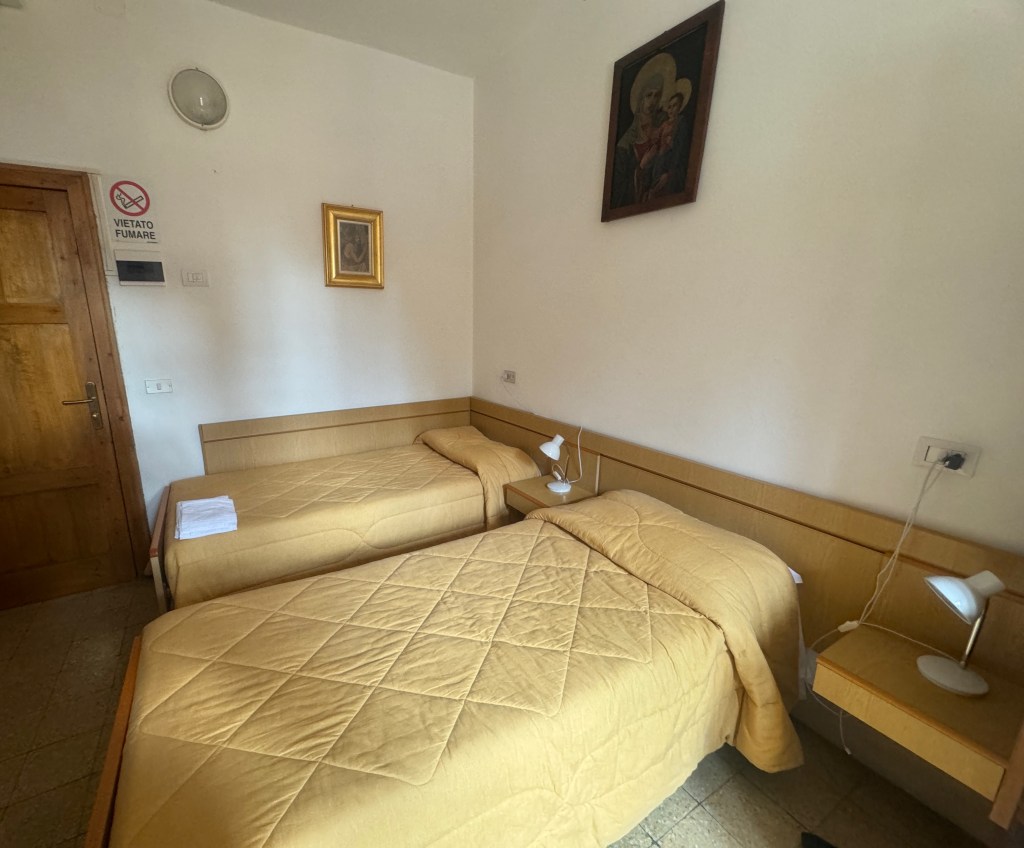
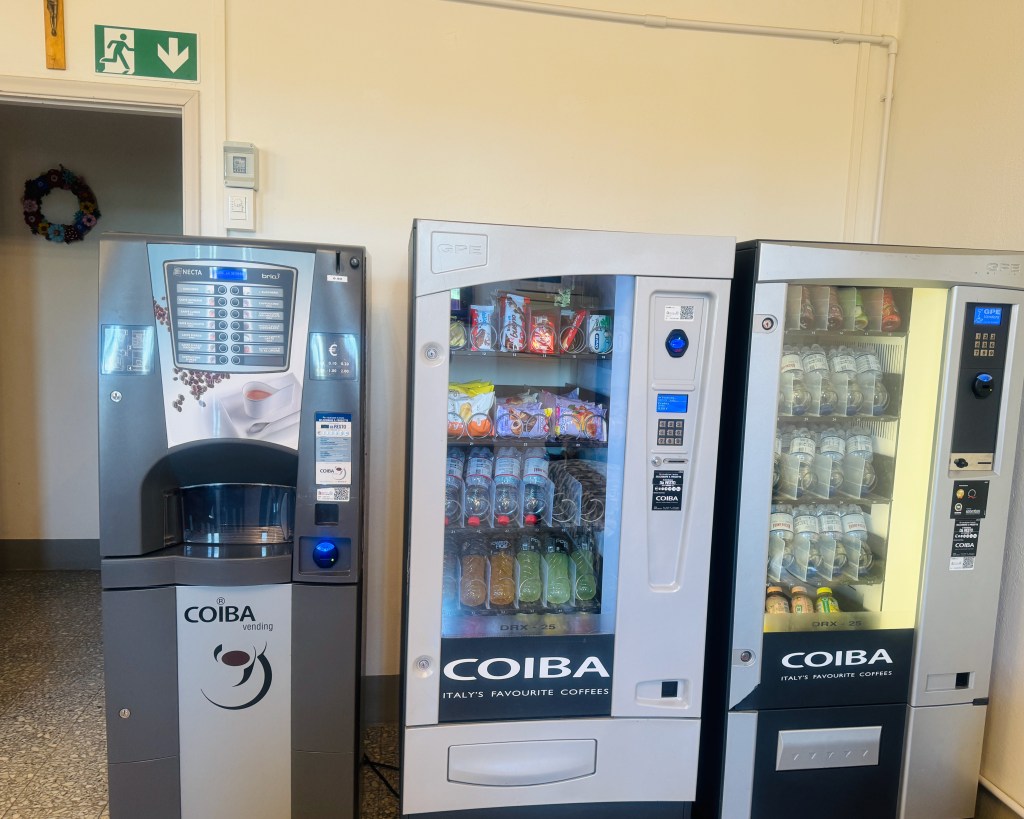
He shows me my room. Clean and simple. He shows me the snack room which is also the library. Three machines with coffee, water, and snacks. Coffee in the morning. Yeah! He points to the wi-fi sign. “Only here, not in your room.” That’s okay. I’m pleased that I have Wi-Fi. I glance at the book collection, one double-wide set of bookshelves, and I ask “English Bible?” He scans the shelves as I do, “No, no English Bible.” With that, he returns to his office; I return to my room. Silence.
I unpack my pack. My entire pack. Putting on hangers shirts that have been wadded and stuffed in my pack for at least a week. It’s close to 5PM and Vespers are at 6:30 PM. Decision time. Should I eat my cheese now or wait until after vespers? I decide to wait.
The bells ring at 6:22 for the service. I walk the 100 feet to the church. I’m the first to arrive. One monk acting as sacristan is hurriedly shuffling around the altar area lighting candles. He quickly eyes me, sees that I’m harmless, and shuffles to another candle.

A minute later, I hear the monks’ sandals as they stream in, a quick genuflecting toward the altar, and choir seats being unfolded.
I’m puzzled where to sit. The pews and chairs facing the altar are in front of the choir area. So, I take a seat with the monks twenty feet behind me. It dawns on me that the monk sacristan could have removed the rope between the pews and the choir area. If he had, then I could sit in the first row of the choir area, closer to the monks but still separate from the monks. Since I’m the only one present and since the monks are behind me, so much for taking cues from someone who knows when to stand, when to genuflect, when to cross myself. Oh wellll….
The vespers service is Latin Gregorian chant. The chanting varies. One monk may chant a line to which all the other monks respond; or one group of monks chants a line to which the other group of monks respond; or all the monks chant both together in unison. After only a minute or two, they find the harmony and the rhythm. I shouldn’t be surprised. While there are 5-6 younger than 30, the other 15 are middle-aged to elderly. Needless to say, they are well practiced in this chanting. Several times a day; 365 days a year. For some of them, probably 50 years! When Oak Grove United Methodist choir sang the modern, French composer Durufle’s Requiem last Lent, a difficult blending of modern and traditional Gregorian chant, we could have used the authentic chanting of some of these tenors, baritones, and basses.
After standing twice when I hear wood creaking as the men stand, or sit, I decide to remain seated. I realize that the monks don’t, or shouldn’t, care! For thirty minutes I’m taken into the prayerful world of the chanting. Wonderful!
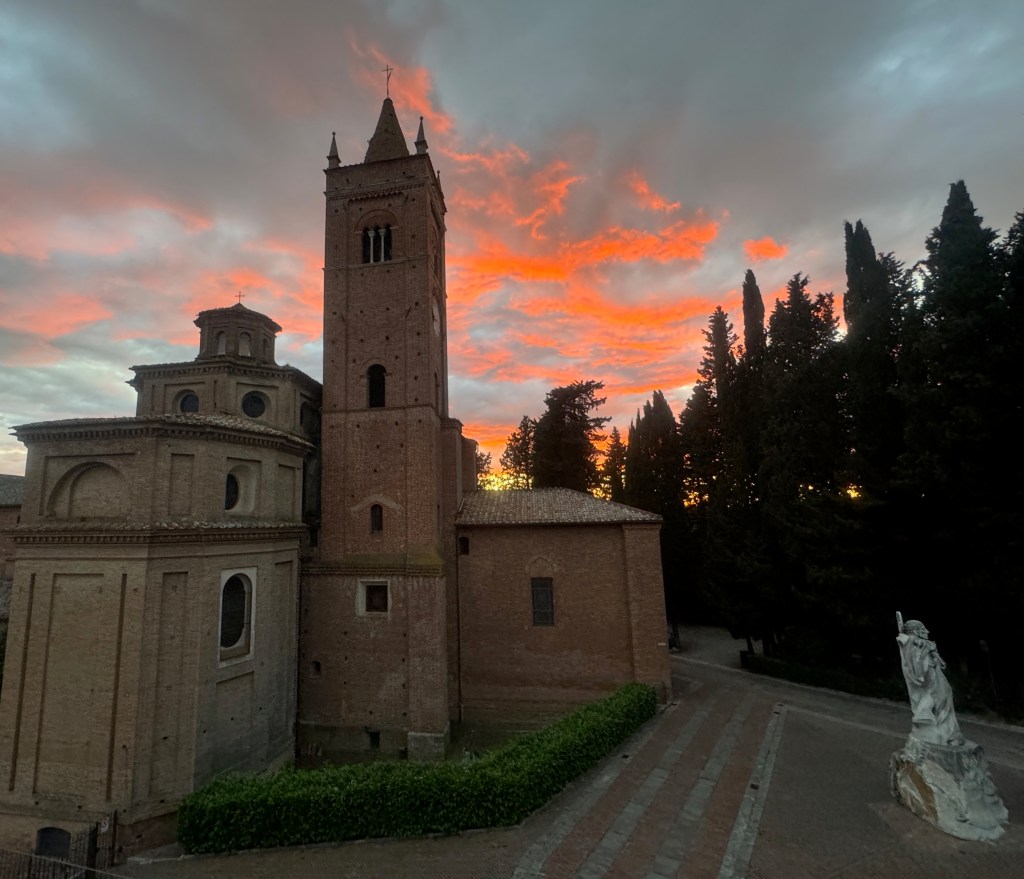
I return to my room. I watch the sunset next to the brick bell tower and between the Italian cypress trees. I hear the swallows and the pigeons during their last daytime flights. Nice! The night is quiet.
I’m up at 5AM. I go to the snack bar for two cups of coffee. I decide to write a post. As I finish right before the 7:30 service, I try sending the email written post to myself. No luck. I see “Can’t connect to server.” I check and recheck my settings. Trying each time to email myself the post. Whatever the cause for my failure, I close the iPad, losing 1-1/2 hours worth of work. Used to almost seamless connections of home Wi-Fi, I am frustrated. Arghhh.
I attend Lauds and other services. I learn to hear individual voices. I hear the pause between one set of chanting and the follow-up response. I hear a quiet confessing and a louder intense, but controlled praise. I hear words that even I identify: Gloria, Dios, Alleluia, Christo’s, Kirie Eleison, Spiritus, and more.
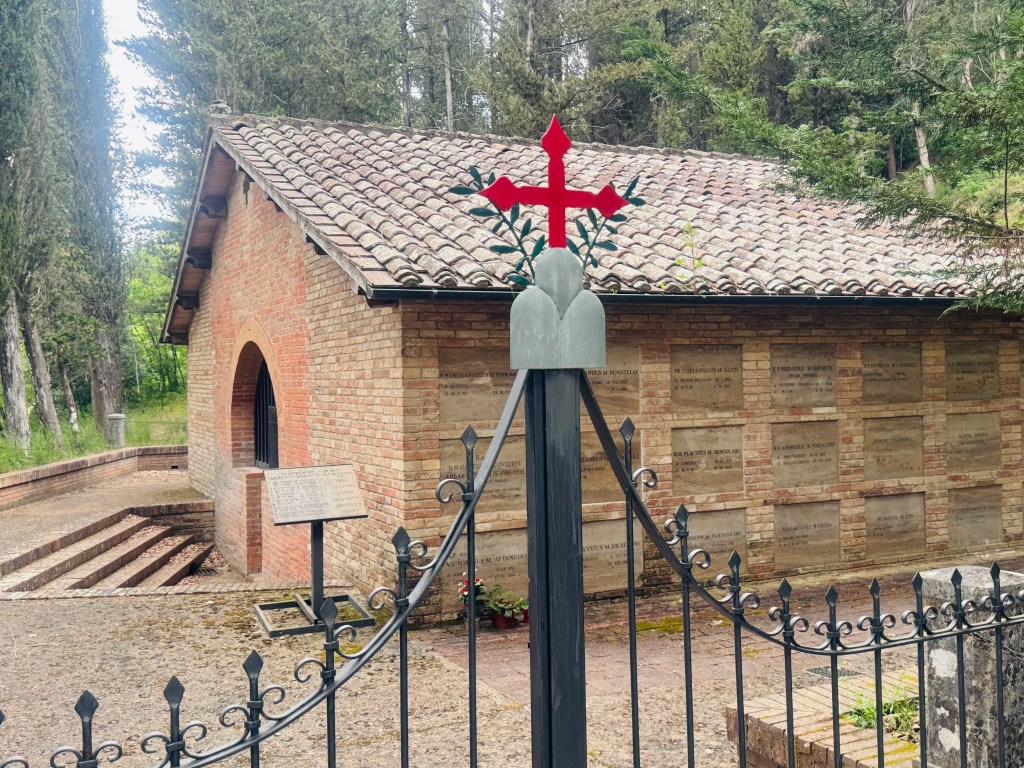
The second day, I explore the public parts of the abbey. I walk to the soundless cemetery.
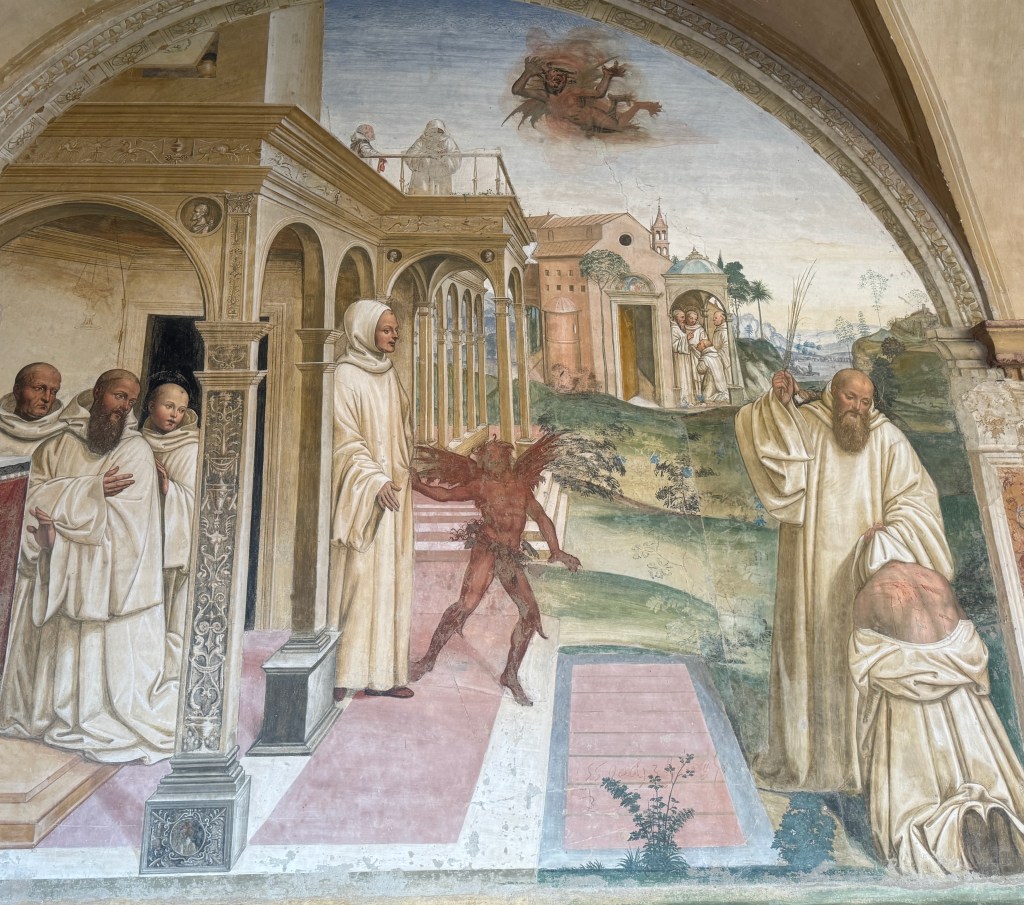
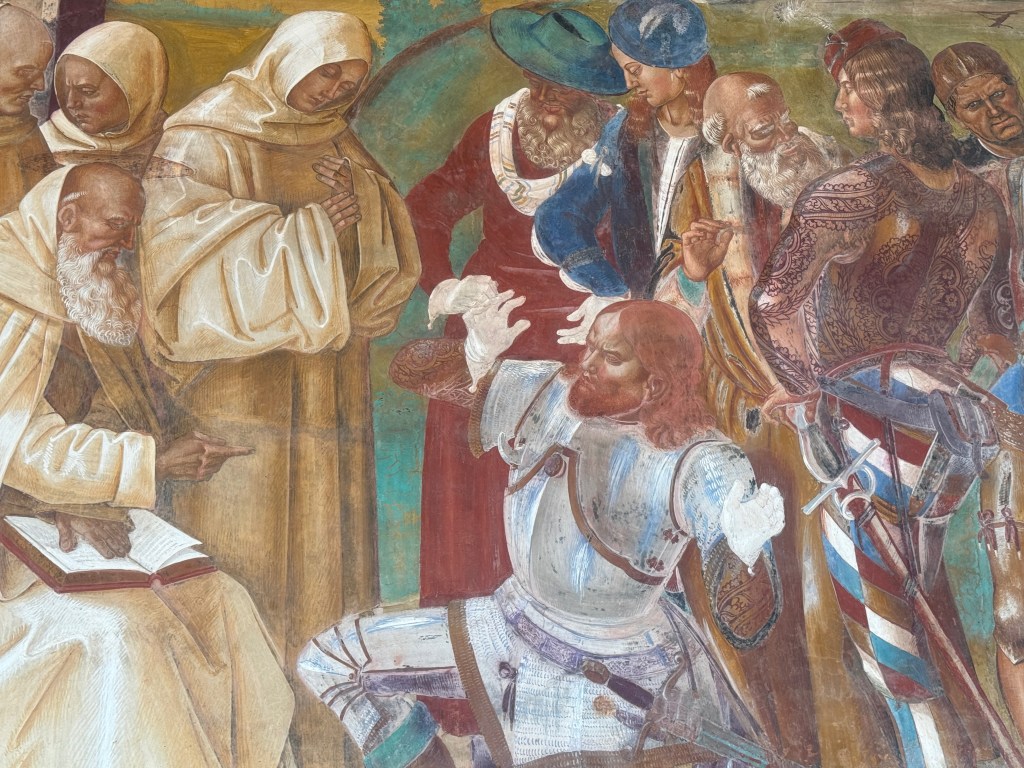
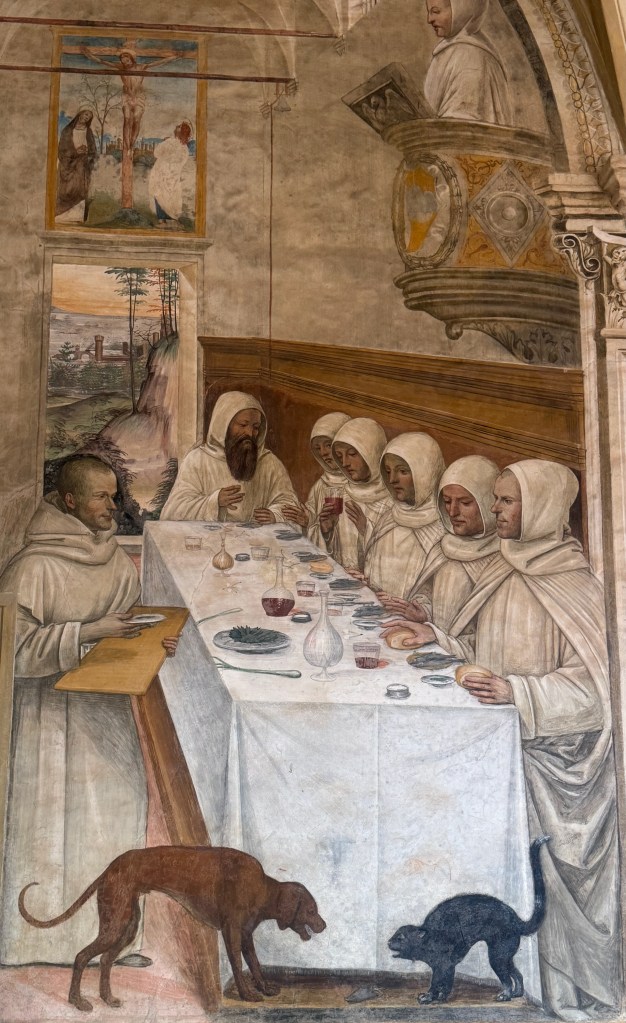
I hear my footsteps as I walk the cloisters with its collection of frescos of St Benedict done by a father and son beginning in 1395.


I find the silent library of 40,000 medieval volumes. It contains two Bibles, one from 1490 and one from 1506. Until 2012, monks copied books for centuries, even restoring damaged books. Walking down old stone steps to the cellar, I see large caskets and numerous wine bottles. There is no sound made by monks today.


Why is the monastery so restful? I have no great disclosure. The rest comes from the sound. My ears hear unfamiliar, atypical sounds. Monks chanting. My ears hear calming sounds, the bells, the birds. Even the metal gate or the heavy wooden door opening and closing. My ears hear no sounds. Completely different than Simon and Garfunkel’s “Sound of Silence”, this silence is rejuvenating. Oh yes, the 20 middle-grade kids didn’t spend the night! Can I have a “Hallelujah?”
 Journeys: Explorations in Body, Mind, and Spirit