

I’m fortunate to walk the Via Francigena at my young 72. With decent health, sufficient financial resources, and Mary’s support, I find that this pilgrimage is “doable.” I can feel the effects though. Losing a toenail on my right foot from walking shoes not tightly laced for the downhill walking in Aosta valley. The top of my left ankle giving me occasional pain from overcompensating and tying those laces too tight. Get it right Lindquist! I’ll mention my chest cold one last time, as it resulted in my diaphragm muscles hurting from coughing. Finally, that feet-numbing, thirty mile hike up, over, and down the Apennines. Yet, I and others are proof that slow-travel is possible, not only for young’ns but also for us older folks. Maybe not all older folks, but some of us.
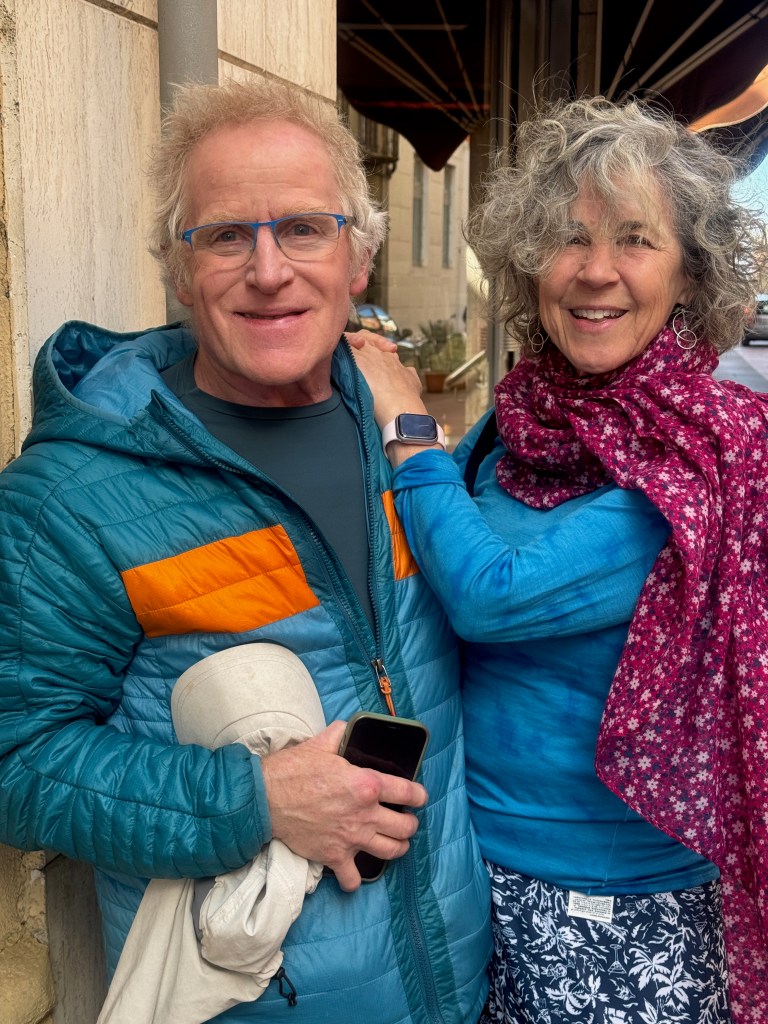
Laurel and Dave describe their walking as a”gap period between work and retirement.” (Do I have that phrase right?) Even though some writers describe the various stages of retirement, Laurel finds the “gap year,” normally reserved for late teens, as a fruitful and motivating way to think about her walking. She can begin the process of shifting from the stresses of employment to this new period of life. The physical exertion of walking, the stimulation of new sights and people, the opportunity to freely imagine different ways of moving into that future makes walking the Via Francigena fit perfectly that “gap period”.
I remember the three Irish fellows, two retired and one still working in Scotland. Since university over 40 years ago, they have been friends. In order to maintain that friendship due to living in different cities and countries, they walk together for two weeks a year. Walking helps strengthen their bonds frayed during years of family and work responsibilities.

A visually-challenged Swiss older walker wants to walk while she still can. “Time is running out. I want to walk this year.” Realizing the difficulty of a solo walk, she asked friends and family to accompany her. When I meet her, a friend has been walking with her for several days. Within two days, two family members join her as her friend must return to Switzerland. While she senses “the onward movement of time,” she shows amazing courage and inspiring witness of friends and family who want her dream to become reality.
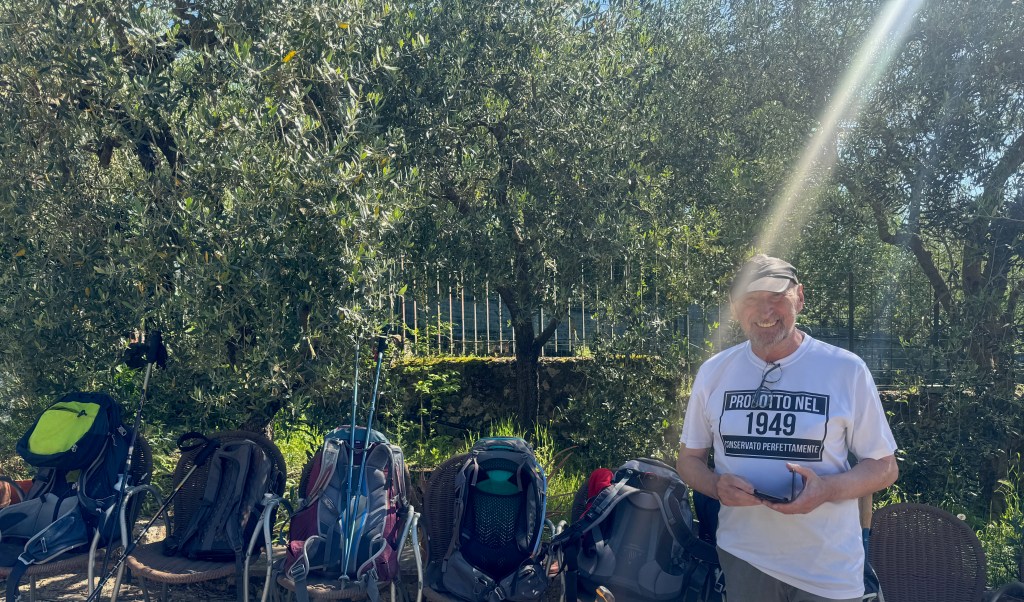
There’s the Italian Emilio who for the last 18 years has lived in France close to the border with Spain. He started walking longer and longer distances only a couple of years before covid. Because his wife has diabetes, he walks to stay healthy. As we walk, he proudly tells me about a daughter in Luxembourg and a son in Germany. He dreams of walking with them for a week. “Maybe in Albania next spring?” He says hopefully. At 75, Emilio loves walking, feeling Italy under his feet and seeing Italy all around him. Reconnecting with his “forever home” and dreaming about walking with a son and daughter! What a wonderful reason to walk!

I meet Stephen at an Ostello. We talk that night as well as talk in the Siena Duomo. A retired IT specialist, his wife still works as a judge. While living in Pisa as a study-abroad student 40 years ago, Stephen fell in love with the places and the people. This walk is his wife’s idea. Since her high- responsibility job precludes her from taking a month off from work, she said “Go walk for the both of us!” He is. “I view my walk as one filled with gratitude and one filled with encounters.”
I treasure so many comments from these older pilgrims. “I’m 70, but I feel like 20.” Being honest, another one says “ I’m exhausted at night. But after a night’s rest recharges my battery, I’m ready for the next day.” I treasure that I’ve met two women who flew to Italy from New Zealand and who hope to walk 200- miles to Rome. They are 75! Wow!
Unlike many pilgrims from Sigerico’s medieval period, we moderns don’t walk for penitential reasons. We don’t walk to remove a burden of guilt . Of course, Chaucer shows us that neither did all of them.
We walk for all sorts of reasons. We recognize all sorts of desires and we have all sorts of hopes. For us modern pilgrims though, I sense two commonly shared attitudes. We can’t count on the future. We each sense a “window” in our life, a “window” of opportunity that will eventually be shut. We also walk in gratitude. Despite my repetitious use of the word, I hear that word spoken every day by fellow pilgrims.
Walking the Via Francigena as a pilgrim at 72. I know not everyone can be such a pilgrim. I know that I never dreamed about walking the Via Francigena 50 years ago. Heck, I didn’t dream about walking the Via Francigena 10 years ago! But, as my Irish friend from last year kept saying, it is “doable.”
 Journeys: Explorations in Body, Mind, and Spirit