
I’ve been home for a week. Only now am I starting to put my walking this section of the Via Francigena into perspective. Although many more thoughts will emerge, my following posts show where my mind is still walking!
The main joys of walking the Via Francigena are meeting people. Others and myself! Every single person that I meet is a stranger. I know nothing of their past. I know nothing of their present walk except what I am told and what I infer.

Although I am very aware of the limitations of our time together, I can affirm what a professor said about these individuals and me. We share a “common uniqueness.” A phrase that enables all sorts of interesting thoughts!
We pilgrims share a practice with others from around the world. I’m reminded of the Ancient writer who wrote ““I was glad when they said to me, ‘Let us go to the house of the Lord!” Certainly, even evangelical Christians who dismiss “pilgrimage” get excited if they travel to Jerusalem or Galilee. Other pilgrims have “destinations.” I’m reminded of the pilgrims that I saw visiting various temples in India. Or the hundreds of Asian Buddhists chanting at Bodh Gaya. We share a purposeful intention to place our bodies in a locale that has important past, present, and future significance for us.
Since I’ve already described some of my more immediate fellow pilgrims in prior posts, I won’t repeat my comments about them. They show me that individuals walk this ancient route with all sorts of motives and all sorts of goals. I also won’t show in this post photos of the “ordinary” Italians that I love to photograph (more in my next post). Instead, as I walked this particular part of the Via Francigena, I’m aware of certain types of people missing from my “awareness zone”, and certain types of people emerging into my “awareness zone.” Of course, that zone is a very, very narrow band of experience stretching from Canterbury to Rome!
I see very little religious diversity in Italy. Surprise! Surprise! Yet, I know that there is more diversity than I actually see. Either I caught glimpses of that diversity or I can infer from what I saw a wider diversity. Walking by a Lutheran Church, I know that there are Protestant pilgrims and Protestant locals. Regarding religious diversity, I know that there is a Jewish community in Rome. Although I wanted to visit Rome’s Jewish Ghetto and its 1906 Great Synagogue, and simply didn’t have the time, I can note that some commentators claim that the Rome’s Jewish community is one of the most continuous in existence outside of the Mideast. Similarly, although I couldn’t visit the Islamic Cultural Centre of Italy and the Grand Mosque of Rome, internet sources claim that these sites form a large complex which can accommodate 12,000 worshippers. When I search online for Hindus and Buddhists, I find that there are Hindu Temples in the metro Rome area as well as Hua Yi Si, “Europe’s largest Buddhist Temple” according to a 2013 article (which now may be inaccurate).
I did see hints of these formal and informal religions.

Because of her language, I’m inferring that this woman in Assisi could range from being a “New Age” spiritualist to a Buddhist. I could be completely wrong though! I had to include the next photo!

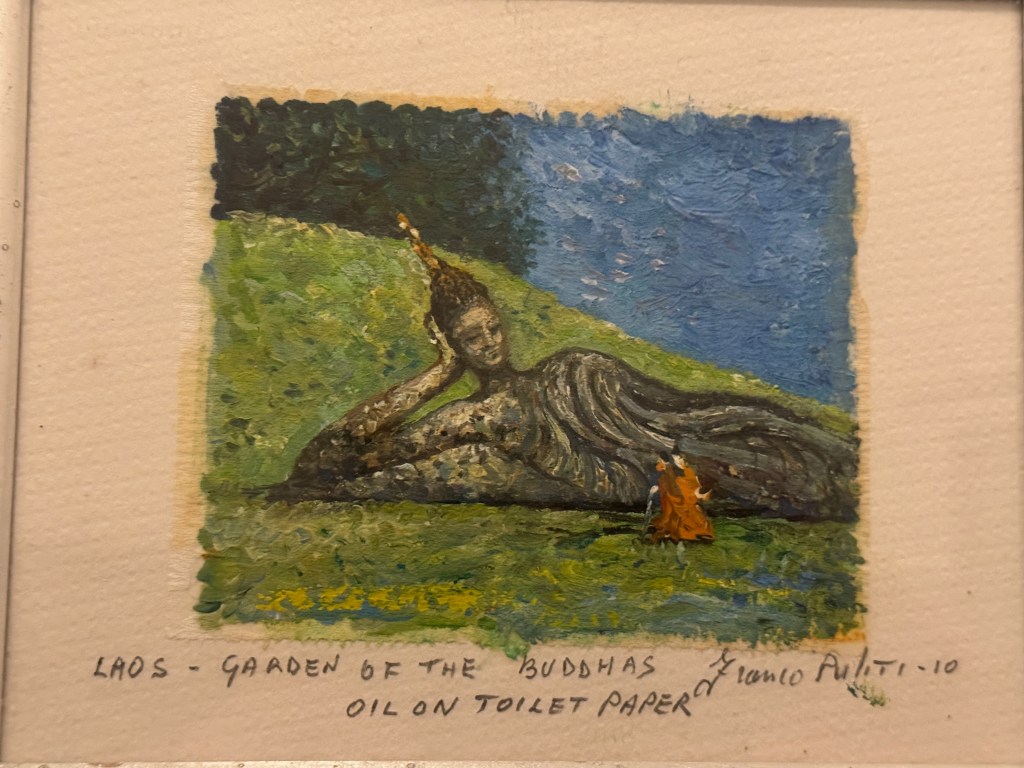
Regarding Buddhism, I only saw one explicit signs pointing to a Zen Buddhist monastery; I didn’t meet anybody who seemed to be Buddhist, certainly not like the wonderful Dutch woman I met last year on the Via Francigena in France.
Besides religious diversity, I did see “continental” diversity. The number of individuals of African ancestry stands out. Not knowing Italy’s political situation nor each individual’s political status, I don’t know how many were migrants or African-Italians. Another visual reminder that political borders are porous.


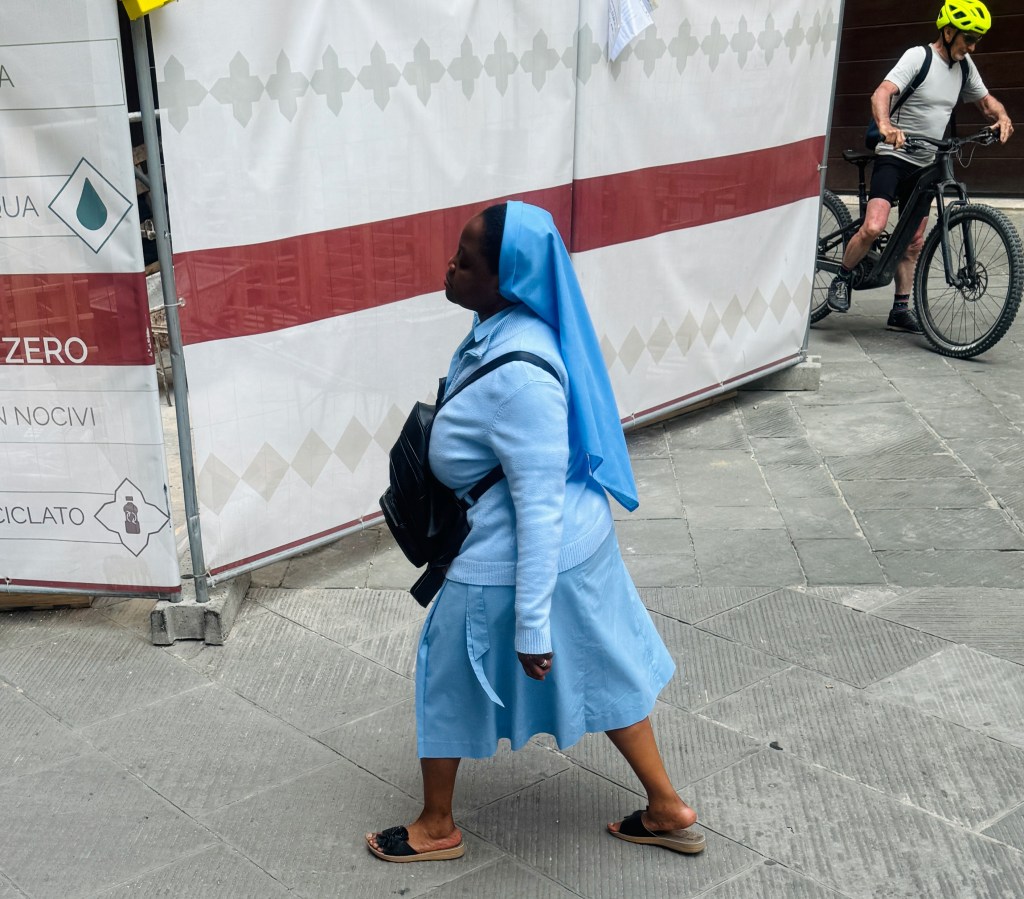

There are other visible signs of Africans presence.


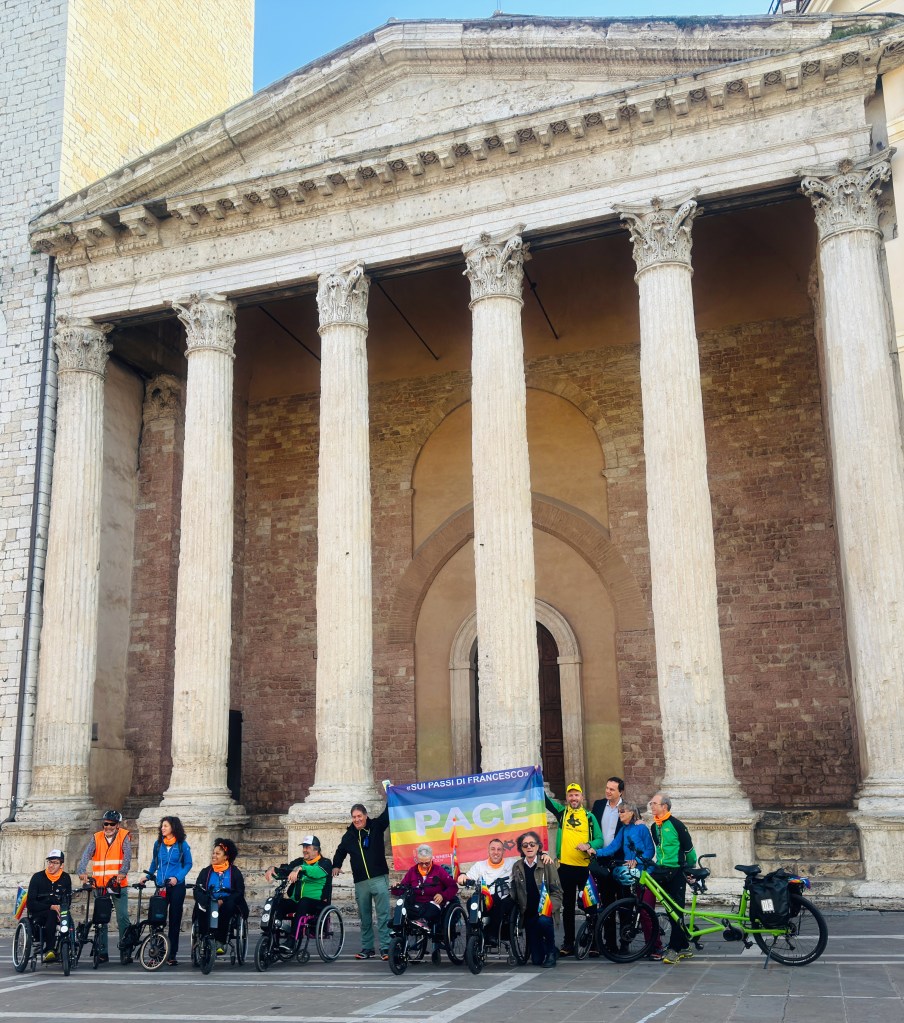
I see Rainbow flags in several cities. Here were cyclists, several in wheelchairs, in Assisi.
I also see homeless. Since I wanted to use some discretion, I never took their photos; however, here is the bedding of a fellow who was standing above this underpass.

I also encountered a bit of the “unpleasantness” of our shared world. As I am standing twenty feet from two English-speaking priests at a bus stop, a young man speaks to the two priests in English. He asks the two priests for money. After they say no, he puts his fingers to his lips as if he is blowing smoke from a fired gun. He says “I’ll see you in Hell.” Only five minutes later, as I walk to the train station, I hear sirens. As I get closer to the train station, he is handcuffed and being placed in a police car. (Sorry that the photo is blurry).

I love meeting fellow pilgrims. I appreciate their purposeful walking even if I don’t know all their various motives and purposes! I love seeing the diversity around me. Even when I encounter the young man who told the priests “See you in Hell”, I feel as though the pilgrimage allowed me to see a slice of real life.
 Journeys: Explorations in Body, Mind, and Spirit