

My destination has been Rome. Emotionally, my own walk probably ended when I left Assisi. I had time to rest and reflect on my 40+ days of walking. While I started walking to Rome from Viterbo, I really wanted to reach Rome. Besides acquiring my Testimonium when I reached Rome, I knew that Rome had numerous museums and churches that I wanted to visit. I went into full tourist-mode!
Unlike the Camino to Santiago de Compostela, Rome has a pilgrimage at the end of a pilgrimage. In other words, there are further “sanctioned” pilgrimage destinations within Rome itself. Philip Neri in 1553 created a route to visit the Seven Sister Churches of Rome. According to Wikipedia, “He and a few friends would gather before dawn and set out on their “Seven Churches Walk”. These pilgrimages were designed to be a counterpoint to the raucous behavior of Carnival.” Interesting! After all the walking though, I might be driven to drink! While the pilgrimage to the seven church is often observed the Wednesday during Holy Week, I randomly visited the churches walking and taking public transportation during my hectic last two days .
The churches and their traditional order of pilgrimage are as follows:
The Seven Churches Pilgrimage
- St Peter’s Basilica in the Vatican.
- Basilica of Saint Mary Major.
- Basilica of Saint John Lateran.
- Basilica of Saint Paul Outside the Walls.
- Basilica of Saint Lawrence Outside the Walls.
- Basilica of the Holy Cross in Jerusalem.
- Basilica of Saint Sebastian Outside the Walls.
Although I had visited several of the sites, I wanted both to revisit those basilicas and visit for the first time Saint Lawrence Outside the Walls and Saint Sebastian Outside the Walls.
Just as the pilgrims earned a Testimonium, a parchment stating that they had successfully reached Rome, the pilgrims who desired to complete he Seven-Sister Churches Pilgrimage were given a map showing their location. The map is from 1590.

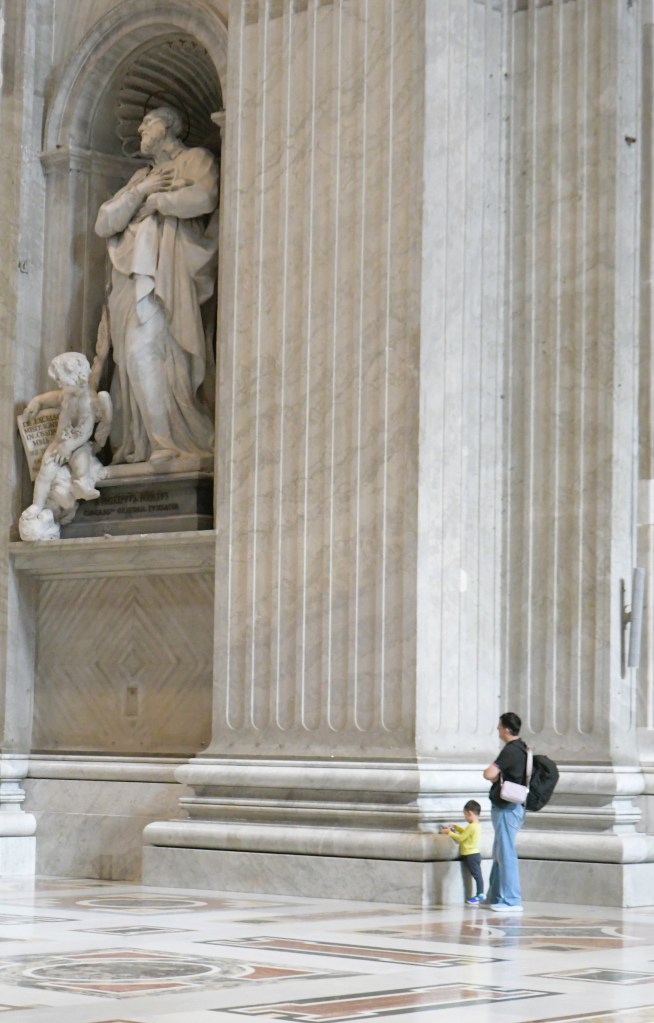
My first church is St. Peter’s where I received my Testimonium. On my previous walk, I had failed to notice the side chapel for Pope John Paul II. Because everybody has seen photos of St Peter, I’m only including the photo of the child and statues to show the immense dimensions of the basilica.

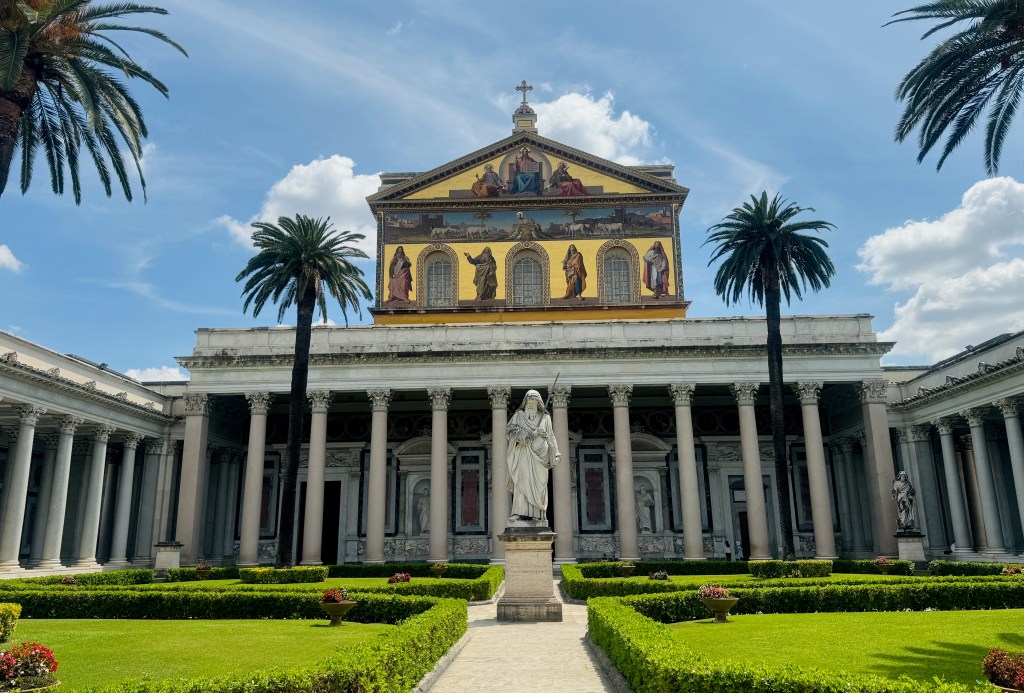
St. Paul Outside the Walls is often the first church on today’s usual pilgrimage itinerary. Constantine constructed a church and consecrated the church in 324 CE over the traditional site of St. Paul’s tomb. Because raiding Saracens, earthquakes, and fires have destroyed the original building, the current basilica was reconsecrated in 1854. With a cloister, shrubs and palm trees at the front of the church, the church has an unusual exterior setting. Adding the statue of St. Paul and the beautiful mosaic, I probably loved the exterior of this church more than any other Rome church.
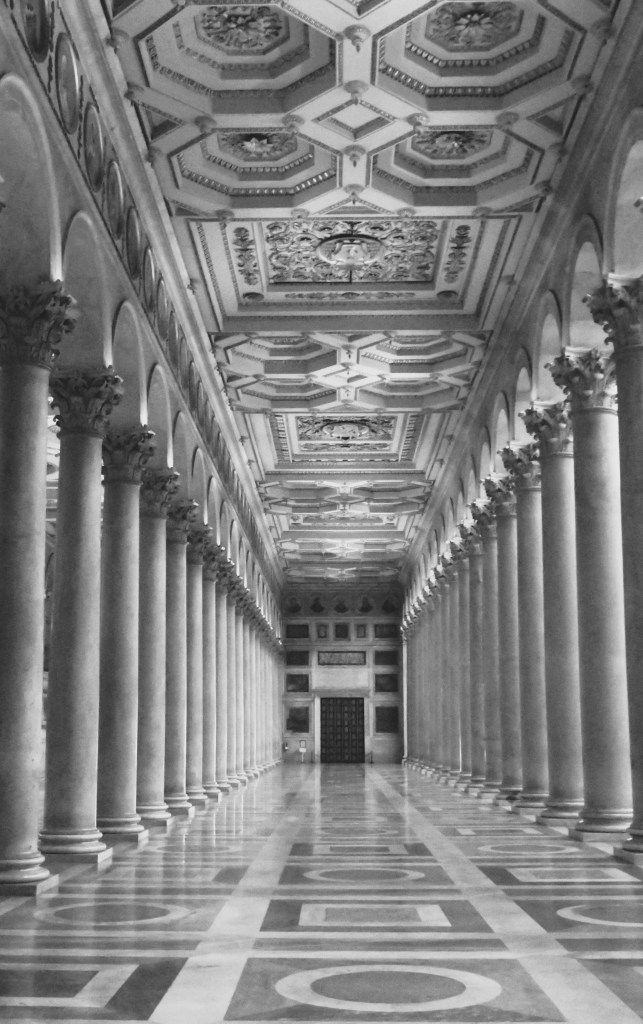
The interior is also appealing in its simple elegance.

According to legend, the church is located over his burial spot. Interestingly, St. Paul’s Outside the Walls has his torso; his head is at St. John Lateran. The chains are his purported chains during house arrest.

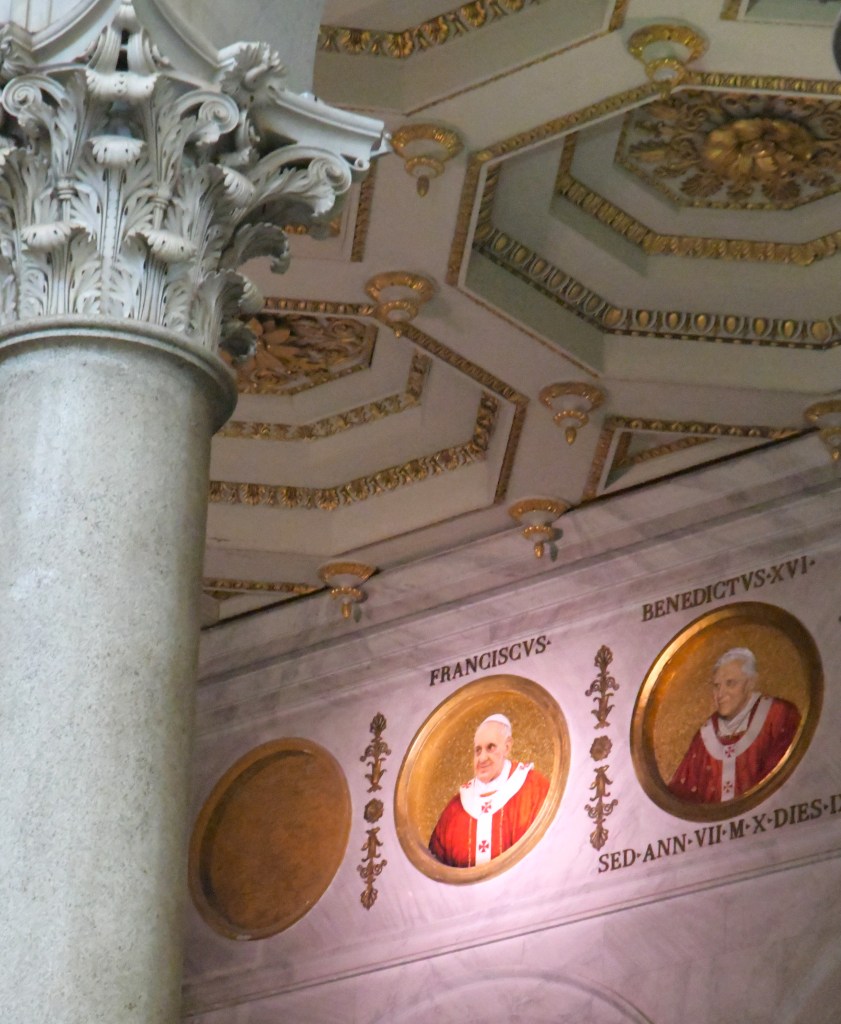
While standing in the nave, one might feel as though one is being observed. You are. The 266 popes from St Peter to Pope Francis are portrayed high on the side walls of the church. According to legend, when there is no longer any room for popes to be portrayed, then the church will cease to exist during this “end of the world.” There are spots for 26 more popes!
For me, the most difficult church to reach is Saint Sebastian Outside the Walls. Located on the Appian Way, I took two trains and buses to reach the church.

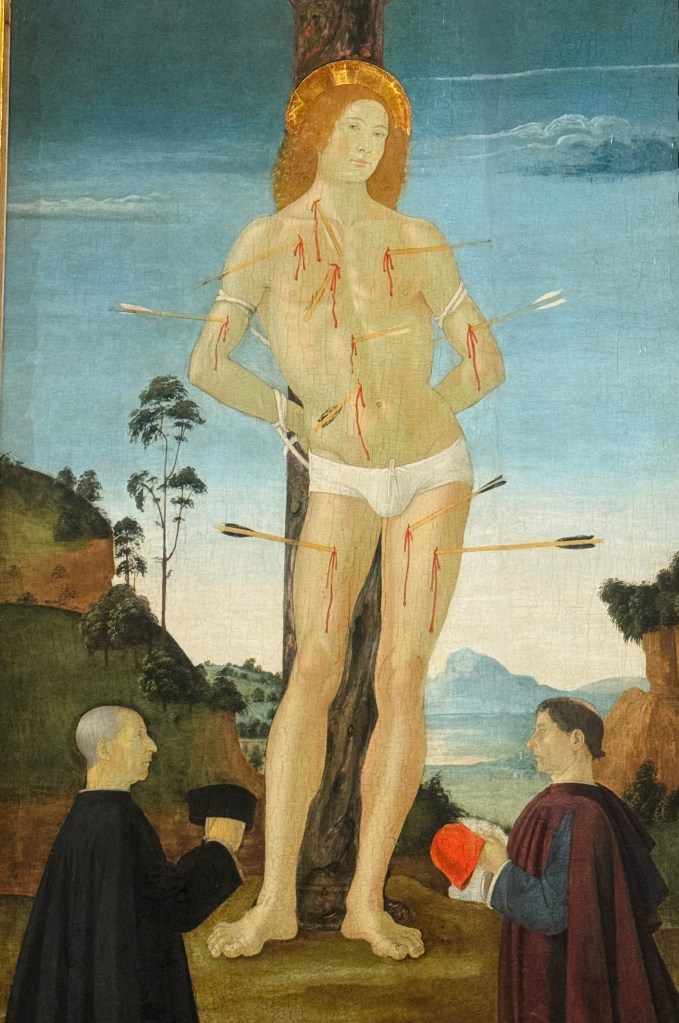
According to tradition, St. Sebastian was a Captain of the Praetorium Guard. By aiding Christians, he disobeyed Diocletian’s order to persecute Christians. From the emperor’s perspective, not a good example! Seized, he was taken to a field where archers shot him with arrows. Surviving and brought back to health, he later surprised and reproached the Emperor. Undeterred, the Emperor had him clubbed to death. He is patron saint of athletes, and wait for this, archers! During the medieval period, he was viewed as the protector from the plague.
Leaving my BnB, I walk two miles to St. Lawrence Outside the Walls.
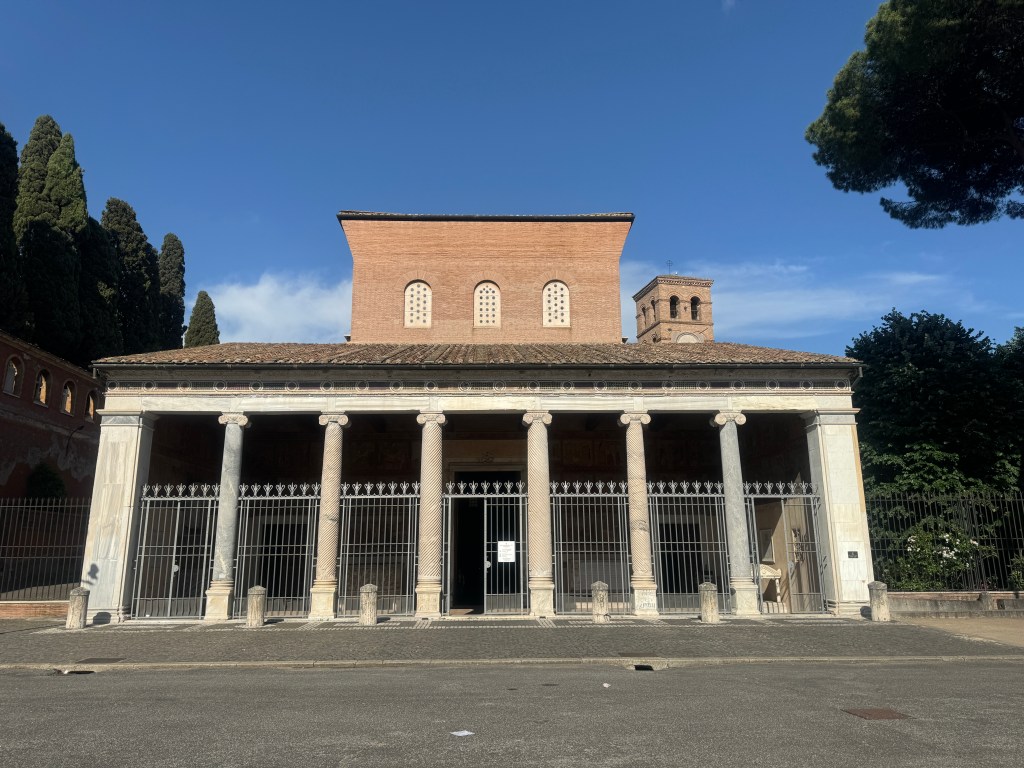
St. Lawrence was one of the deacons of an early Roman church who was given the responsibility by the Pope to oversee the financial resources of the church. When he was ordered to turn all the wealth over to the Roman officials, he said “Give me three days to accumulate everything.” During those three days, he gave everything to the poor, crippled, blind and other needy individuals. Upon arrest, he is reputed to have said “”Here are the treasures of the church. You see, the church is truly rich, far richer than your emperor!” Like Sebastian, Lawrence is seized and condemned to death. He was to be roasted over a fire. Argh. As he is burning, the traditional story declares that he stated “I’m well done on this side. Turn me over.” He is the patron saint of chefs and cooks! I’m not kidding!
An early church was constructed on the site of his burial in 258. While not impressive from the outside, the interior has a calming simplicity to it.

The last three churches are within walking distance of each other.

One has to love the legends attached to the Church of the Holy Cross of Jerusalem. Empress Helena, the mother of Emperor Constantine, believed in acquiring frequent flyer miles. After traveling to Jerusalem and finding relics of Jesus’ Passion, she had some of those artifacts brought to Rome. These included a nail from the cross, two thorns from Jesus’ crown, and three small pieces of the cross. And, to be able to claim that the church was “in Jerusalem”, the church had its floor covered with soil from Jerusalem!

This pilgrimage destination was so important that during the medieval ages in general and Good Friday in particular, Popes would walk the half-mile from St John Lateran to the church in order to venerate the relics.
If you have read this far in my posting, then you are probably as tired as I was trying to visit all of these churches in two days! However, only two more churches!
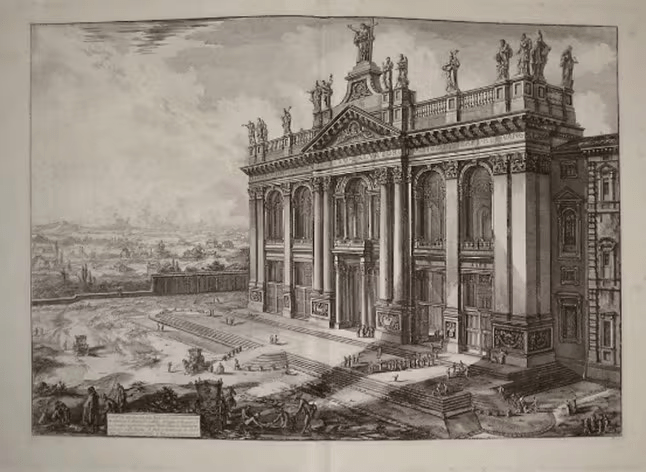
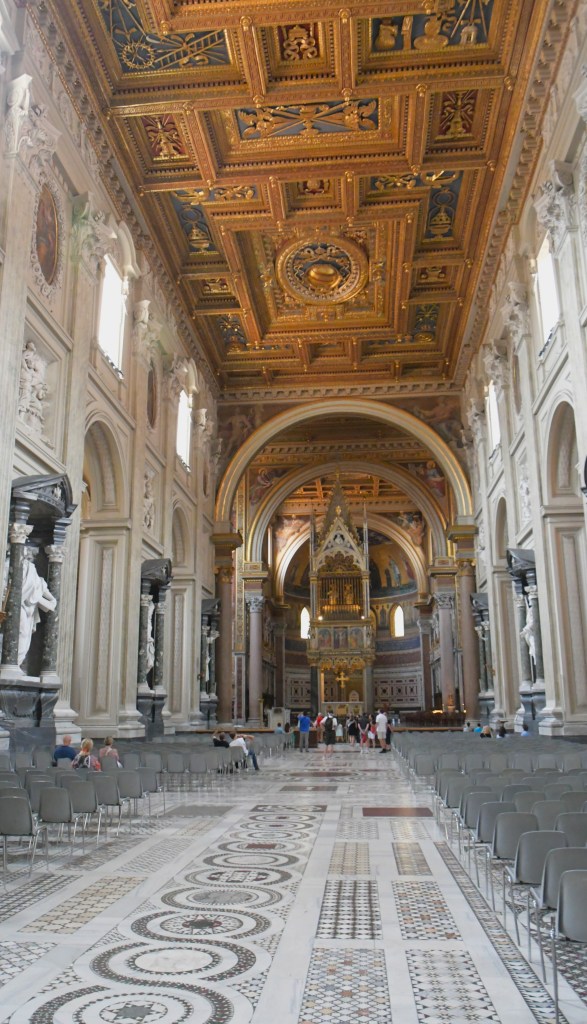
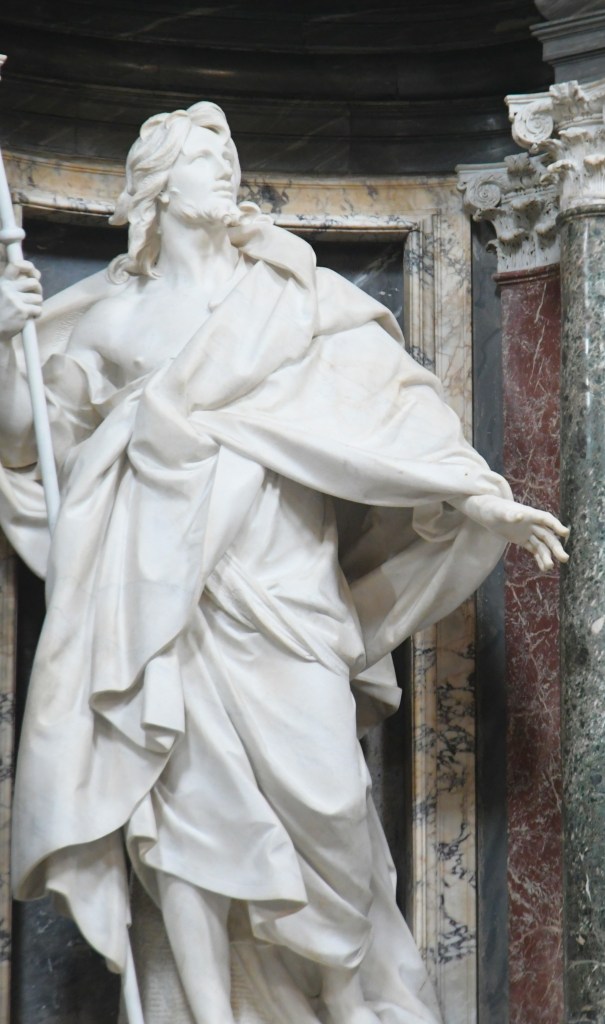
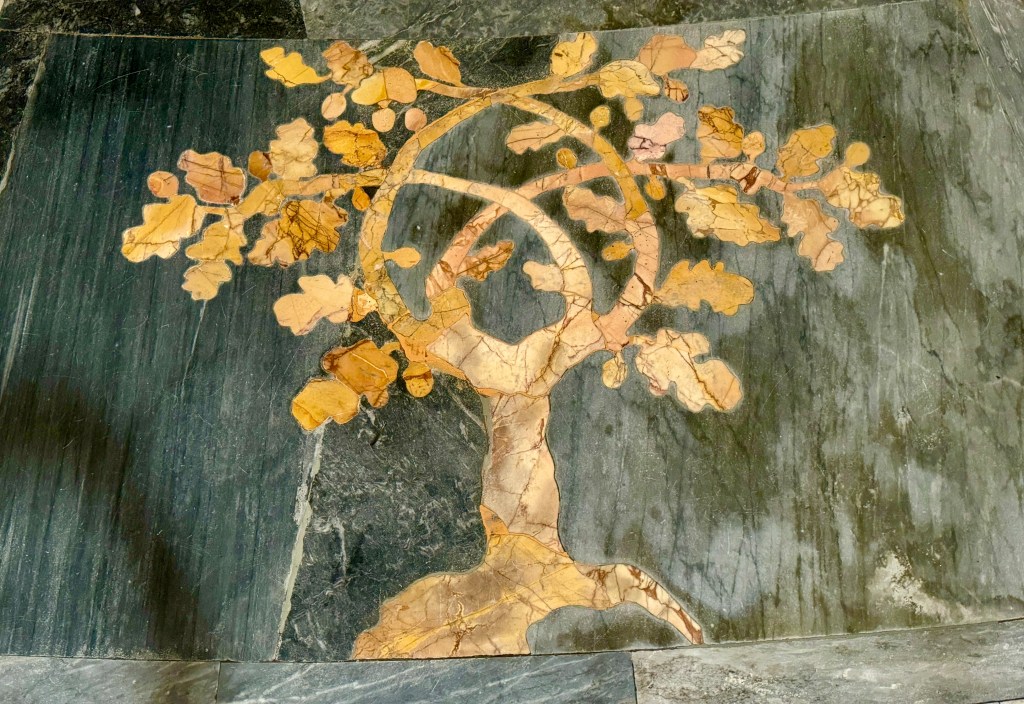
What is the oldest public church in Rome? If you guessed St. John of Lateran, then you are right. Of course, if you said that the oldest church is “Major Papal, Patriarchal and Roman Archbasilica Cathedral of the Most Holy Savior and Saints John the Baptist and the Evangelist in Lateran, Mother and Head of All Churches in Rome and in the World”, then you are really, really right! Consecrated in 324, St John Lateran was the major church for much of the early and medieval period. When the papacy returned from Avignon and after several fires, the Popes resided in other churches, eventually the Vatican. However, until 1870, all the popes were enthroned in St. John Lateran! Even today, on Maundy Thursday, the Pope celebrates Mass here.
The interior of the church is quite beautiful, the ceiling, the twelve statues (no Judas and no Matthias, St. Paul instead), the inlaid marble flooring, the intricate scenes depicted on the massive entrance doors.



Finally, the last church is Saint Mary the Major.

Constructed in 432, the present church may have been a response to the Council of Ephesus declaration that Mary was “the Mother of God.” As a result, the church has some beautiful mosaics and sculptures of Mary. Since I’ve shown enough photos and pictures, I’ll repeat one that I used in a previous posting. Commissioned during World War I, this sculpture “Mary Queen of Peace” was placed in the church at the end of that war. Her raised left arm is almost saying “”Basta! Enough! Stop the war and violence!”

Rome was a shock. After walking the Via Francigena in three segments, after the end of walking approximately 1250 miles, I should have simply rested. Yet, in some ways, there never is one final destination! Even the destination has destinations worth exploring and absorbing. I may have been tired and worn-out, I may have had enough of scooters and motorcycles; however, there was still much to see and experience in and around Rome. In that way, I suspect that I was like Sigeric and all the other pilgrims who walk to Rome.
 Journeys: Explorations in Body, Mind, and Spirit