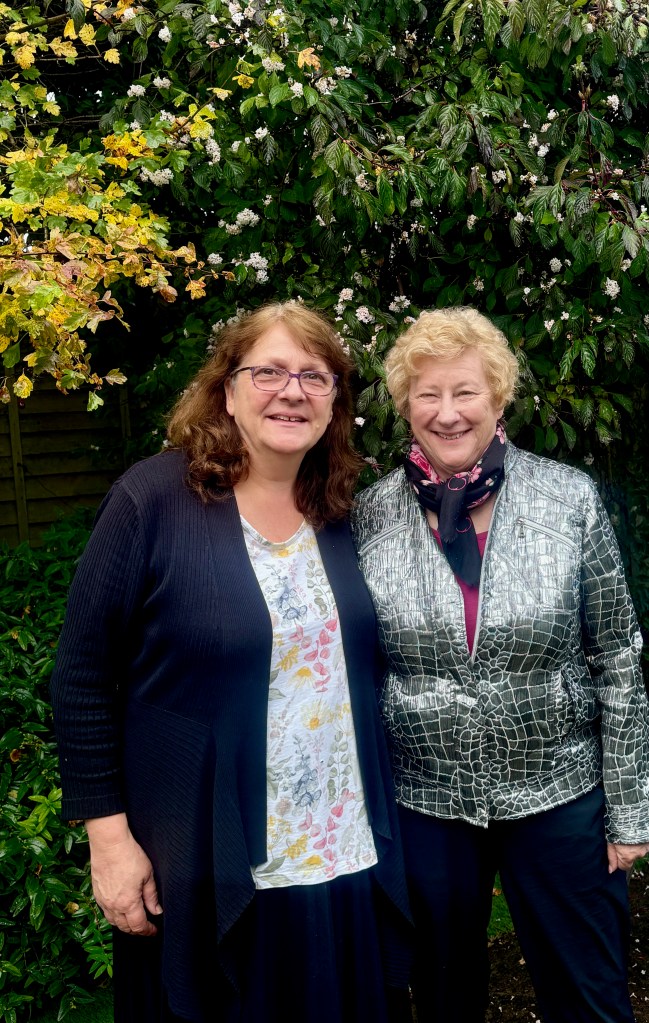
We easily arrive in Dorchester. Only two blocks from our BnB, we walk past the Dorset History Center. “Look, here is where we meet Fran tomorrow. This will be easy. No rushing!” In a few minutes, we meet Allison, our wonderful BnB owner.
At 8:30 AM, Allison brings our breakfast. I casually say, “Well, going to be an interesting day.” “I checked my emails from Ms. Winters at the Dorset Family History Society. The good news is that we meet Fran, her associate, at 11AM today. The bad news is that our appointment is not here in Dorchester, but in Poole, 25 miles distant!” Surprised, Allison puts her hands to her face. “But if we catch the 10AM train and then a taxi, we should arrive right on time.” Thinking how to help, Alison says “To make sure you are not frazzled, I’ll drive you to the train station.”
Today is the one day that I have an appointment. Since I’m a beginner when it comes to genealogy, I seek help from Ms. Debbie Winters, the Research Director at the Society. For about $15, she locates some basic facts about my great, great, grandfather William Henry Kingsbury and his wife Jane Way. Since these Kingsburys’ villages are from the area near Dorchester, “Thomas Hardy country”, Ms. Winters is able to offer some basic information about their lives and the small villages in which they live.
I do enjoy thinking about ancestors. At Yale, Janet Edwards was a member of my class. Yes, a patrilineal descendent of Jonathan Edwards, “Americas greatest theologian.” At that time, Yale’s President was Kingman Brewster. Yes, a descendant of the Mayflower’s William Brewster.
I’m an “occasional” genealogist. Henry Kingsbury migrated from England to the USA between 1871-1882. In that later year, he “renounces all allegiance and fidelity to the Queen of Great Britain” and became a naturalized US citizen. My brother and cousins know the next generation of Kingsburys. In the USA, Henry Kingsbury and his wife Jane Minerva Wells had three children, Curtis, Oscar, and Ollie Lou. I’m named for Curtis Kingsbury who also married a Mary. Small world! Like the Kingsburys in England, Curtis and his sister Ollie Lou lived in or near small villages in the USA. Because of cold Illinois winters, Ollie Lou, or as we called her Grandma Jones, stayed with us during the winter.
Back to our trip to Poole. We enter the center a few minutes early. Tables with computers. Four individuals working at those computers. Bookshelves. A small space organized for research.

Since Ms. Winters can not be present, she has arranged Fran to discuss the research. Fran introduces herself. We are welcomed. Offered tea or coffee. After more pleasantries, Fran motions for us to sit at a table where there is a small stack of papers. “An unusual name. There aren’t many Kingsburys. Census of 1891 show less than 200 in London alone.”
She shows us a variety of documents for William Henry Kingsbury. “Here are the parish records for his birth, marriage, and death.” As background, Fran tells us that in 1538, King Henry VIII required parishes to keep filial records of births, marriages, and deaths. “Although probably half have not survived, many of the last 100-200 years registrations have survived.” She shows us various English census records taken every ten years. William Henry Kingsbury is listed as an “agricultural laborer”, probably like 90% of the working population are listed as such. Like other “agricultural laborers”, William Henry Kingsbury may have been skilled enough to have a side job as a carpenter, stone mason, or some other work. The men did not outwork the women. While doing primarily household related tasks and some farm-related chores, the women in these families also worked 10-hour days.
There was a hierarchy in English rural, village and town society. At least, until the Industrial Revolution really changes the country. Historically, “farm laborers” did not own much, if any, land. They were poorer than those categorized as “farmers” who would own some land, and certainly poorer than the landlords of the great estates. Fran called our attention to a feature on some of the records. “Notice the X’s on the marriage record. Being illiterate, the Vicar or clerk signed for them.” Unlike the gentry and the landlords, most agricultural laborers were illiterate. Only a few agricultural laborers might have some literacy skills because of the church.
I know that I wouldn’t learn much specifically about my ancestors from Fran. However, I have asked for them to help me understand some of the circumstances surrounding their lives. She describes the Enclosure Act and the Marriage Act of 1754. Due to more difficult living conditions and the wars (Crimea 1853-1855 and the Franco-Prussian War 1872-1873), those “bound to the soil” lived lives filled with anxieties. During these years, many such as Henry Kingsbury migrated. It isn’t hard to understand their motivation. Similar to today’s migrants, my great, great grandfather wanted a better life.
Fran shows us a book which briefly describes the small villages that I hope to visit tomorrow. Winterbourne Whitechurch where William Henry Kingsbury was born and buried. Milton Abbas where his parents, Joseph Kingsbury and Rebecca Strickland were born and lived for a while. Morden where Jane Way, William’s wife was born and where they were married. I love these village names, so English!

We end our session and begin to say good-by. Colin Best, one of the individuals using a computer, speaks up. “I may have Kingsbury ancestors.” He proceeds to show us his computer screen. When I say, we’ll have to be in contact by email, he says “That might be hard. I don’t have a personal computer and I don’t use email.” From across the table, a woman, smiling, adds “Colin doesn’t have a mobile phone or a TV either!”
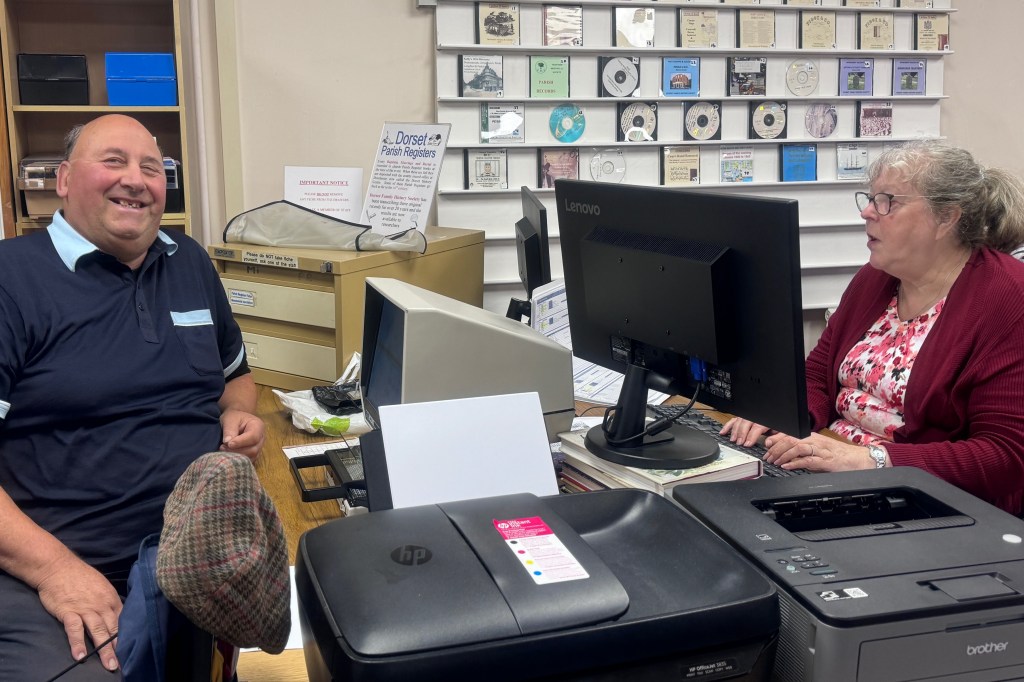

A man living in the 1850’s along with my great, great, grandfather Kingsbury. I like him immediately!
 Journeys: Explorations in Body, Mind, and Spirit