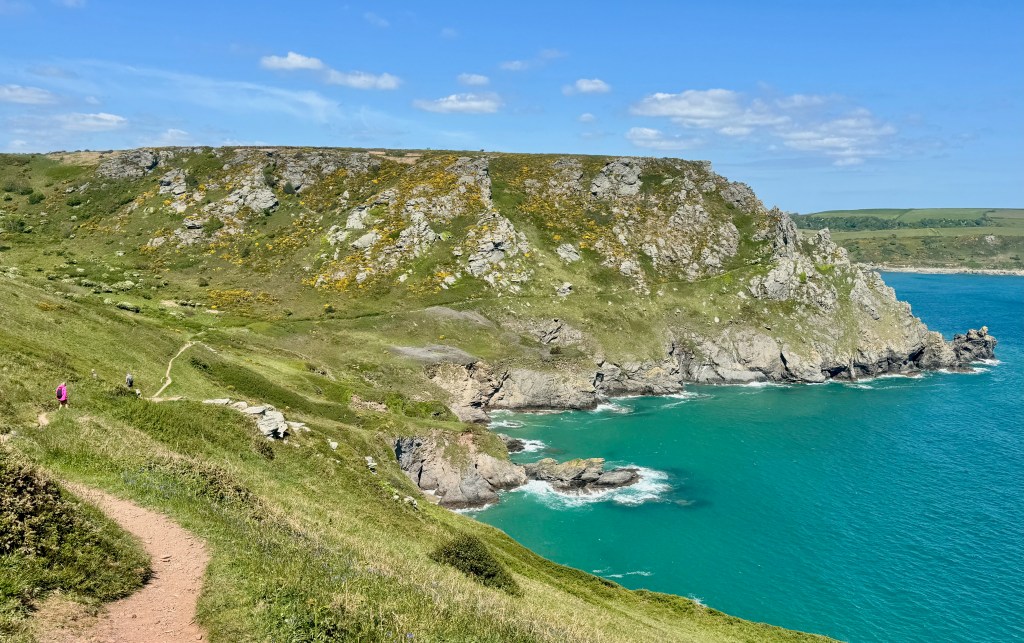
How innumerable are words about a path or the path. I’ll add my own words as this hike along the South West Coast Path unfolds. While my Path started inland at the White Hart Inn in St. Austell, my actual SWCP path started a few miles later.
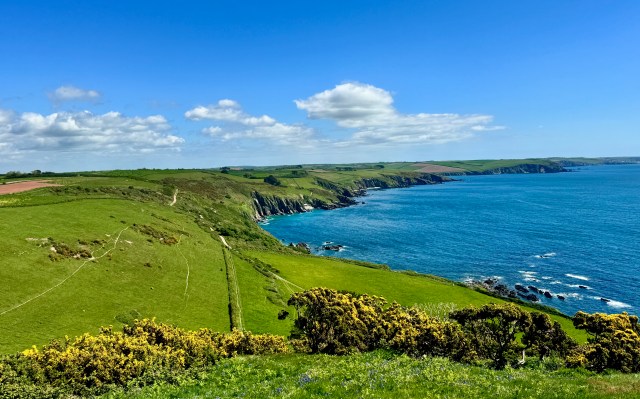
The glory of the path is the companionship of the Atlantic Ocean or the English Channel. I never, never forgot for long that I am near water. The path allows unforgettable views!
What else can I say about the path? After this first week of walking, I realize that many of the words about paths are words about possibility, words about what the path allows “Oh look, what a wonderful coastline view.” Or their words of judgment about the difficulty of the path “Oh my gosh, not another cliff to walk! There are other words than these!

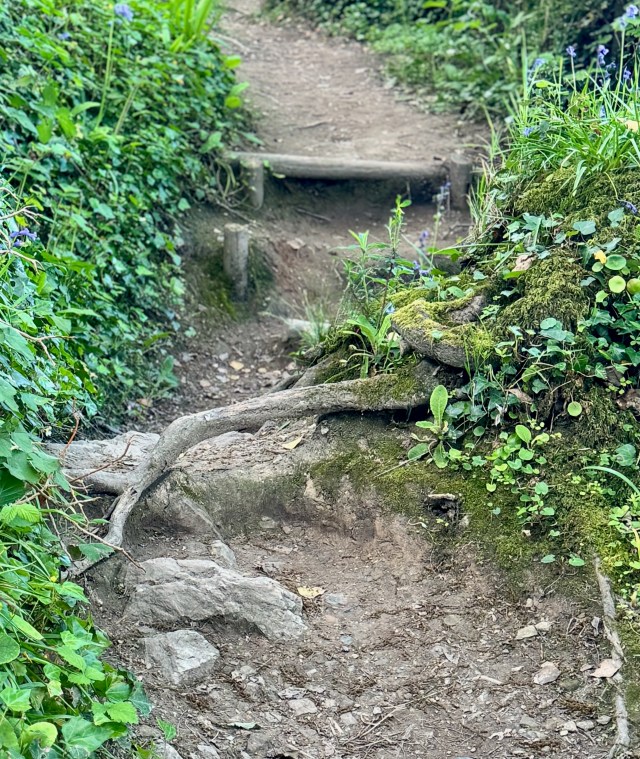


There are words about the path itself.There is a remarkable commonness of this path with other paths. I’ve walked briefly on soft woodland soil; I’ve walked on field grass shared with sheep and cattle; I’ve walked on hardened soil from the sun and boots; I’ve walked on beaches; I’ve walked on small round rocks and sharp shards of rock; I’ve walked over flat stone; I’ve walked over gravel. And, unfortunately, I’ve walked on tarmac and concrete. Unlike some guide books, my Paddy Dillon SWCP Guidebook, doesn’t let me know how many miles of “tarmac or road walking” I’ve walked or will be walking. Oh well.


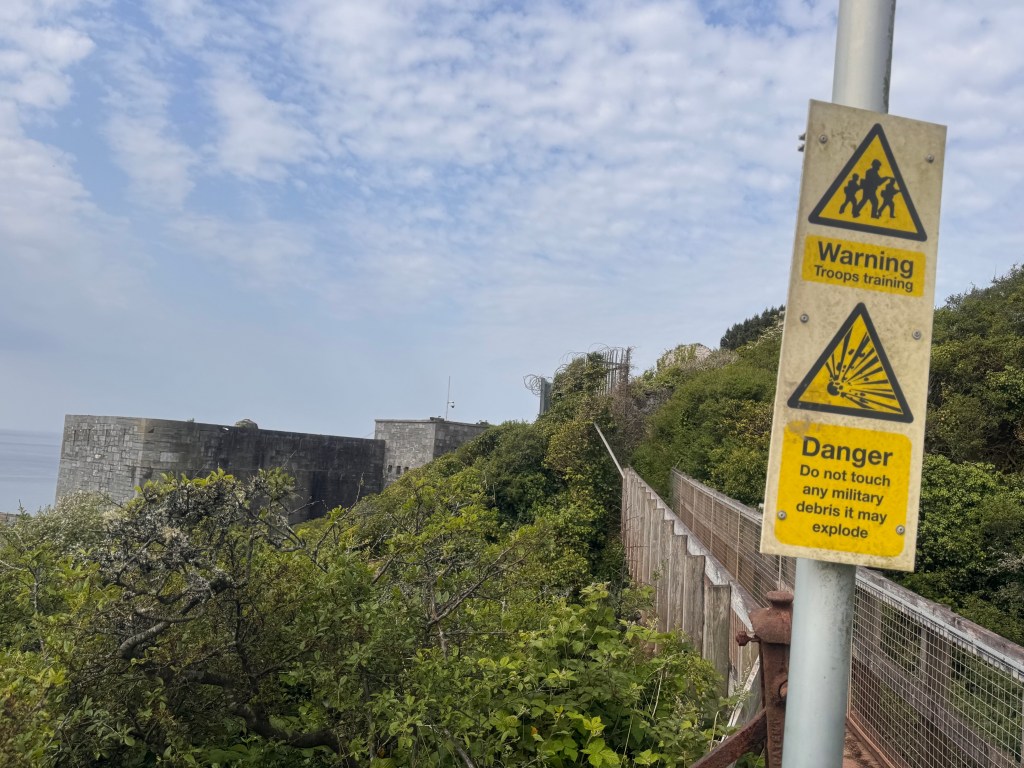

The path is an object of observation and curiosity. That isn’t quite right. My attitude is more than observation and curiosity. I watch to see how close to the cliff edge the trail veers; I watch to see how many military installations I pass!
Besides the composition and direction of the trail, the condition of the path gets my attention. Sometimes the path is rutted. Sometimes the path is higher than the surrounding ground. When the surrounding ground is covered in grass or shrubs, I’ve learned to be careful. A hidden drop of two or three inches can lead to twisting an ankle.

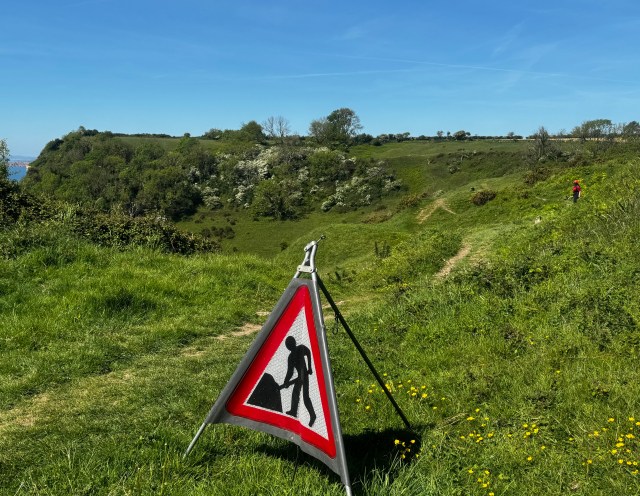
There are times when the path shows that it has had some loving attention or that it needs attention. I’ve learned that May is “path preparation month.” I come upon a young man who is doing contract work fixing a fence and stile for the National Trust. “I love this job. I’m a hiker, and now I get paid to be out on the path every day!” Most of the times, I say to myself when crossing a stream or creek. “A footbridge, how nice!” Sometimes though I get rather judgmental. “Oh, this footbridge is missing a few planks!” Due to the cliffs eroding, some parts of the path have been closed. I can’t imagine walking in the fog or heavy rain on that part of the path! But I know that people do.
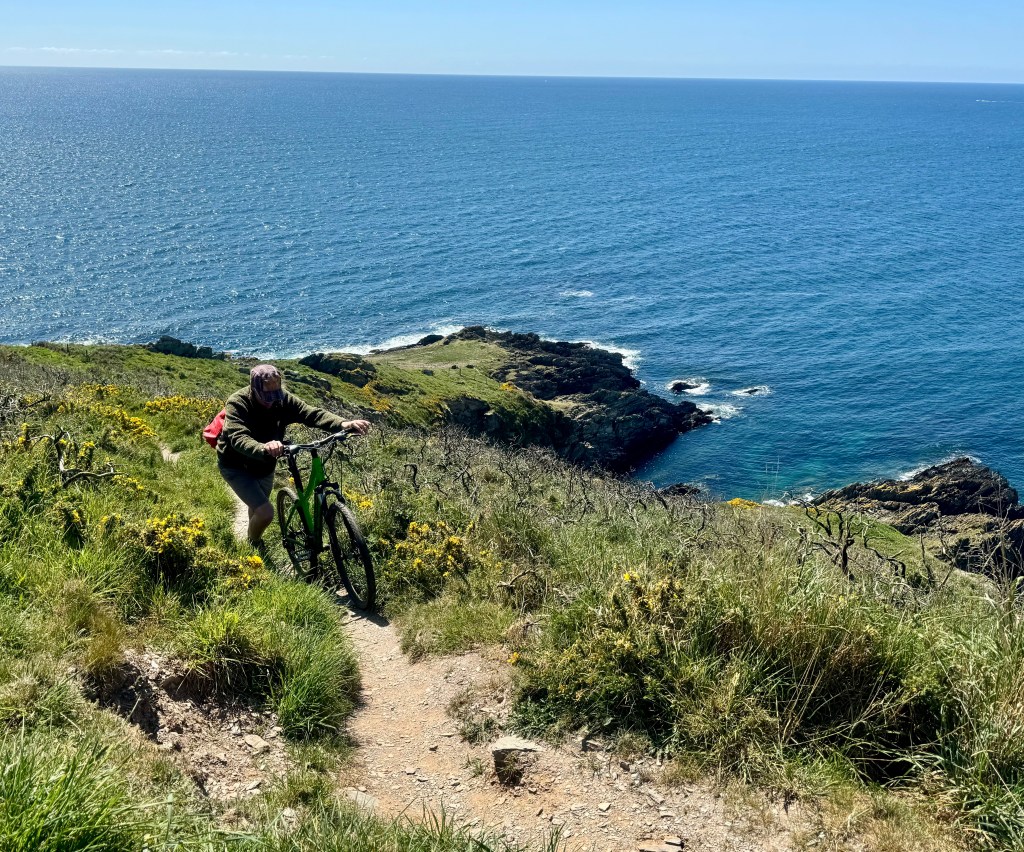
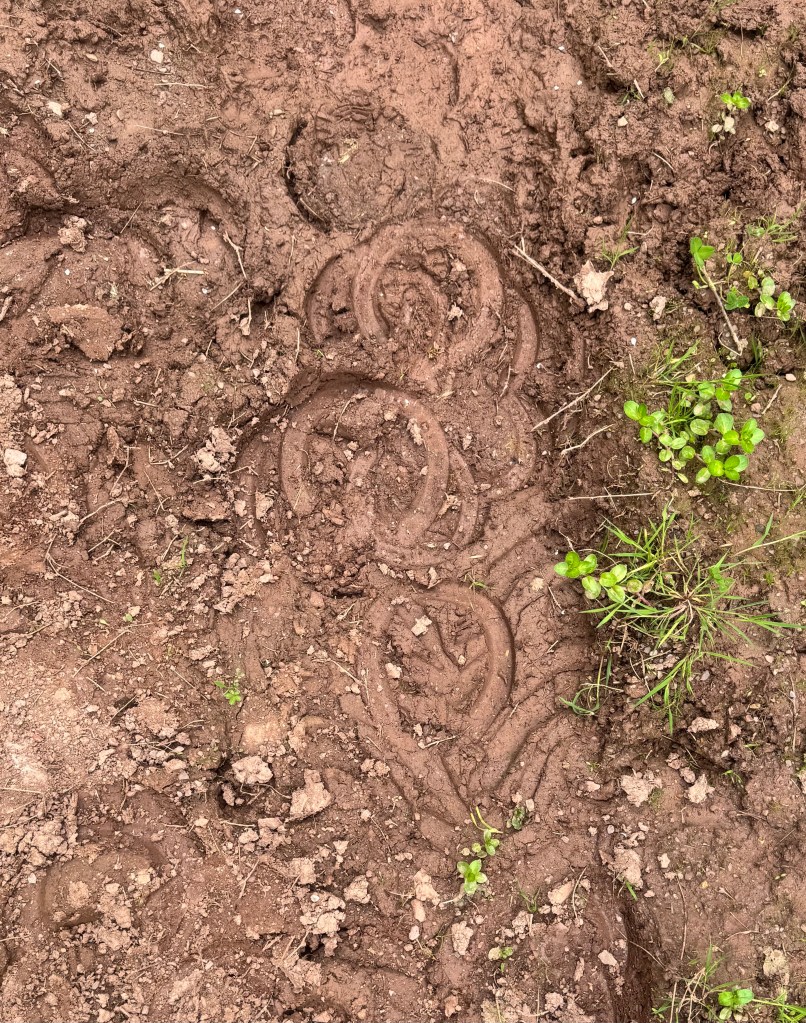
Of course, I also notice that the path is used not only by walkers who I meet very, very frequently, but also by others. From a cyclists to evidence of horse riders. This cyclist regrets his choice!
As I mentioned at the beginning, sometimes I fail to notice the path. Maybe I’ve walked on too many sidewalks! I’m gloriously distracted by other sights. Sometimes I’m briefly aware of the ease or difficulty of a particular section of the path. But, as I walk the South West Coast Path, I realize that there is both a nature, a history, and a “consequence” to this path. Paths are “habits of a landscape.” Robert MacFarlane continues in his The Old Ways: A Journey on Foot:
“Paths are the habits of a landscape. They are acts of consensual making. It’s hard to create a footpath on your own…Paths connect. This is their first duty and their chief reason for being. They relate places in a literal sense, and by extension they relate people. Paths are consensual, too, because without common care and common practice they disappear: overgrown by vegetation, ploughed up or built over (through they may persist in the memorious substance of land law). Like sea channels that require regular dredging to stay open, paths NEED walking.”
What a wonderful phrase “paths need walking.” This path has interacted with its surroundings. During its past, the path has interacted with surrounding geology; its interacted with surrounding lifeforms from shrubs and trees to rabbits and farm animals. During its past, the path has even interacted with people. Some people have resisted the path; others such as the members of the National Trust have made this path possible. Some continue to allow this path to “connect” them to others, to the natural world, and even to their own memories and hopes. There is so much to this path; there is so much to walking this path.
 Journeys: Explorations in Body, Mind, and Spirit