
Those words aren’t about my experience; but about others’ experiences near the South West Coast Path. More particularly, individuals experience those feelings on October 27, 1916, January 26, 1917, and April 28, 1944.
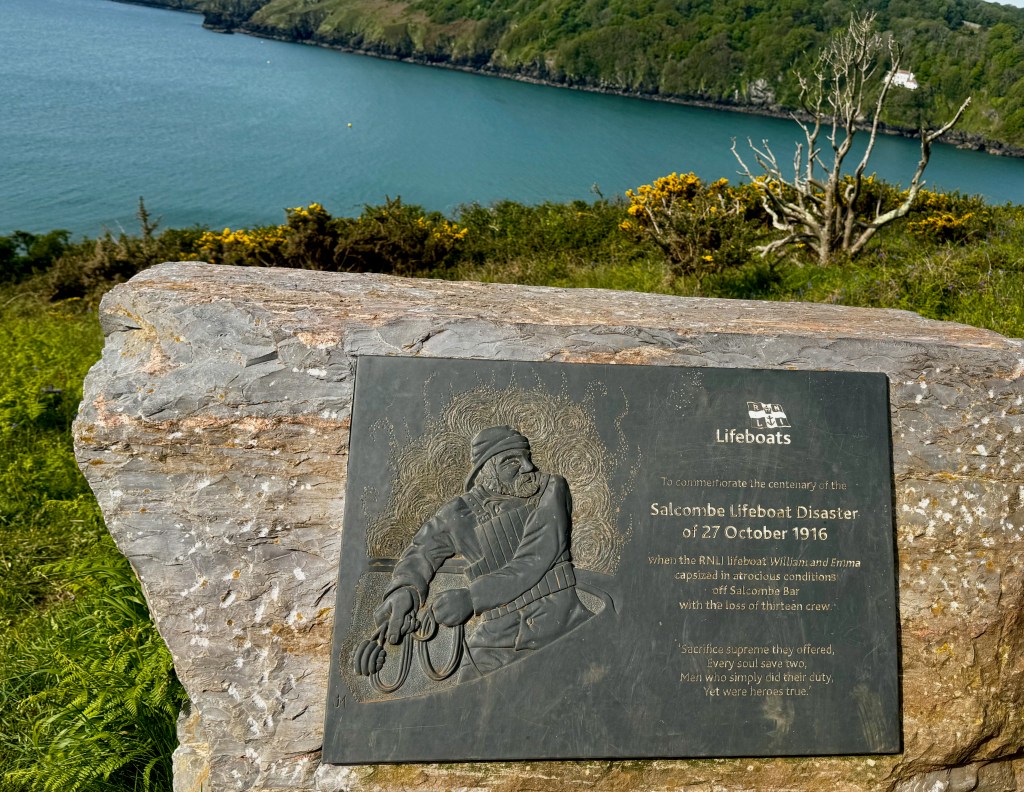
On October 27, 1916, a schooner runs into problems in the face of gale 9 winds (50 mph) off Prawle Point, the southern most point in England and not far from Salcombe. A lifeboat with a fifteen member crew sets out, unaware that others on shore are able to use rescue lines to save the schooner’s crew. By the time the lifeboat gets near the schooner and sees there is no one on the schooner, they try to head back to the station. Twice starting and then backing off, the skipper and crew try one more time. Eddie Distin, one of two survivors, tells the story. “That is when we met with disaster. A bloody great sea struck us.” The lifeboat capsizes; the crew try clinging to the overturned boat; slowly, the waves wash the men from the boat. Eddie Distin and Bill Johnson are washed onto a rock. “We hung onto the rock like grim death because the sea is trying to wash us off.” Finally, the two men are rescued. The only lifeboat crew survivors. Terror. Panic. Despair.

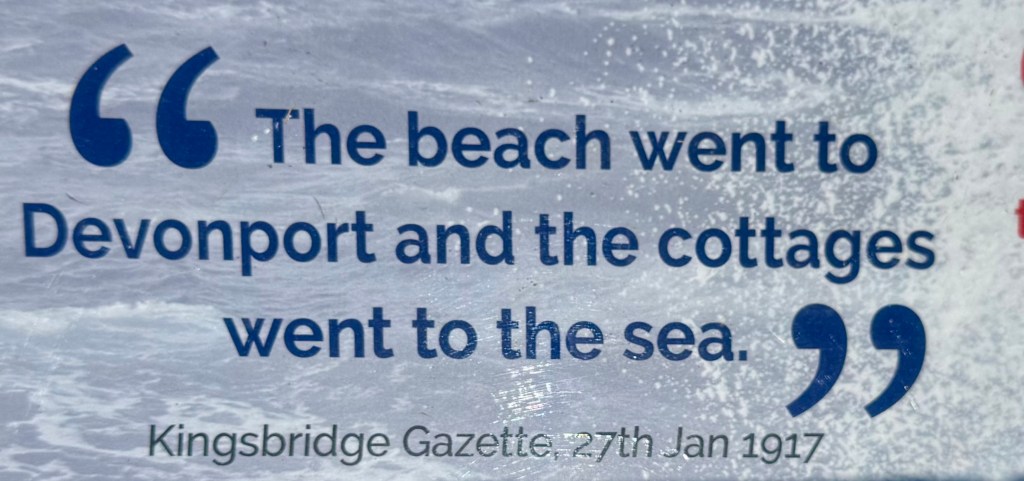
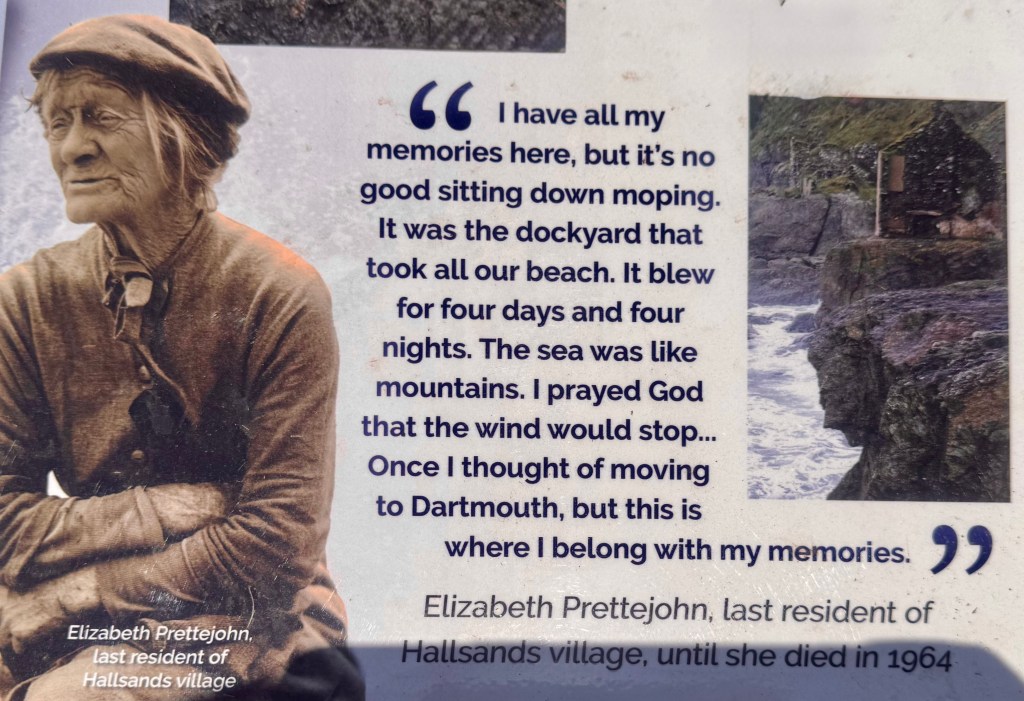
On January 26, 1917, the end comes to the village of Hallsands, built on a narrow cliff above the sea not far from Torcross. Ever since the government decides to expand the Plymouth naval docks by using sand and gravel off the coast of this village, the beach has eroded. The storm surges higher and higher each year. On that night, the sea wall protecting the villages partially breached. A survivor, Edith Patey who was 17 at the time, tells others “The sea came down the chimney. All of a sudden the walls came tumbling down. We felt like being right the sea, the roaring waves bouncing over us, the rafters breaking in. We could see the white waves foaming underneath theflooors. The coal house all slipping away… the sea came down the chimney.” Shortly, the villages 37 houses, store, and pub had disappeared. One partial house remains. More terror. More panic. More despair.

On April 28, 1944, Exercise Tiger takes place at Slapton Sands in Devon. The Allies wanted a simulation exercise preparing allied landing ships and soldiers for the upcoming D-Day invasion. Eight ships with thousands of men and tanks proceed to Start Bay. Due to using different radio channels, the American landing ships do not know that the British destroyer accompanying the ships has to return to port. Unfortunately, the German e-boats (fast speed torpedo boats) then attack. Two landing ships are sunk and one badly damaged. Because of German fire and “friendly-fire”, because of men jumping into water without being trained how to use life preservers, because of men jumping into water from a height of 40-50 feet, because of hypothermia, almost 700 men die. In more recent years, an American Sherman tank has been raised from the bottom of the sea to memorialize those who died. One last item: the Allied command threatens court martial to anyone who releases information about the affair. They fear a loss of morale. Two months later, when these same Americans storm Utah beach, only 197 die on that beach. Even more Terror. Panic. Despair.
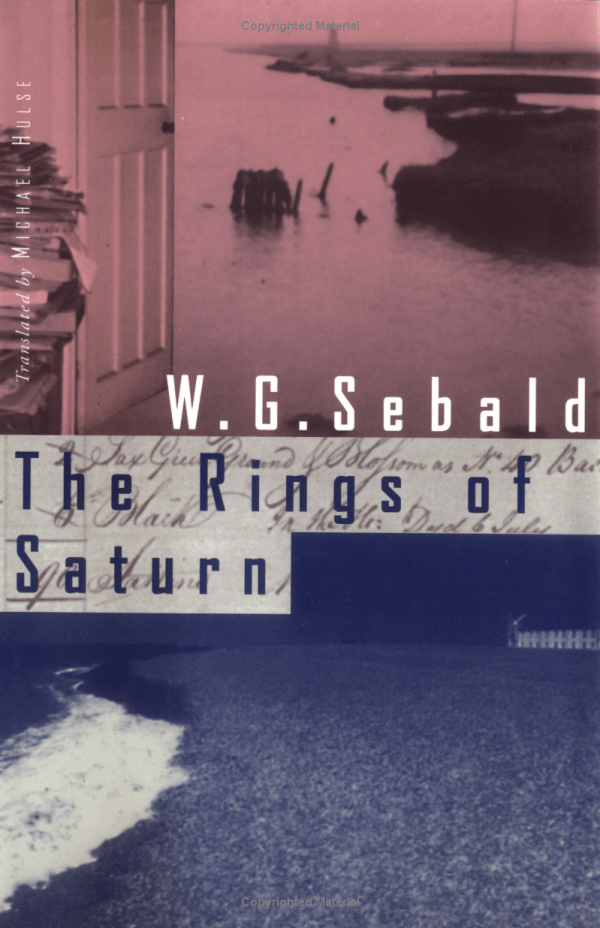
One way to write travel narratives is what has been called “psycho-geographic writing.” Sebald’s 1985 “Ring of Saturn” is one example. While walking in East Anglia, Sebald describes an initial encounter while walking with some person or event, living or dead. He then spins off into other slenderly connected, but always unfailingly, powerful occurences of tragedy. For example, he connects Joseph Conrad’s brief visit to the same East Anglia to the terrible world of Belgium colnization in the Congo. Or, he connects the silk industry’s presence in East Anglia leads to the cruel world of China’s Empress Dowager. Sebald’s walk is a walk into melancholy. Not exactly encouraging reading.
Terror. Panic. Despair. Sebald is right though that there is more to a walk than what we ever see. He is right that there can be a surrounding sadness as one walks in some areas. Prawle Point, Hallsands, Stapton Beach. Individuals felt terrible emotions. Terror. Panic. Despair.
As true as those emotions are, there may be other emotions. If you have read any of my other postings, you know that at some places and at other particular times, compassion, hope, and peace may also be found.
 Journeys: Explorations in Body, Mind, and Spirit