
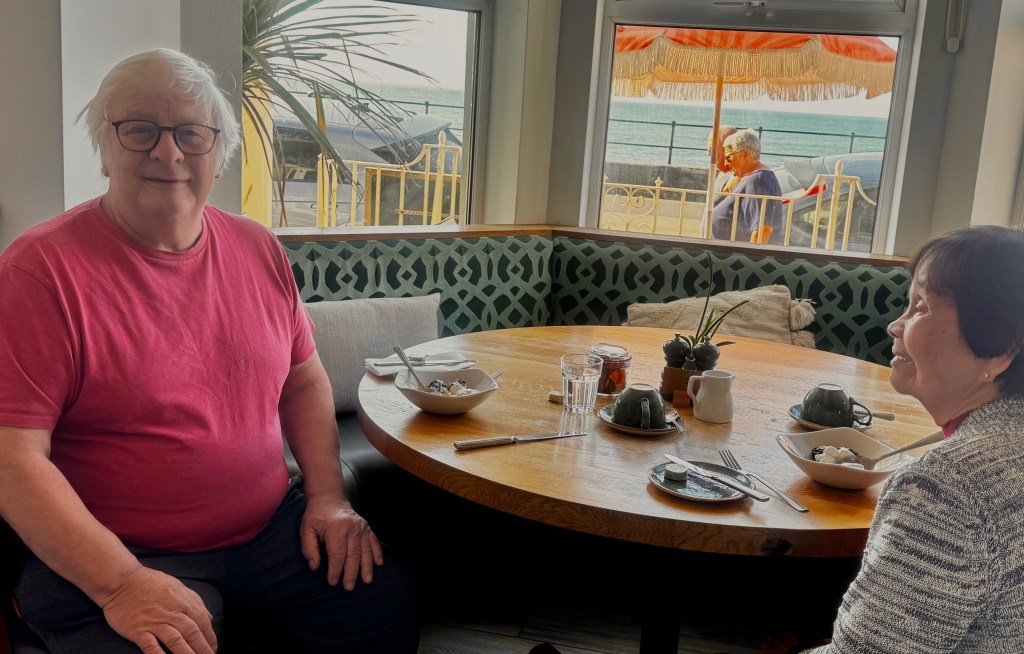
I’m the first one to the hotel restaurant at 6PM. I’ve had another one of those days of walking 10+ miles and an elevation ascent of 2500 feet. Since I always start at sea level, and end at sea level, an elevation ascent of that distance means a descent of that distance. My thighs and my knees tell me: “If you aren’t prone by 8PM, you are going to have to walk by yourself tomorrow.”
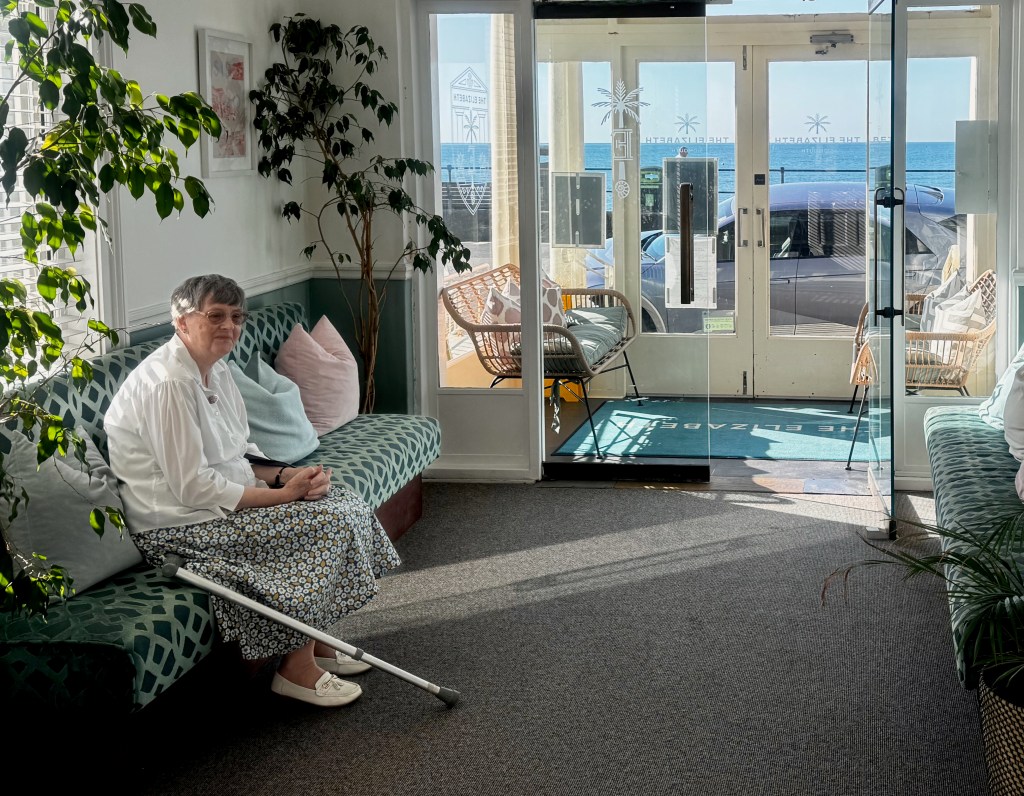
Two or three minutes after I enter the large restaurant, an 80+ year old woman with a cane and a plastic bag enters. We chat. She has been “holidaying” in Sidmouth for twenty years. “I like this hotel better than the Duke.” “Oh, why is that?” “The single rooms are nicer and this restaurant is so much nicer.” We go back to our own thoughts and worlds.
A few minutes later an older couple enters. They sit down near me. Looking at the beach and the water, he says: “Can’t see what is going on out there.” His wife says, “Oh, a lot of people in the water.” Keeping up the conversation, he says: “I bet its cold. What are they doing?” When she can’t answer him, I say: “It looks as though they are trying to surf. But there isn’t a wave for miles.” Just then the waiter enters to take our order, “They are just young kids learning how to get on a surfboard and paddle a surfboard.”
After the waiter takes my order, he turns to the older woman and the older couple. I hear the man muttering “I’ve got to decide between duck and pork cheek. I only like duck if it is cooked in a Chinese way. Hmm, I’ve never had pork cheek.” As the older woman orders, I hear the man still muttering “I’ve never had pork cheek; I bet it’s tender.” When the waiter moves to the couple’s table, he orders the pork cheek. And, of course, for the next twenty minutes before his order comes, I hear every minute, “I’ve never had pork cheeks.” Or, “I wonder how they’ll cook the pork cheeks.” Or, “I hope the pork cheeks are tender.” Or, “In all my years, I’ve never had pork cheeks.” On and on and on. The conversation between the couple is rather limited.
Since my meal is a simple traditional fish pie, I’m served in five minutes. The older woman is also served very quickly. In fact, she rises from the table and says to me “If you want coffee, they serve coffee over there in the lounge area.” When I leave my table five minutes later, there she is. Drinking coffee in the lounge area. I find out what was in her plastic bag. She is now knitting.
I wonder how will the pork cheeks turned out?

The next morning I find out. Once again, only a few individuals in the restaurant, the older couple is there. After I finish my breakfast, I walk over to them. “How were the pork cheeks last night?” “Oh, they were delicious. You know, I’ve never had them before.” We chat. He is 78-years old. They are from London where he still works. “I run the till at a local Sainsbury.” In other words, he works at the checkout at Publix or Kroger. “I’ve had four heart stints. But the Big Governor hasn’t called me home yet.” I now instantly like the fellow!

Sidmouth is a seaside community especially for the elderly. Besides smaller hotels, there are several large, grand Regency hotels such as the Victoria. They certainly were the place to stay and be seen a hundred years ago!


In Sidmouth, the average age must be 70. I meet people walking the promenade along the sea; I meet people sitting in wheelchairs or using walkers; I meet two friends sitting on a bench with their morning drink; I visit with a elderly person and her daughter enjoying the beach.
I wonder what these older folks ponder and feel. I wonder what lessons about life and aging they have acquired. Parker Palmer in On the Brink of Everything offers these words about aging:
- Older Life may Simplify
- Older Life may lead one to see the threads of one’s life, not simply work but vocation.
- Older Life may make clear importance of others, for mentoring for investing for sharing.
- Older Life may lead toward wholeness, only if one embraces one’s brokenness
- Older Life may lead one to accept limitations and contradictions/ paradoxes.
- Older Life may lead one to say “all shall be well. All shall be well.”
His use of the word “may” jumps out. Aging allows for learning; aging never guarantees that learning. He also includes a story from one of those wise Hasidic stories: “Before he died, Rabbi Zusya said: “In the world to come they will not ask me, ‘Why were you not Moses?’ They will ask me, ‘Why were you not Zusya?’” Wonderful words!

Not everybody fits the stereotype of an elderly person. I suspect that some have learned basic lessons as they’ve aged. Regarding the physical aspects of being older, I meet some who are really fit. I meet a walker on a bench “I just retired two months ago. In the military special services in my younger days. Got to go. Have to stay fit!” Soon he is charging up another hill. A short while later, I see two older men running.
I have to be careful. I have to remind myself that Parker Palmer’s words don’t include any comparisons. I especially have to catch myself that I don’t let the attitude of superiority creep into my spirit. I flash back to my mother. Before she died, my mother was severely depressed after my father died. In order to restore her spirits, Mary and I took her to St. Simons along the Georgia coast for a weekend. For a few days she was a different person. She simply loved sitting and watching the ocean, the waves, the seagulls, the other people. In a way, that experience renewed and restored her spirit, at least for awhile.
One of the dangers of long-distance walking is that one senses a difference between oneself and others, certainly with the elderly but also with those who are younger. My “fitness” level even differs not only from most of the elderly, but also from many of the middle-aged that I see at Sidmouth. My speech differs; my accent differs; my using a luggage transfer company differs from those carrying all their “kit”; my spending a night at a hotel differs from those wild camping. Yet, allowing those differences to foster a sense of comparative “superiority”, a “heh, I’m better than you,” is both so inappropriate and wrong. Once I sense that comparative attitude, I know that within the hour I’ll be passed by three younger guys, or a ex-special services fellow! Watch out for the dangerous side of pride! Despite the differences, we all need to find a place, a time, a means of renewal. The others that I meet, may simply find that which restores them in different ways.
Back to the man who never had pork cheeks. Despite the saying “When in Rome, do as the Romans do,” I’m not planning on trying the pork cheeks. Tender or not.
 Journeys: Explorations in Body, Mind, and Spirit