

As I’ve mentioned before, every day shortly after noon, I begin to look forward to my night’s lodging. Despite names like East Farm BnB, my lodging has all been within villages or towns. My desire to reach my accommodations for the night is always heightened by my romantic vision of thatched roofs and quaint cottages. Who doesn’t carry that image of English villages?


In Chillingworth, I walk to a local pub for dinner. On the way, I notice that a cottage was having its thatched roof replaced. As a man walking his dog approaches me, I ask him: “How long have they been working on this house?” “Oh, at least three weeks. But I’ve never seen them work. I walk the dog before they arrive; I walk the dog after they’ve left!” The next morning, I shout up to a worker on the roof. “How is the work going?” “Hard work, but we love it on nice days like today.” I learn that the roofs generally last 20 years. Depending upon the condition of the old thatch, they’ll either keep part of the roof or strip the roof almost bare. Not everybody can do the work. This young fellow learned his skill in a training program that lasted for five years. England recognizes that it has to provide programs to train workers to keep this part of its cultural heritage alive.

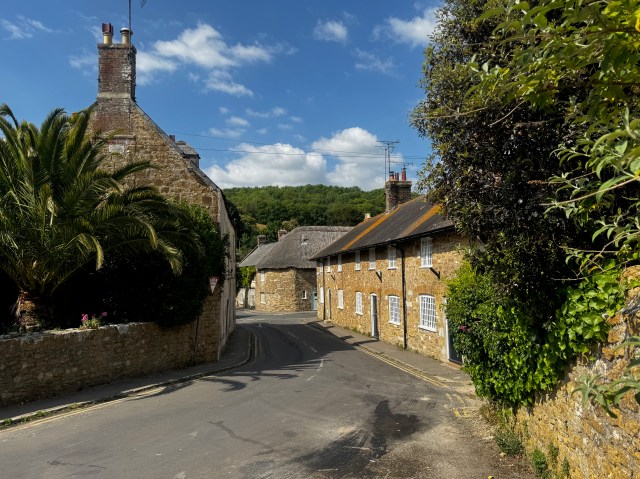

I enjoy reading Ben Robinson’s England’s Villages: An Extraordinary Journey through Time. Despite these villages being a quintessential part of England, village history is “dynamic and turbulent, which belies the sleepy image that many people associate with them today.” Only after the 1066 Norman invasion wore off that England begins to develop villages in a way which allow the cooperation between conquering Normans and conquered Anglo-Saxons. These villages become “nucleated villages: compact in form, centered on a focus such as a castle, monastery, market place or main street.” Furthermore, since the production of food was central, “practically everybody in the village was equally close to, or far away from the strips of land they had to farm dispersed across the open fields. People in a compact village could quickly get together to communicate…”(88). Obviously, this system changes over time with field enclosures, with continued concentration of wealth and land in only a few families, with mechanized farming techniques, with small factory villages, with the formation of the large industrialized cities. On and on and on, the changes come. However, the small village with the village green, the parish church, manor house, the local pub or tavern and barns remains a constant of the English landscape.
We should not be surprised by these changes. We all know that the place we call home changes. We move; towns and cities have buildings torn down, replaced. English villages are no exception. Several weeks ago, I passed the area where Hallsands existed, only to be washed away from large storms. This week, I passed the general area of Tyneham, a village which was evacuated so that the British and Allied forces had a “training” village to attack in preparation for D-Day. The people never returned. The deserted village is frozen in 1943. Like these, some of our villages and cities, some of our homes, have been erased.
Some villages have evolved. When local fishermen could no longer compete with the huge trawlers only a few miles offshore, then their and their family’s livelihood disappeared. With no jobs, younger people moved to find their life, to follow their dreams, to larger cities usually. Or, in the case of my ancestors, some of my English and Swedish ancestors moved to new countries. Yet, some people remained. For the villages along the coast, the villages have turned into artist colonies and tourist towns. These villages may not provide the full-range of life as they did in the not-so-distant past, but which village, town, or city does today? Isn’t Trump’s tariff wars an attempt to relocate industry in the towns and cities of the USA, rather than providing employment for people in Ciudad Juarez, in Ho Chi Minh City, in Taipei, in Shanghai, and many other cities. Of course, we can ask questions. Can this goal be accomplished in 2025? Should this be the goal for a globally interconnected economic system? Should this goal be pursued in Trump’s manner given his apparent innumerable political assumptions and the innumerable political consequences, intentional and unintentional?
I love reading Wendell Berry, the American poet, essayist, fiction writer who insightfully criticizes so much-of modern life, from his rural Kentucky farm and village. Only a man with a real sense of place, could write: “Do unto those downstream as you would have those upsteam do unto you.” Or, in his collection of poems Sabbath (1979-IV), he begins one poem conjuring a sense of connection not only with the living but also with those who are now deceased in a way which brings about a sense of “wonders and of uncommon goods.”
“The bell calls in the town
Where forebears cleared the shaded land
And brought high daylight down
To shine on field and trodden road.
I hear, but understand
Contrarily, and walk into the woods.
I leave labor and load,
Take up a different story.
I keep an inventory
Of wonders and of uncommercial goods.”
As I’ve lived for five-years in small Illinois villages of barely 200 people, I can partially understand Berry’s fictionalized world of Port William. In a global world where people seem to say “only the with-it live in cities” and where people dismiss the inhabitants of smaller communities with stereotypes of “redneck, country bumpkin,” I can understand his commitment to a particular location as the place one forms life, as a place where one shares a local responsibility, as a place which is the microcosm of our larger world. In other words, a “place” is so much more than a local address, so much more than a geographical reference point. In an early, early poem “At Peace and In Place” he writes of the difficulties of finding a life which has “grown whole in the world, a peace and in place.”
“In a time that breaks
in cutting pieces all around,
when men, voiceless
against thing-ridden men,
set themselves on fire, it seems
too difficult and rare
to think of the life of a man
grown whole in the world,
at peace and in place.”
How difficult and rare to think of a human life that grows whole in the world, at rest, at peace, in a particular place.
Nightly Destinations. I’ve reached the Sloop Inn. If I haven’t reached my nightly destinations by three in the afternoon, then I really, really, begin to long for a temporary place, a temporary home. As I’m definitely not Odysseus trying to reach home, I know that any simple, temporary place will suffice. However, as I long for a nightly place of rest in some English village, even those without the thatched roofs and the quaint cottages, I recognize a longing, as I recognize that longing in so many other travelers, for an even more inclusive and hospitable place of rest and peace for all.

 Journeys: Explorations in Body, Mind, and Spirit