I hoped to learn about Hinduism. Being an academic, I thoroughly enjoy the earlier lecture about classic textual Hinduism as expressed in the Bhagavad-Gita and the Ramayana. Because Sunithi, one of our seminar organizers wants us to learn about “lived” Hinduism, she leads several of us to Mylapore’s Shaivite “Peacock Temple” as well as the Parthasarathy, a Vishaivite Temple and its chariot festival.
At the Mylapore “Peacock Temple” a religious event is taking place coincidental with the waxing and waning of the moon. According to Sunithi, such a time is “auspicious” because a person’s soul is more in tune with the divine, with the infinite. In the temple, we see hundreds of people moving toward one lingam, an image of Shiva, in the inner sanctum. This image is almost never removed from the temple compound. Today, the image is carried clockwise around the temple compound three times. Following the image of Shiva, three different groups of priests chanted different Vedas.
Sunithi wanted us to understand that the expressed devotion often originates in stories. One of the roles of the god Shiva is as an ascetic teacher. While in the Himalayas, he was explaining to his wife, Parvati, the meaning of the primordial sound Om. As he was quite serious, he expected Paravati to be equally serious. However, as he was teaching, a peacock came and danced in front of them. For only a split second, Parvati’s attention wavered. Siva sensed this wavering; he became angry. Cursing Parvati, Shiva turned her into a peacock. Since even the gods are not condemned for life, Parvati sought her husband’s pardon. He forgave her. But, as penance, she still had to go to earth in the form of a peacock. This “My-lapare” is named the “Peacock Town.” This temple is named the “Peacock Temple!”
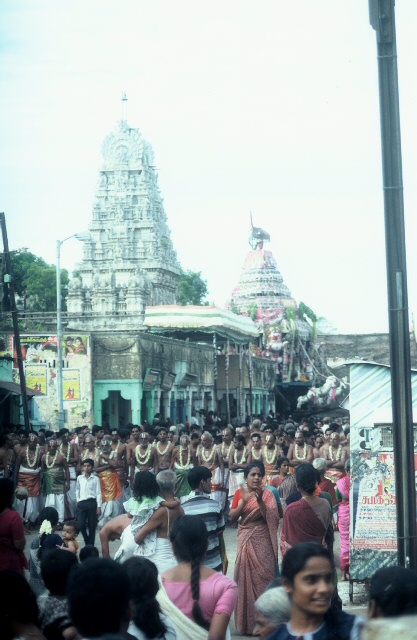
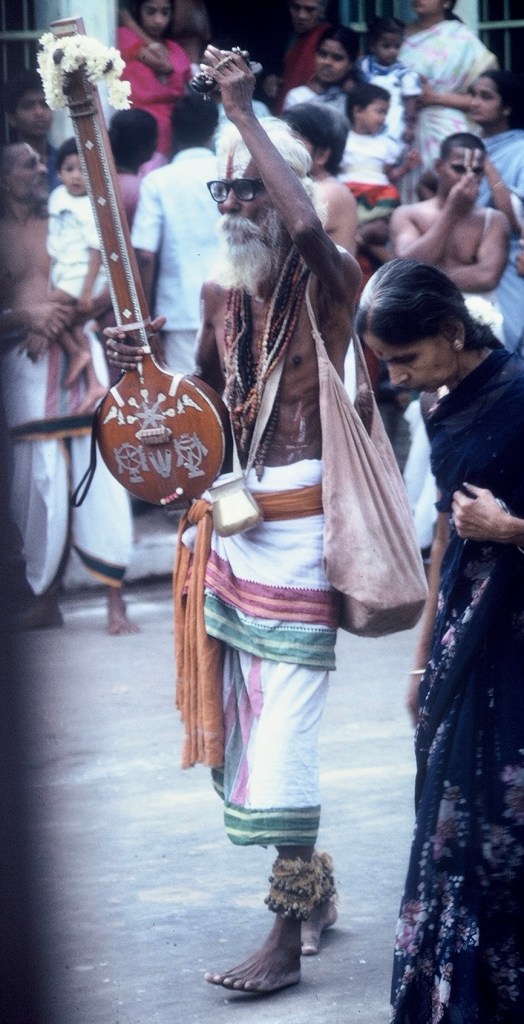
On a later morning, Sunithi met us at 6 AM to drive us to Parthasarathy, a 6th-century Vaishnaivite Temple. We get to observe one of the most important religious festivals of the year, a chariot processional.
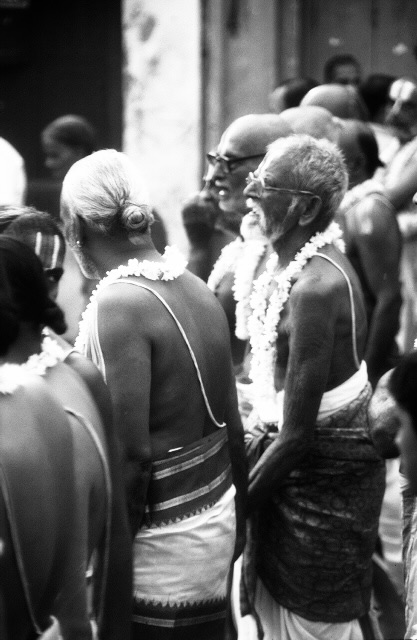
During the year, devotees prepare the temple’s chariot. In this case, this massive, many-ton chariot has to be almost forty feet tall, laden with images of Vishnu, decorated with flowers and streamers, and pulled around the surrounding city streets. Similar to a Roman Catholic laity and priests parading a statue of Mary around the boundaries of the diocese in order to honor her. We see fifty to a hundred chanting priests preceding the chariot; while another fifty or hundred men are pulling the chariot. Whether walking behind the chariot, praying from the sidewalks, or watching from balconies overhanging the street, thousands of people watch and celebrate. In my mind, it has the light-hearted fun of a county fair as much as the serious reverence of a holy day.
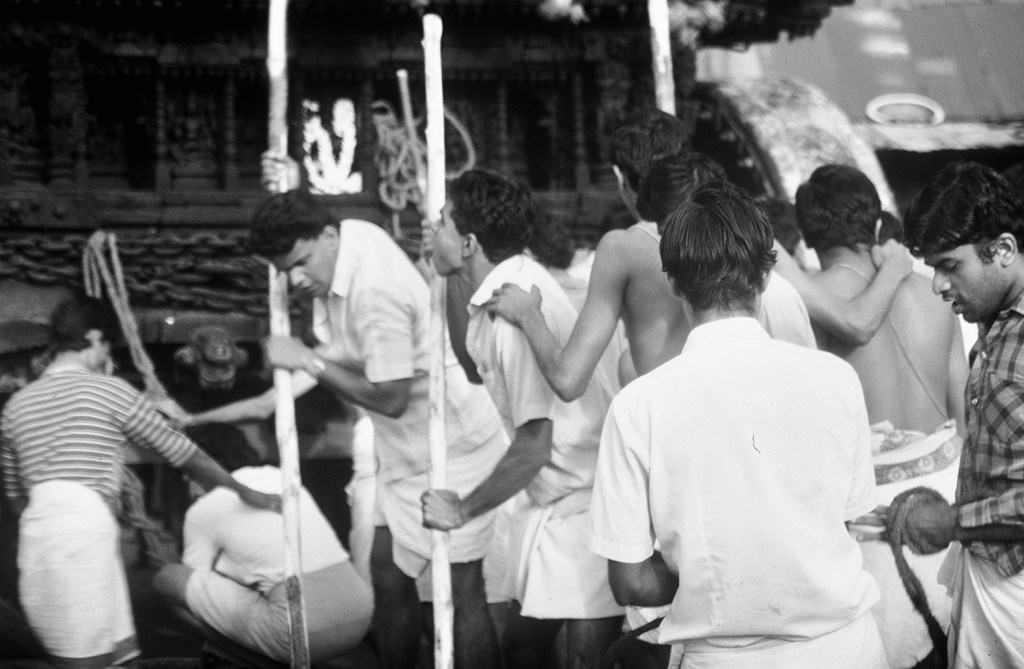
According to the Bhagavad-Gita part of the epic Mahabharata, the warrior Arujuna readies himself for battle. Who is his charioteer? None other than Krishna, an incarnation of the god Vishnu. “Parthasarathy” the name of the Temple simply means the “charioteer of Arjuna.” Only rarely is a temple associated with this story; even more rare is an image of Krishna sporting a mustache!
Each part of the chariot is symbolic. As I later saw other chariots, this chariot is massive. As I mentioned, probably forty-feet tall weighing several tons. One set of wheels represents time; the other set of wheels is karma (action). The wheels are held together by the axle of truth. The five horses imaginatively pulling the chariot are the five senses; the seated charioteer holds the reigns of determination and discrimination (similar to Plato’s dialogue Phaedrus whose charioteer also symbolizes knowledge). The charioteer guides the cart, life, through the smooth times as well as the rough times. As one of the major Hindu festivals, the chariot festival symbolizes the journey of life.
There are other significant features of the chariot moving through the streets. While not only symbolizing the moving journey of life, the chariot also symbolizes the journey of the god to people. An important feature of bhakti Hinduism is darshan, being seen by the god. During the chariot festival, those who are sick, those who are house bound can experience darshan because of the chariot moving the gods through the streets.
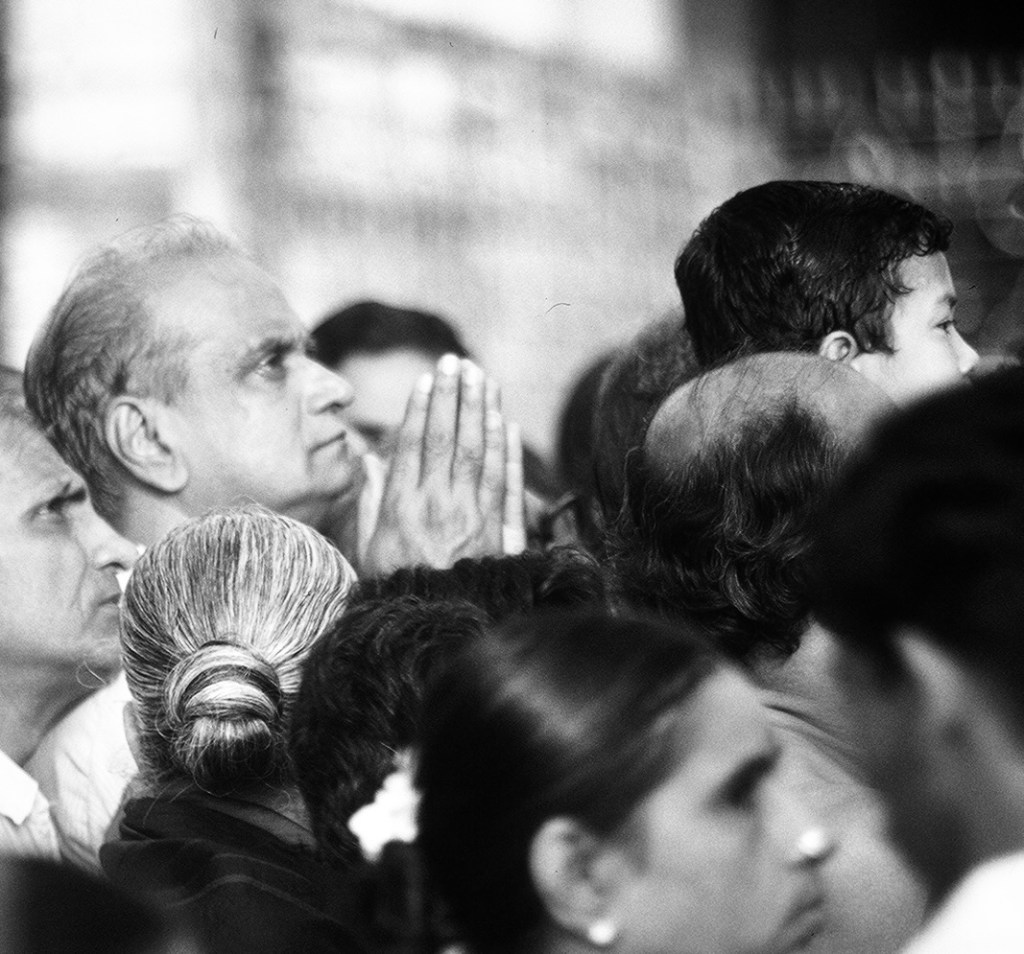
Bhakti is familiar across religious communities. While the understanding may differ in each religion, the popular devotion and reverence of people bowing toward a deity can be a commonality among numerous religious communities. Seeing Sunithi bow with hands clasped was a living example of such devotion.
 Journeys: Explorations in Body, Mind, and Spirit