
What does one do at 5AM? I know that it will be hot as the day goes along; I know that the group schedule will leave little free time. I go for my walks.
In Delhi, the morning after our arrival, I leave our hotel around 7 or 8 AM. I open the hotel door to walk outside. Bam! The heat hits me. “I’ll have to walk earlier in order to beat the heat.”
I walk in Hyderabad early one early morning. Leaving our lodging at 6AM, I walk past St Anthony’s Roman Catholic Church. The Indian priest is beginning a 6:30 AM mass. Although not Roman Catholic, I join others sitting at the back, changing my seat after I realize that I’m sitting in the woman’s section. The service reminds me of an informal Baptist service. An older man in the back of the open-air church, suddenly stands up and begins singing. Without any apparent order, the other members of the congregation walk to the front, kneel at the altar and receive communion. Customs of worship exist for every church!
Leaving the church, I continue my walk, and, within a block I come upon a Roman Catholic mission cemetery. I easily count the graves of over 60 nuns, 20 priests, and several hundred laity. One priest’s grave attracts my attention. The priest, form Italy, came to India on July 5, 1924 and died on Oct 6, 1924, less than 100 days in India. Why did he choose to come to India? What happened to him during those one hundred days? Surely my own stay in India, a few days less than one hundred, will have interesting experiences, but I certainly don’t want one of those experiences to be visiting a cemetery permanently! As I continue to stroll through the cemetery, I come across an even more poignant expression. The despairing Schopenhauer or Nietzsche can not have written more striking words: “Oh God, our lives are a nightmare!” Yikes!
My walking continues in Madras. As much as I learned from the seminars and the group excursions, I also begin to feel that I am confined by the group. While the group allows me to see new things and talk with more people, the group also attracts attention and hinders me from seeing more of Indian life unaffected by my obvious presence. The range of my walks increased.
The images from these walks remain with me. A man pushing a cart made of wood slats that was moving a body whose arms dangled almost to the ground. Women with handmade brooms sweeping the sidewalks’ dust, leaves, and garbage from the “sidewalks and streets” into piles. Cows and stray dogs, and sometimes humans, sticking their hands and faces into those piles to discover food. Men and women covering the sidewalk sleeping so that I had to move to the street to walk around them. A piece of cardboard or plastic covering a two-foot wall of bricks, someone’s “home.”

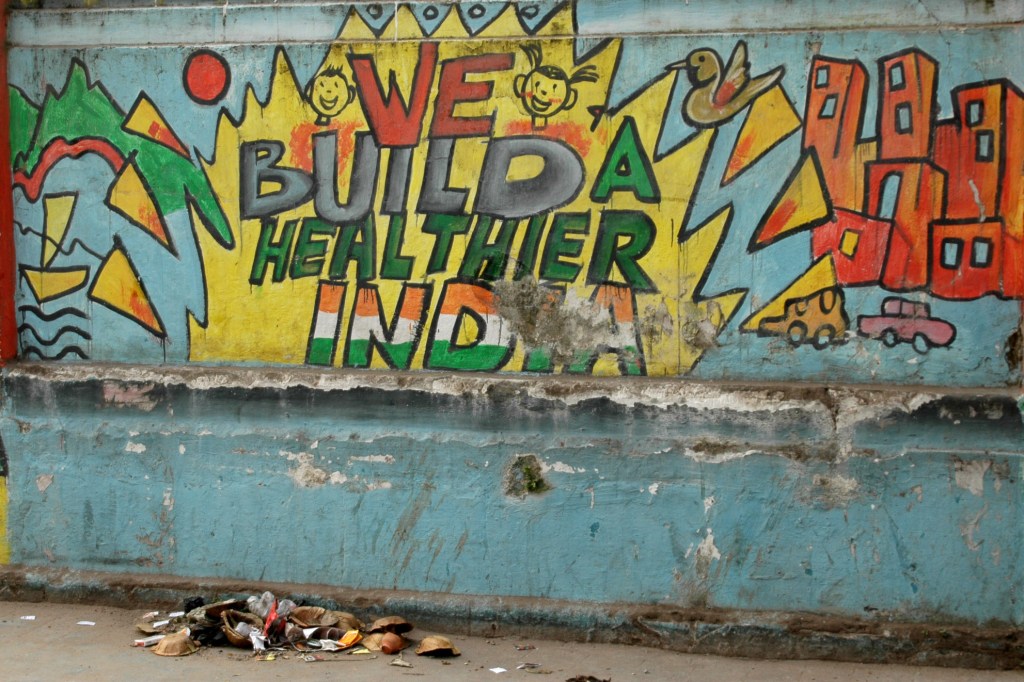
On my walks, I sometimes see signs, street art, and graffiti. An insurance company sign read: “Life is too Wonderful to be spent worrying.” Another bank billboard reads: “Kick off to a secure Future, come grow with us.” The contrast with the men and women who live on the streets is so striking! How many of these people worry about basic necessities? How many of these people could think about their future?
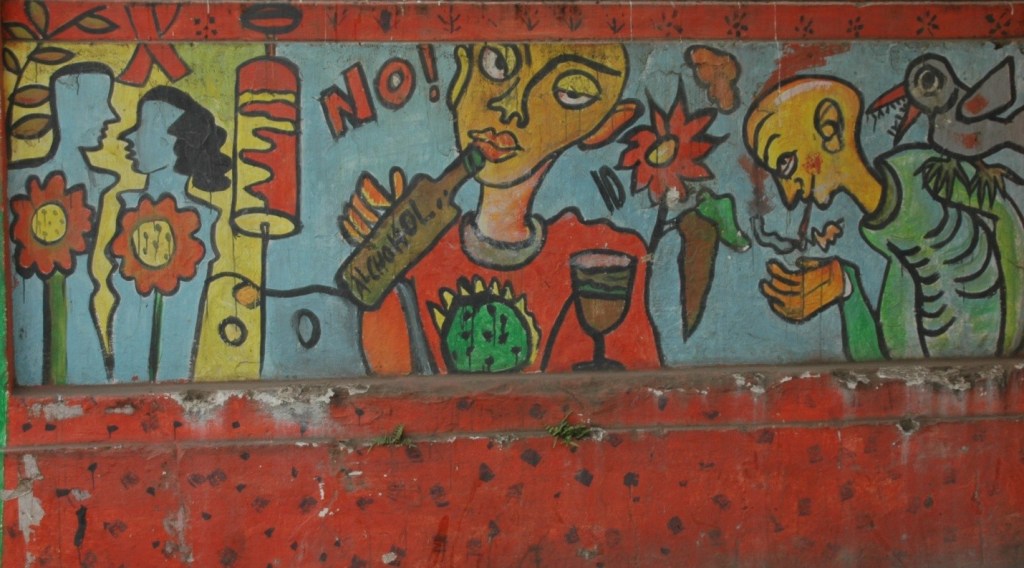
The graffiti is also present. “Fight against the 3-D’s: Drugs, Drink, and Dance.” Or, “Hindi Never, English Ever.” An interesting sentiment!
Rarely, I confront anger. While walking toward the shoreline one morning, I decide to take a shortcut. The shortcut lasts shorter than I anticipate. An elderly woman barely pushing five feet tall and probably sixty years old, runs toward me flailing her arms and shouting something at me. I don’t know what she is saying, but I know what she wants. I raise my hand in apology and turn around, retracing my steps. As I glance back, I notice a number of other women. I am probably intruding on the morning toiletry. I’m thankful that it is she, rather than the husbands or fathers or brothers of the women, who warn me!
Or another incident of anger. During my walks, as much as I tried to pay attention, there are times I don’t. Sometimes I simply become engrossed in my own thoughts. Sometimes I selectively ignore things around me, garbage, cows, etc. This morning, I’m walking on the sidewalk. To my surprise, I feel someone slapping my leg. As I looked down, I realize that I have passed a beggar who has his hand out for help. I not only ignored his request for help, but I completely miss seeing him. It is as though, in Ralph Ellison’s phrase, he is “an invisible man” to me.
A completely different and unsettling encounter occur on the Madras beach on the Bay of Bengal. The sun is just coming over the horizon. As I approach a collection of fishing boats, a man comes up and kneels before me. Surrounded by silence, he begins to say: “Christ is in all. Christ is in all. Christ is in you.” Christ will make you wealthy.” Then, he begins to recite Genesis 1 and John 1. A strange experience! Having a person kneel before me, almost treating me as I am a god.
I’ll mention one last walk. Bangalore has been an important city since becoming a “hill station” for the British. From 1896-1899 even Winston Churchill lived here as a junior officer. I begin my walk around 4 or 5 AM. About fifteen minutes before sunrise, I heard a “whoosh,” a minute later, another “whoosh.” I squint to make out what is across the street. I eventually see two men. Behind the men are two caddies carrying golf bags. For all its high-tech companies, the image that remains with me is two men playing golf in the darkness. Playing golf like some British officer from 150 years ago!
 Journeys: Explorations in Body, Mind, and Spirit