
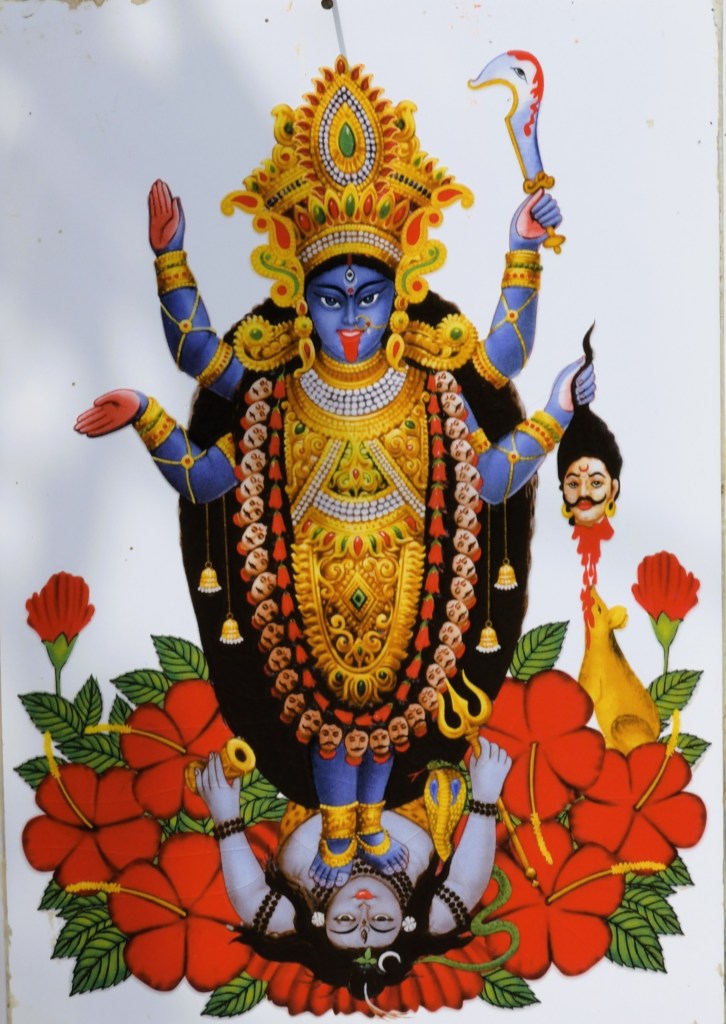
Carl Griffin and I are visiting Kolkata. Rev. Subodh Mondohl acts as our host in Kolkata. One afternoon, he and his friends Probal Dutta and Rev. Mohan Lal take Carl and me to the Kali Temple. Statues and photos of Kali show a fierce feminine deity. She has swords in her arms and a necklace of skulls. Yikes!
As Carl and I wait outside, Subodh returns with two “official guides.” Guiding us toward the temple compound, we remove our shoes. We join hundreds of people as we move toward the inner sanctum. Glancing toward the rear of the temple, we are reminded that this temple still uses animal sacrifices as a means of relating to the goddess. We see the trail of wet blood from a very recent goat sacrifice. Someone has already removed the goat. The guides tell us proudly, “If you return Saturday, then you will be able to see almost two-hundred animals sacrificed to Kali.” I remember thinking: “We’ll definitely not come back on that bloody day!”
We enter the inner sanctum. In some Hindu temples, this area is reserved for Hindus only. Allowing us to enter this area is either quite a gift to us western non-Hindus or a breach of usual temple etiquette. The inner sanctum is the size of a small side chapel in a Roman Catholic cathedral. As we enter, we see five or six priests in the middle of a room, beyond them is a curtain hiding the rest of the room. Besides the priests, there were two dozen shoving, pushing, and excited men. Everybody is trying to go directly to the curtain’s opening, obviously to see the statue of Kali on the other side.
With all the noise, I can barely hear anything. I remember asking myself “What are you doing in here?!” Following Subodh, his friends, and the “official guides,” we are pushed and shoved to the place immediately in front of the priests and the curtain. The priest shouts at us. For probably thirty seconds, he keeps shouting and pointing at the curtain. Then, one of the other priests pulls the curtain aside. There is the image of Kali. Eight arms, a garland of skulls around her neck, her blood red tongue hanging out, staring down at us. After another five seconds gaping at this image one of the priests points to a donation box. That I understood! I pull out a two rupee note, place it in the box, and with the others, begin to push my way back towards the exit.
After catching our breath outside, Subodh asks “Did you understand anything?”
Carl and I, “No, not really.”
Subodh, responds “The priests were wanting us to confess our sins to Kali and to make an offering to her.”
“Well, I did place two rupees in the box.”
Subodh laughs, “You did not make the priests very happy then. They were telling us to give 200 rupees!”
As I later thought about Kali and the sacrifices, I thought of the historic emphasis upon the sacrificial rites which have historically been intrinsic to religious communities. From the ancient Hebrews to Mayans in Mexico, sacrifices have been used to mediate the relationship between the sacred and the human. To the One who is all-important, humans offered that which is most important to humans, namely blood and life. Although in other traditions of Hinduism sacrifice does not occur, why is it that in this particular temple, sacrifices to Kali still occur? What is the transaction revealing about Kali worshippers’ notions of Kali, about their notion of what humans must do to propitiate her, about how humans interact with the divine?
With Enlightenment-influenced sensibilities, such an expression can be interpreted in numerous ways. From Sigmund Freud to Rene Girard, the activity has been interpreted as an at crucial for social maintenance. Besides these functional explanations, contemporary Christian theologians have sought to distance themselves from explaining the significance of the primary Christian motif of the sacrificial death of Jesus, through such easily misleading concepts. In particular, if sacrifice assumes a wrathful and vengeful God who requires Jesus’ bloody death, then this distorts the dynamics of Jesus’ sacrificial death. For those theologians, interpretations of Jesus’ death on the cross must connect to humanity’s sin and evil, not to a certain way of understanding God angrily requiring God’s own sense of justice be met. Still, if the human condition is comprised of sufferings both undergone and afflicted, and if the sacrificial imagery is powerfully evocative because it is directed at guilt in those afflicted suffering, then I can understand such imagery and practices. But animal sacrifices? That is too much!
In fact, the Kalighat experience remained with me upon my return to Atlanta. While the question of sacrifice remained, another question emerged. Did the primacy of a feminine deity, make any difference for the role and status of women? As I research Hindu poems to Kali and read other scholars’ articles about Kali and her worshippers, I realized that I could only conclude the negative. The worship of Kali did not seem to cause any recordable impact upon improving women’s status. The priests were still men; those allowed into the inner sanctum were still only men. So much for a feminine deity improving the roles and status of women.
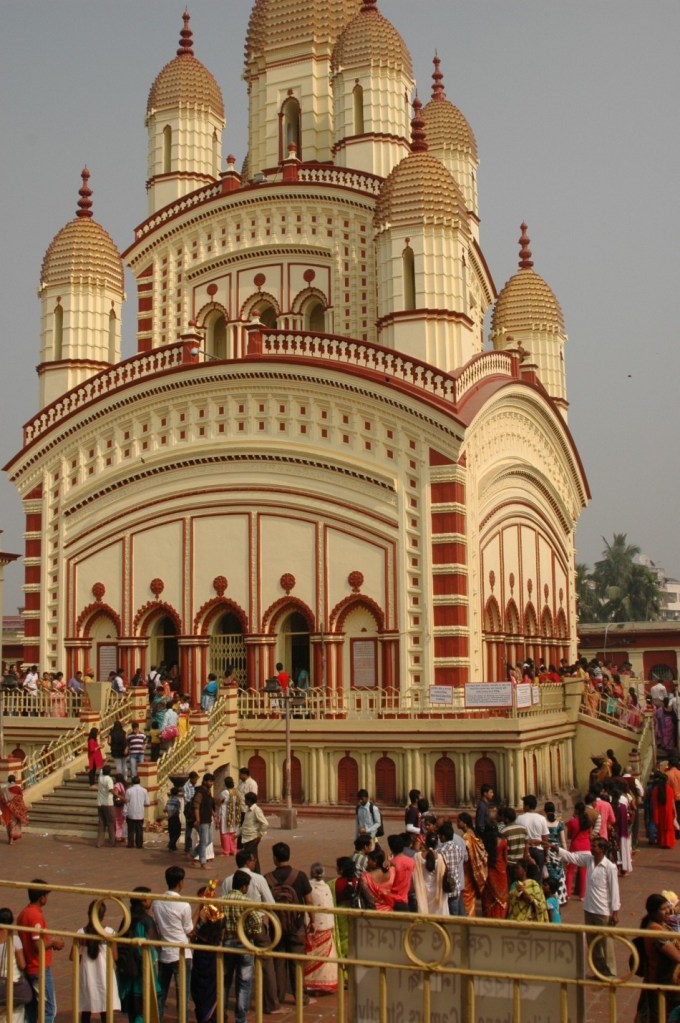
The following photo is a different Kali temple on the Hoogly River.
 Journeys: Explorations in Body, Mind, and Spirit