
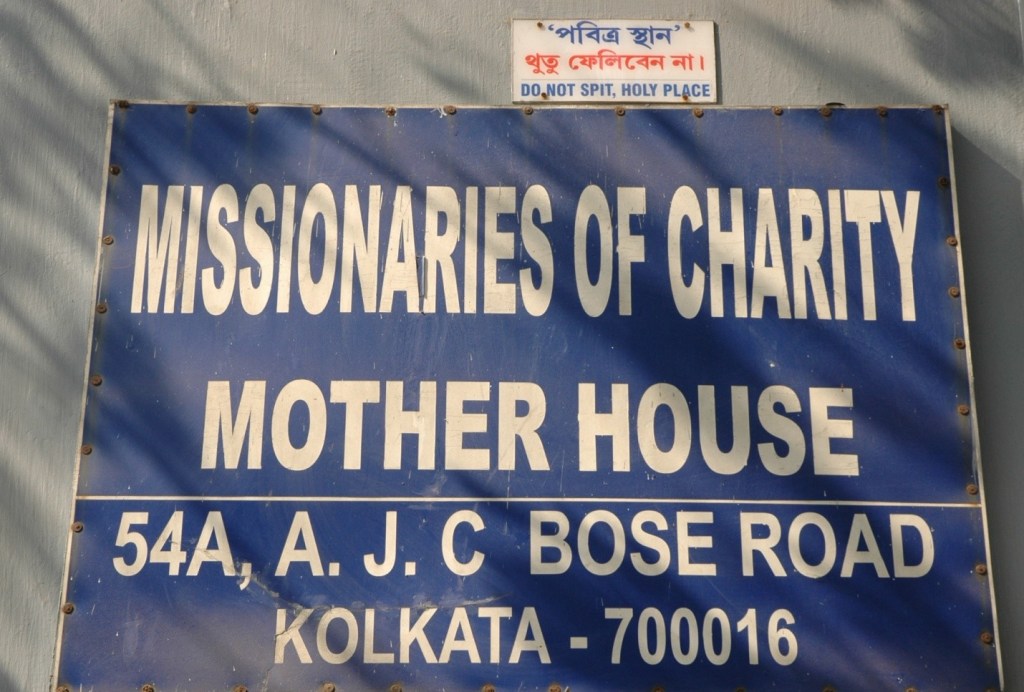
In Kolkata, Subodh Mondal, our host, take us to an amazing array of places and enable us to meet fascinating individuals, Hindus and Christians. The highlight is our visiting Mother Teresa at her Mother House. Memorable.

We also visit the House of the Dying, Nirmal Hriday which means “the Home of the Pure Heart.” Carl and I learn about this heart of Mother Teresa’s Kolkata service. Originally, the land and building had been part of the larger Kali Temple. As part of the complex, this building provided shelter for those who were pilgrims to Kalighat. Over time, this building became a center for individuals who preyed upon those pilgrims and upon other neighborhood people. After repeated requests to the Calcutta governing authorities for a building to care for the dying, Mother Teresa finally received approval. In 1952, the authorities gave her this building.
As elsewhere, the Missionaries of Charity wear their white saris with blue trim. White is the color of death in India. The sisters have two large rooms which can handle forty or fifty individuals, one room for men and one room for women. Between the two rooms is another room with four cots, reserved for those who would probably die before that day ended. The sisters are present to the dying person: holding the dying person’s hands, pressing wet cloths to their lips.
As we made our way through the rooms I have two strong contradictory feelings. On the one hand, a deep feeling of sadness for the one’s dying. My breath is almost taken away as one sees the emaciated bodies barely clothed, barely breathing. They literally have nothing. On the other hand, I feel a profound, silent reverence. In this world of dying and near-death, sisters care by giving what they could, their simple presence and attention. As Mother Teresa said, compassion can be offered without worrying about “effectiveness.”
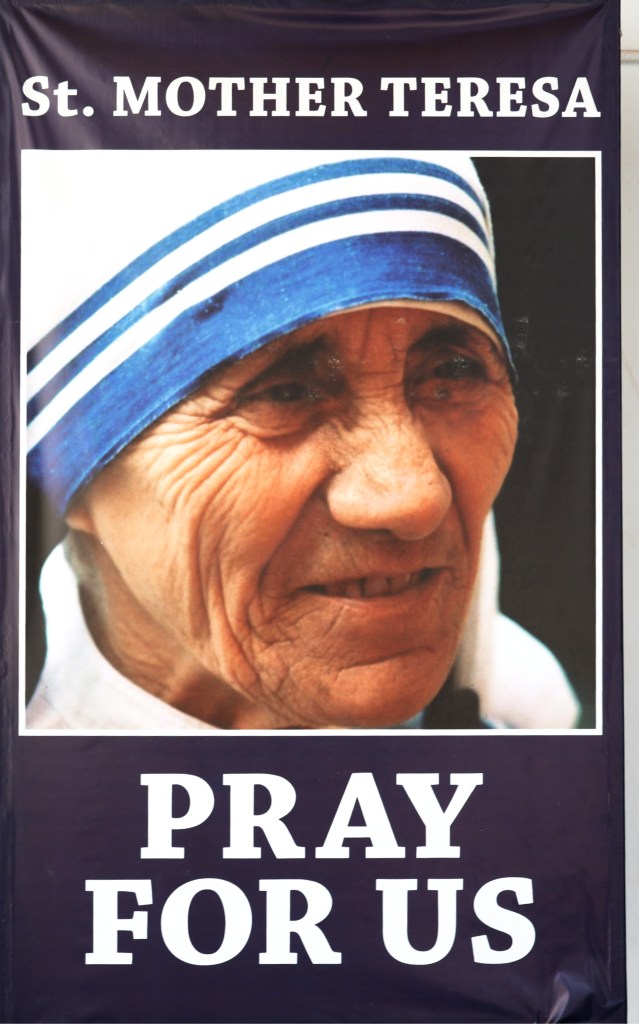
Anita Mathias, who has witnessed Mother Teresa in this place, wrote: “Kalighat felt like holy ground. I often sensed God in the dimness and hush of that place. Bhogobaan ekane acche, Mother Teresa whispered in Bengali as she went from bed to bed: God is here. Her creased face looked sad and sweet. This is Bhogobaan ki badi, God’s house, the sisters tell new arrivals, believing that Kalighat is sanctified in its very stones by the thousands who have died peaceful deaths there.” Mathias continues, “In her speeches, Mother loved to quote the dying man she brought to Kalighat from Calcutta— “All my life I have lived like a dog, but now I die like an angel.”
There is an apocryphal story about this particular House of Dying. As I mentioned, the original building was part of Kalighat. As Mother Teresa pressed for a building for the poor and dying, a Hindu priest Kalighat resented her efforts. Whether his criticism of Mother Teresa was jealousy at her public recognition or a desire to remain ritually “pure,” the Hindu priest did all that he could to undermine the transferring of the building to Mother Teresa.
Finally, the building was transferred. Shortly after the transfer, an outbreak of leprosy or cholera occurred in the area. This Hindu priest contracted the disease. Where did the elderly Hindu priest who hated Mother Teresa go? Where did the Hindu priest who had tried to prevent her from carrying for the sick and the dying? The questions are rhetorical. He went to the very building, Mother Teresa’s House of the Dying, that he had for so long opposed to transfer to her. She and her sisters took care. Some versions of the story claim that he died; other versions of the story claim that he survived and later supported Mother Teresa’s work. An apocryphal story? Even if it is, the story certainly captures what many see in Mother Teresa, forever compassionate, persistently forgiving.
 Journeys: Explorations in Body, Mind, and Spirit