So much to see and learn about Varanasi. Since Jai has guided me on one walking tour, he recommends that I should take his colleague Mayank’s night walk. “He’ll show and tell you some unforgettable things about Varanasi.” He isn’t wrong.
Jai describes Mayank as “our secret Sikh weapon!” When I meet Mayank, he tells me his story. His Sikh ancestors have served in the military for fifteen generations. How is that for ancestry! His own father, a colonel in the Indian Army, has enjoyed arm life. Good salary, good retirement, and a chance to see different parts of India because of staff rotation every three years. However, his father did not pressure Mayank to continue the tradition. Without saying the reason, I suspect that it was because of Indian troops storming the Golden Temple in 1984, followed by two Sikh guards assassinating Prime Minister Indira Gandhi. After working in a bar near Mumbai’s film companies, he eventually made his way to Varanasi. He is getting married to a Danish woman. Although nervous about his family’s reaction, he doesn’t want to underestimate his family’s reaction. An uncle has already married a German woman; and several cousins have moved to the USA and dated Indian-American girls.
He tells me a basic truism of visitor’s reactions to Varanasi: “Some people like Varanasi; other people can’t survive in Varanasi.” He has stayed because it is “a special, magnetic city.” As we walk, he greets a number of people; a number of people greet him. He is definitely comfortable walking Varanasi’s night streets. He carries a flashlight, not so much to see where he is going, but in order to avoid stepping on sleeping dogs! We have two destinations, main southern cremation ghat, and an Aghori temple.
Mayank describes Varanasi’s ghats. With over eighty ghats, Varanasi’s ghats perform different functions. While the north one (Manikarnika Ghat) is for temporary visitors or short-term residents, Hindu pilgrims who want to die in Varanasi, this southern ghat is for more permanent, local residents. Besides these cremation ghats, there are other ghats, some primarily for bathing, some for ritual ceremonies (such as the Dashashwamedh ghat), others are simply royal residences.
As we reach the southern ghat, briefly describes his own familiarity with cremation. Although a Sikh, his father was cremated in Delhi. “I didn’t have much of a role. Basically, after I lit the funeral pyre, a regimental army guard took over the rest of the service.”
Mayank tells the story as to why cremation occurs on this southern ghat. Centuries ago, a one-eyed brahmin sees Shiva meditating on the bank. As the brahmin jumps into a well to avoid being seen, Parvati, Shiva’s wife, shrieks. With his third-eye, Shiva is about to destroy this brahmin. The brahmin repents for startling Parvati and awakening Shiva. While Shiva allows him to live, he is punished. He must cremate bodies on the Ganga bank. In other words, the brahmin became involved in one of the most polluting activities possible, the handling of corpses. I love these ancient stories!
Similar to Jai’s description of ghats, Mayank confirms that a family group controls this ghat. While lower caste people do the manual work of handling the corpse, a “Dom” oversees the process. Think a “Hindu undertaker.” A very, very, very wealthy “dom.” He is usually quite wealthy because business is…..constant!
If a person dies, then males of that deceased family member bring the corpse to the ghat at any time of the day or night. As we are standing at the ghat around 8PM on an early December evening, we see several corpses and pyres being readied.
The cremation does not occur haphazardly. Elaborate Hindu rituals dictate the treatment of the corpse, the role of the eldest and youngest sons, and other family members. The rituals and their performance are meant to help the deceased’s soul in its continuing journey. Mayank mentions that there are five corpses that are traditionally refused at a ghat, children under five, pregnant women, those who die of snake bite, sadhus (holy men), and the poor.
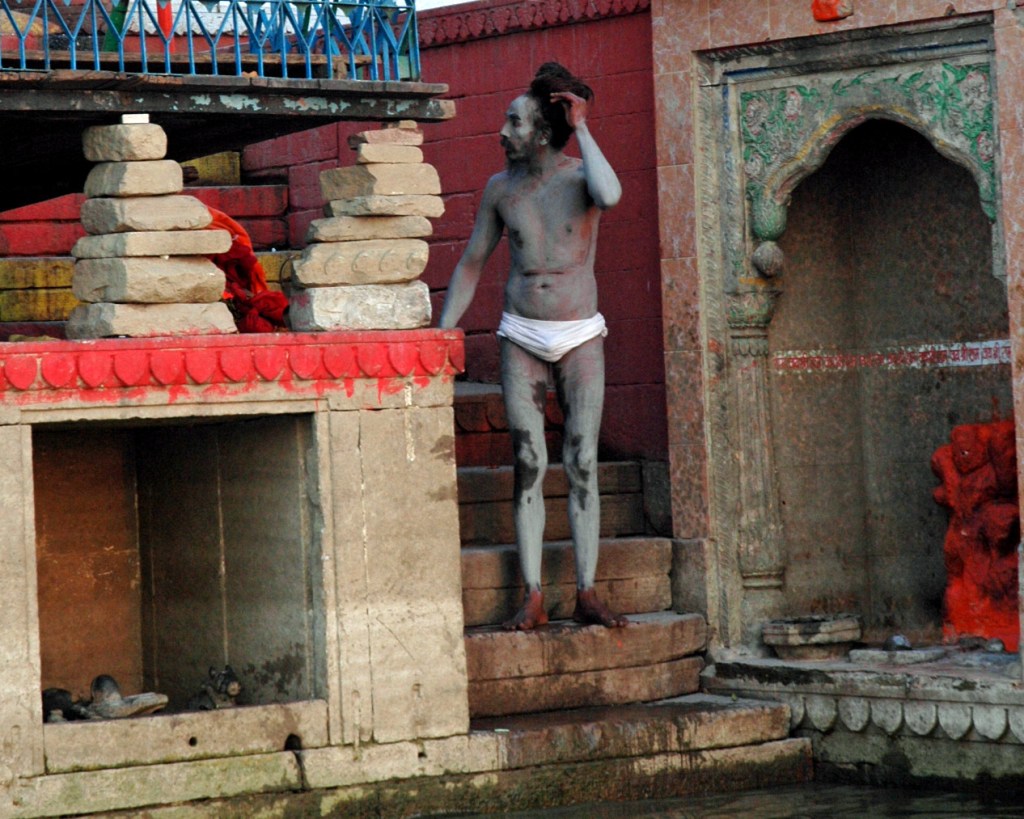
From the ghat, I’m about to be part of “dark tourism,” visiting a group once viewed as a form of “heretical Hinduism.” We walk to the Baba Keenaram Ashram, a home for the Aghori sect. Aghoris claim that “aghor” means “simple.” Simple maybe, different certainly!
While the Aghori sect can be traced back to the 11th century, Baba Keenaram is born in the 17th century. He is believed to have special insight and powers from an early age. Like previous aghoris, he believed that the sacred can be found in anything and everything, even those incidents and occurrences which conventional Hindus are taught to be polluting. Even death.
Mayank says “They are not your typical Hindu!” He proceeds to describe them as traditionally living near cremation grounds. Unlike most observant Hindus, for them “nothing is impure.” They use human skulls for drinking bowls; they drink alcohol; they smoke marijuana; they may meditate on corpses; and, they may smear themselves with the ashes of cremated bodies. Mayank cautiously states they might engage in even more bizarre acts, get ready! “Sex with a corpse.” Why do they practice this form of Hinduism? Later reading suggests that they believe that all differences, dualities, are simply illusions. They engage in culturally and religiously condemned actions in order to show the ultimate superficiality of our usual distinctions.
Needless to say, this group is considered outside the boundaries of ordinary Hinduism!
A footnote. In a 2008 article describing the research of Ron Barrett, a medical anthropologist and assistant professor in the Emory School of Nursing, who writes about another Varanasi Aghori group. The author writes: ““The Aghori are working with people considered the most untouchable people in humanity, in Banaras, a place that is all about purification,” Barrett says. “In a sense, the leprosy treatment clinic has taken the place of the cremation grounds, but instead of the fear of death, the Aghori are taking on the fear of a disease.” Rather than simply being titillated at the Aghori way of life, we might do well to see them in another way. As providing a way of changing attitudes toward social stigmatization and actual helpful treatment of those individuals.
So much to see and learn in Varanasi. On the one hand, I hope that I haven’t become enamored with simply the exotic side of Varanasi. Even with the Aghori though, there is a way to see that the exotic can possibly have helpful benefits. On the other hand, my actions consist of visiting what does exist in Varanasi. Granted, some of what happens in Varanasi certainly differs from what we see if we walk into a funeral home or church in Atlanta! But the unusual side of Varanasi, is still in Varanasi!
 Journeys: Explorations in Body, Mind, and Spirit