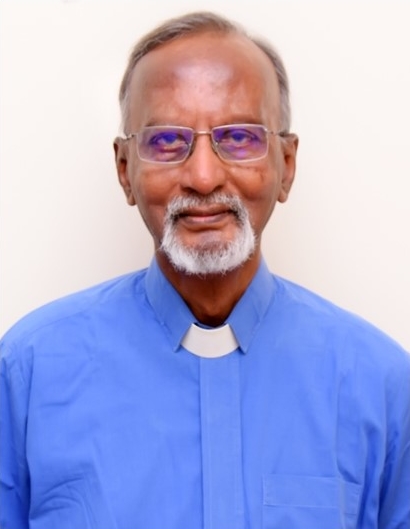
Upon receiving notice of my acceptance in the Fulbright seminar, I know that I want to meet Emory’s Professor Thomas Thangaraj. Although my doctoral degree is from Emory, I had not met him during my years of course work. Graciously meeting me, he invites me to visit him in his hometown of Madurai since he’ll be returning there during the summer months. What a wonderful gesture!
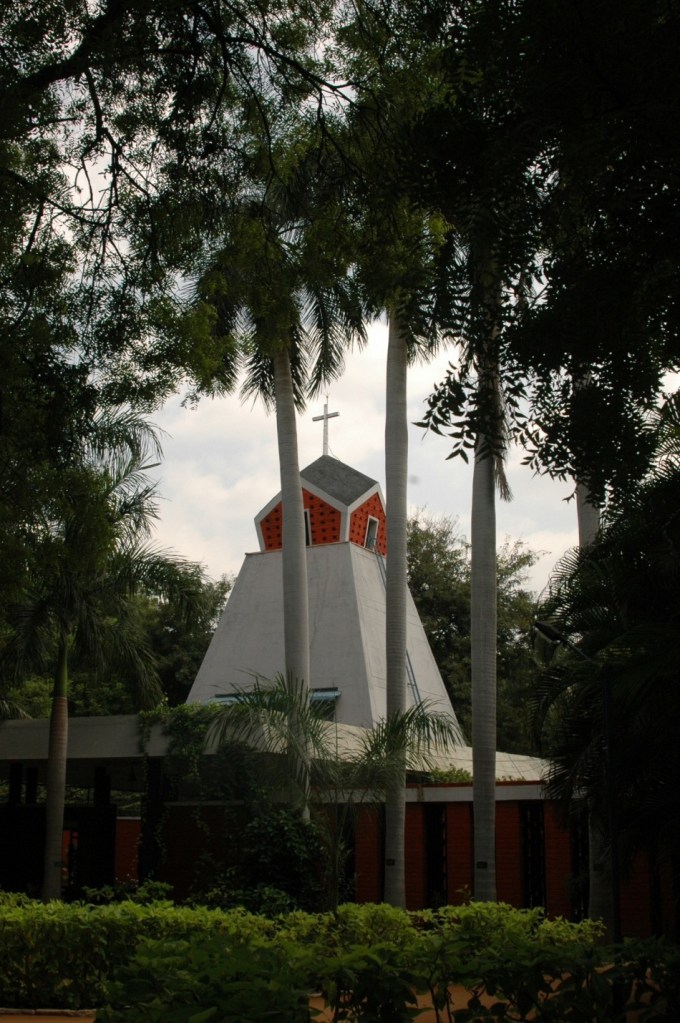
Since I also want to visit the Meenakshi Temple, I take an overnight train from Madras to Madurai a day early. When time comes to visit Professor Thangaraj, I take a taxi to the Tamil Nadu Theological Seminary. This seminary resulted from the 1969 merging of a Church of South India Seminary and a Lutheran Seminary. We meet in the faculty office area where he introduces me to some of his colleagues.
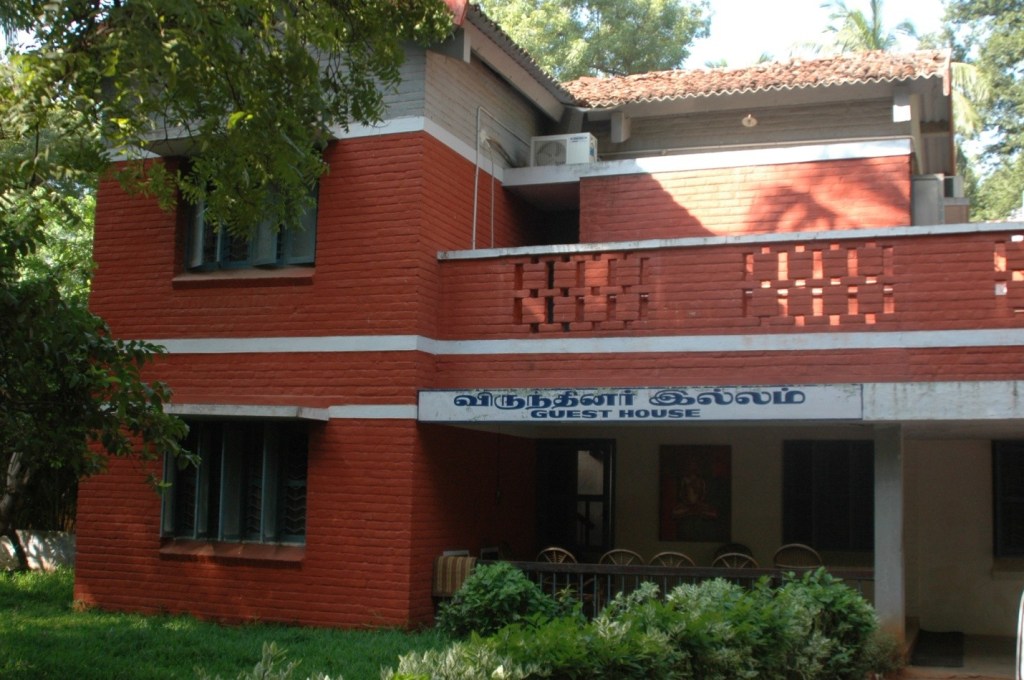
After chatting, we tour the seminary. The chapel is at the center of the small campus. Different from British or North American chapels, the chapel is open to the elements, except for the roof of course. Like Hindus visiting a temple, we remove our shoes as we enter the chapel. The high ceiling is accentuated by a tower above the altar area, like the inner sanctum of a Hindu temple. The seating area focuses upon an altar and cross.
As we sit in the chapel, he tells his story. His father was a Christian minister. As a result, Thomas was not exposed to the severe and harsh poverty of many Indians. Given the rarity of Christian ministers with advanced degrees, he began to teach at the seminary with only an M.Div. After moving to the USA for additional education, he studied with Harvard’s Professor Gordon Kaufmann. Graduating with his Th.D., Professor Thangaraj returned to the Tamil Nadu Theological Seminary.
In his eyes, the seminary has three educational priorities: an awareness of India’s pluralism, the need to understand interreligious dialogue, and the importance of social work. To accomplish these goals, the seminary emphasizes contextualization. The students must work for six months in an urban project, then four months in a rural setting. Thomas admitted the results are mixed. Since almost every student will find either the urban or the rural setting completely new, Thomas admits the reality: “We can expose them to these contexts; we can’t guarantee that they’ll reflect deeply about that context.” Because of their goal of interreligious dialogue, Thomas describes a distinguishing feature of the students’ education: “Because some students have never been in a Hindu or Muslim place of worship nor become friends with a Hindu or Muslim, the students must live with a Hindu or Muslim family for fifteen days!” Interesting strategies for learning about India’s pluralism and the need for interreligious dialogue!
Thomas explains some of the recent Indian Christian history. During the 1930’s through the 1960’s, the church had numerous creative people, writers such as E. Stanley Jones Christ of the Indian Road, M.M. Thomas and Leslie Newbigin. Since then, the church has focused more on praxis and the intentional reorganizing of theological education to face the current Indian context. He confessed that he, like many others, found it easier to speak than to write. He gave an example of teaching a seminary course on “Interreligious Relations.” However, when he left to teach at Emory University, nobody else could teach the course except some of his own students who used Professor Thangaraj’s own notes!
A major challenge for the churches in India are for them to be aware of their own roots and characteristics. The fact that only a few theological books are published in Tamil language, the professors usually have to assign English language texts. Unfortunately, not all the students read English!
He has a mixed assessment of the Methodist Church. According to Thomas, one of the major reasons that the bishops in the Methodist Church in India refused to join the Church of South India (an ecumenical church body joining Anglican, Congregationalist, Presbyterian and Continental Reformed churches) was because of the church’s wealth. Although the bishops in the United States wanted a union, they were reluctant to push the Indian bishops because of past paternalistic interference. If these USA bishops would have pushed, then the Methodist Church would have been part of this more ecumenical Protestant church.
The seminary trains pastors serving primarily the lower castes. By becoming Christian, some Indians hope to break free from the “suffocating” caste system. Thomas knowsthough that caste conditions and treatment can not be broken so easily. Within the church, the earlier “untouchables” became renamed by Gandhi as the “harijans” or “children of God”; now, they wanted to be called the “Dalits,” or the “oppressed.” As a sizeable part of the Indian Methodist church, the Dalits want to have representation in authority structures. Thomas understands the difficulties as he is from the Nadar caste, one of the lower Shudra castes. Thomas’ own life illustrates the complexities of caste life. Not only is there tension between the brahmin caste and other castes, there is also tensions between even the lower castes!
Having lived in a Hindu dominated society, he has judgments about Hinduism. It is a world view that offers “psychological security, but it is socially damaging.” It allows for “individual righteousness within an unrighteous system.” “Because time goes on and on and on, there is no great demand in the present. People are simply urged to accept, accept, accept….maybe, maybe things will be better in the next life.”
Professor Thangaraj is one of those “insider critics.” Having lived his life in India, having stepped outside of India to teach an American university, he knows the value of understanding his context.
 Journeys: Explorations in Body, Mind, and Spirit