My flight to Delhi is uneventful this time. No falling luggage from overhead bins. No developing a chest cold which requires a doctor visiting my hotel room. Instead, a smooth flight. A welcome from Pravia my Delhi BnB host!
Pravia offers me a welcome fruit juice, offers practical suggestions about my Delhi days, and even loans me rupees before I acquire money from a ATM machine. Nice!
In my first few days in Delhi, I begin to have glimpses of Delhi’s religious diversity. Two memorable walking tours help me to reacquaint myself with Delhi, and to visit new sites. My first full day I meet Molly for a walking tour of the Nizamaddis Dargh area. My second walking tour is with Ms. Chavi who led me through Delhi’s old city.
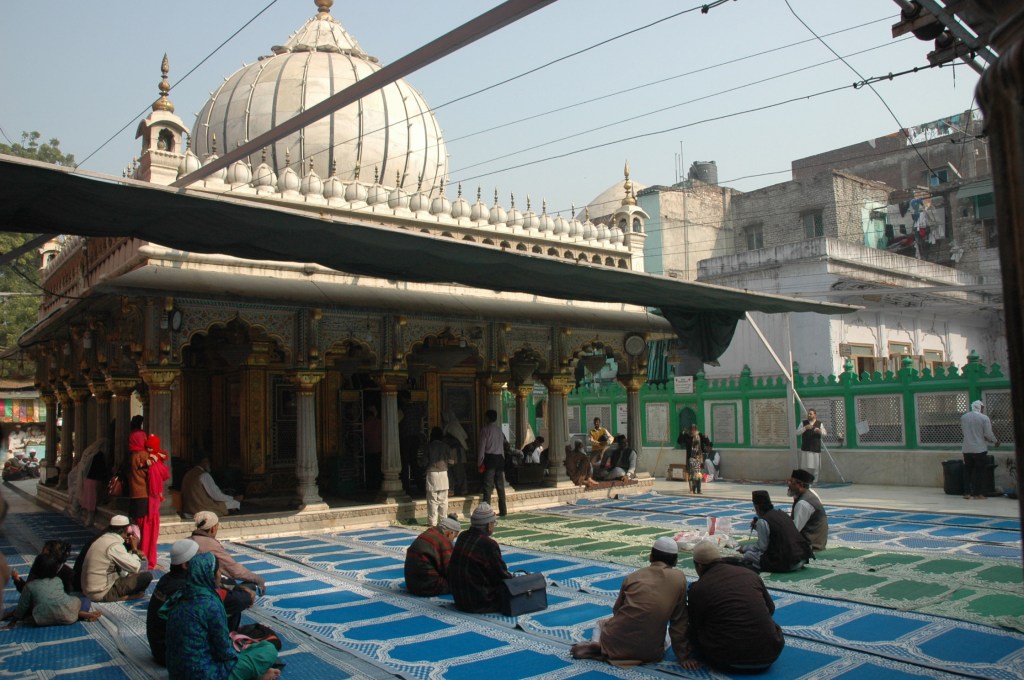
Molly, originally from Kerala, works as a local guide while completing her masters in Medieval Islamic history. Meeting her in south Delhi, we walk toward the Nizamuddin Gargh, the burial site of a 14th century Sufi saint. Approaching the Nizamaddin Gargh, we walk through narrow lanes, some only five-feet wide, filled with stalls where merchants sell flowers, textiles, and Korans.
Molly talks about Nizamuddin as we walk. Nizamadim was a Muslim Sufi-saint, a member of the Christie Sufi, who died in 1325. During his lifetime, like other Sufi saints, he mentored hundreds of other religiously seeking individuals. While holding onto the tenants of Islam, Nizamadim and other Sufi saints embraced both a more mystical Islam emphasizing each individual’s journey to God and a willingness to borrow local practices, even non-Muslim devotional practices.
His grave is a magnet for other Muslims, past and present. Along with approximately 70 others, Jehan Ara Begum, a daughter of Shah Jahan, is buried at the entrance. Interestingly, when a mausoleum was built as his anticipated burial site, he insisted that he not be buried in that extravagant structure. It became a small mosque instead. Because of this grave and shrine, members of the the Nizami family still live across from the Dargh.
I feel relaxed at this site. Unlike the thousands of people I remembered at the Jama Masjid in the old city, this site has maybe a hundred, most Muslims, but not all. Visitors bring flowers and place them at the marble screen shrine. Some listen to a man a man singing holy verses. I’m unsure whether the words come from the Koran or the Sufi saint’s writings. Others quietly sit, praying and reading.
The next day, Chavi shows me the Chandni Chowki area, Delhi’s old city. Taking the metro to Chandni Chowki, I’m so glad that I had her as my guide. On the one hand, people everywhere. Animals everywhere. Food stalls everywhere. Scooters, motorcycles, rickshaws, tuk-tuks, taxis, trucks everywhere! On the other hand, I don’t hear a single word of English spoken; I don’t’ initially see any signs in English. Regular chaos and pandemonium. Welcome to India!
She points out that there are five or six Jain Temples in this area. Although part of the family of Indian religions, the Jains developed differently than traditional Hinduism. Originating as early as the 9th-7th BCE, Jains attribute the religions beginning to 24 Tirthankaras or “ford-makers.” Rejecting any creator god, the Jains stress a rigorous ascetical and ethical approach to life in order to attain moksha. They are vegetarians; they reject any form of violence.
As we stand in front of one large Jain temple, she describes Delhi’s very long Jain history. Since the 12th century, Jains have not only lived in Delhi, but also have established some 165 temples. Particularly in the 1500s during the Mughal era, Jains emerged as important merchants and trading partners. Known for their honesty, they became wealthy as “financial brokers” for anybody, Hindus and Muslims.
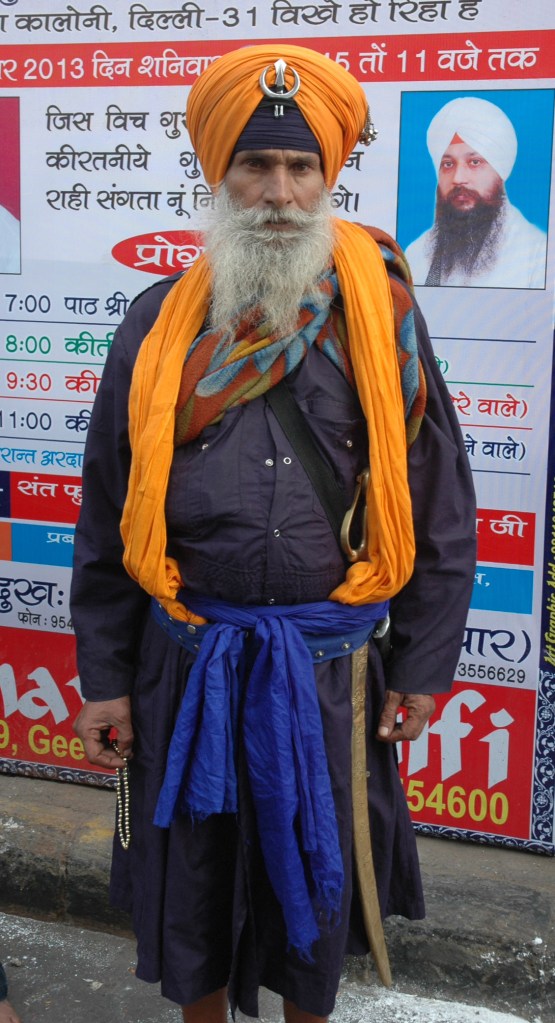
After the tour, I wander around the area. Noticing a number of Sikhs, I take their photos. While not able to understand the reason for their gathering, I read later that they were probably commemorating the birth anniversary of Guru Nanak Dev Ji, the founder of Sikhism.
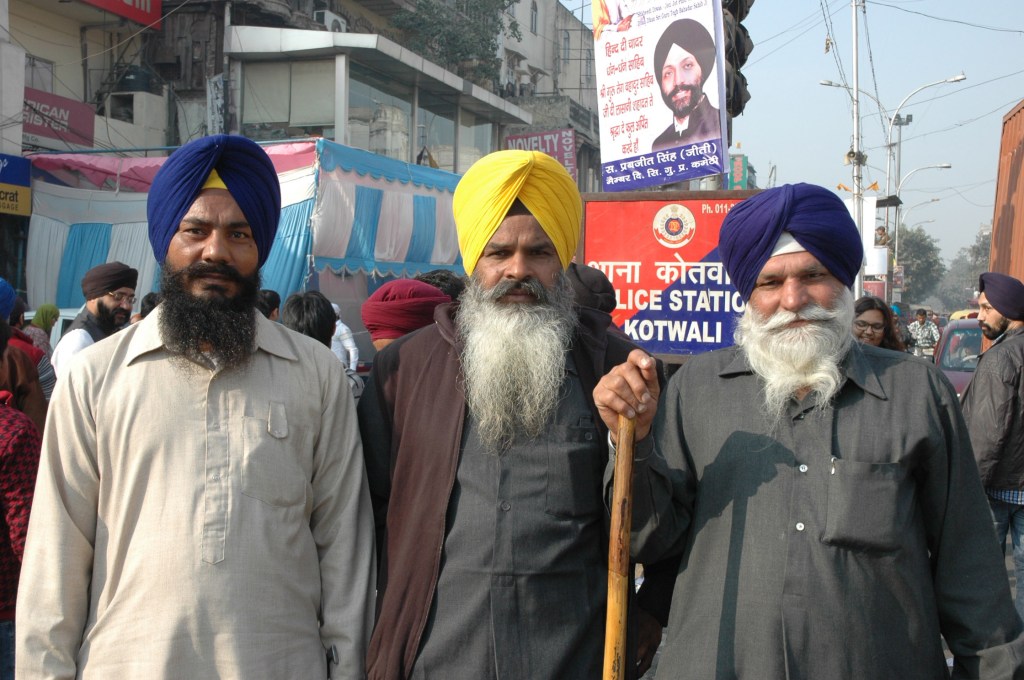
India is incredibly diverse religiously. Reflecting on my 1990 seminar, I saw India primarily through a Hindu lens. Erudite lecturers. Sensitive responders to our naive, and maybe harsh, questions. Yet, all the seminar participants were Hindu. No Sufi perspective. No Jain perspective. No Muslim perspective. No Sikh perspective. No Buddhist perspective. No Christian perspective. All Hindus, either trained in Western universities, or molding their scholarship after Western academic traditions. While I am deeply grateful for that 1990 experience, I know that the diversity of India extends beyond the diversity represented by the seminar!
 Journeys: Explorations in Body, Mind, and Spirit