
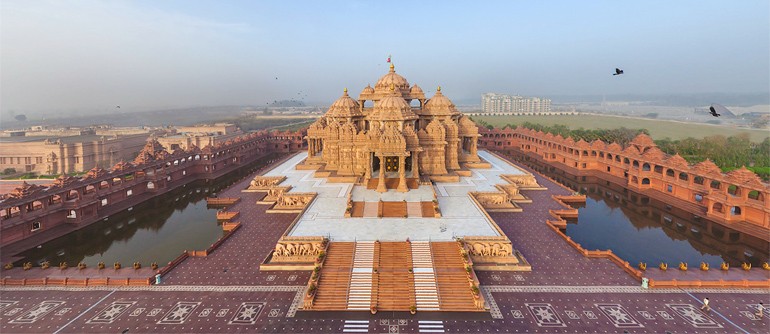
Delhi has numerous Hindu religious communities. After my 1990 conversation with Professor Raymond Williams, I become familiar with the modern Swaminarayan branch of Vaishnava Hinduism. While the headquarters is in Gujarat (western India), the Delhi Temple complex describes itself as “the largest Mandir in the world.” It might well be!
I reach the complex easily by the Delhi metro. Along with thousands of Indians and a decent number of Western visitors, I walk the short distance to the complex. Free admission to enter the Mandir; a hundred rupees to visit the exhibitions. Unfortunately, I notice the signs “No Cameras.” Since in 2013, I still did not own a cellphone, I had to deposit my camera and backpack with security. I admit that I’m suspicious: “Will my camera still be there when I finish?” (It was). I follow the crowds to the complex.
I have visited both Atlanta’s and London’s Swaminarayan Temples, I have some expectations. The Delhi Mandir dwarfs both of those temples. Constructed in 2005, this Delhi complex is described by some as “the Vatican of India.” The size of the property is over 100 acres. Like St. Peter’s Cathedral and its two arms, this complex has the central Mandir, which is flanked on either side by exhibition halls, a museum, a theater, a restaurant, and more. A large garden with water-features, and, interestingly, quotations from all sorts of authors. Hindu quotes I expected. Besides Swaminarayan notables, I read quotes from Emerson, C. Jung, George Washington, John D. Rockefeller, and others.
From the past come these words. Shakespeare “This above all: to thine own self be true, And it must follow, as the night the day, Thou canst not then be false to any man.” (From Hamlet, Act 1, Scene 3). Lincoln’s quote is “With malice toward none; with charity for all; with firmness in the right, as God gives us to see the right, let us strive on to finish the work we are in…” (From his Second Inaugural Address, 1865). From the more recent past, these words. Einstein’s quote is “”Science without religion is lame, religion without science is blind.”ML King’s quote reads “Make a career of humanity. Commit yourself to the noble struggle for equal rights. You will make a better person of yourself, a greater nation of your country, and a finer world to live in.”
I did not expect all of these figures to have quotes at this Hindu complex. However, from their perspective, these individuals illustrate that there is a oneness to ethical and religious teachings.
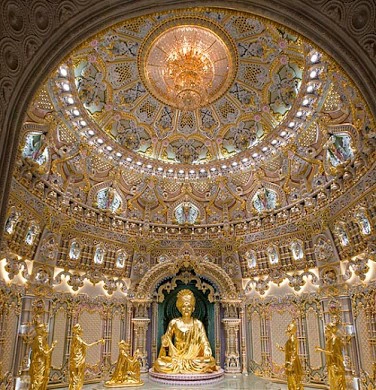
In the Mandir is a gigantic statue of Narayan. As one moves past the statue to the exhibition area, I learn about his life. Living from 1781-1830, the exhibits describe his astonishing Sanskrit masters at the age of eleven. After his parents die, he, as a young man, “circumambulated” India, walking for seven years to various religious sites. While in Gujarat in 1800, he meets disciples of Ramanand Swami and, shortly later, Ramanand Swami himself. Upon Ramanan Swami’s death, Narayan becomes the leader of this religious group. Because his own religious devotion centered around Krishna (an incarnation of Vishnu), some of his followers saw him as an incarnation of the supreme god, an incarnation of Krishna.
In my opinion, Narayan shows the influence of a more modern form of Hinduism. His social convictions certainly contrasted with many Hindus of his day. He criticized sati; he condemned the notion of untouchability; he stressed the importance of feeding the poor, sick, and elderly; he worked to expand education. However, before viewing him as a radical figure, we should note that women were still excluded from certain temple areas, and that devotees should not listen to women’s teachers. So much for gender equality. Similarly, while he helped the “untouchables”, these individuals could not be full members of the religious community.
To use a common expression, I have to confess that the temple complex is almost a “religious Disneyland.” However, knowing the dedication of the founder and their efforts to improve life for many, I temper that judgment.

