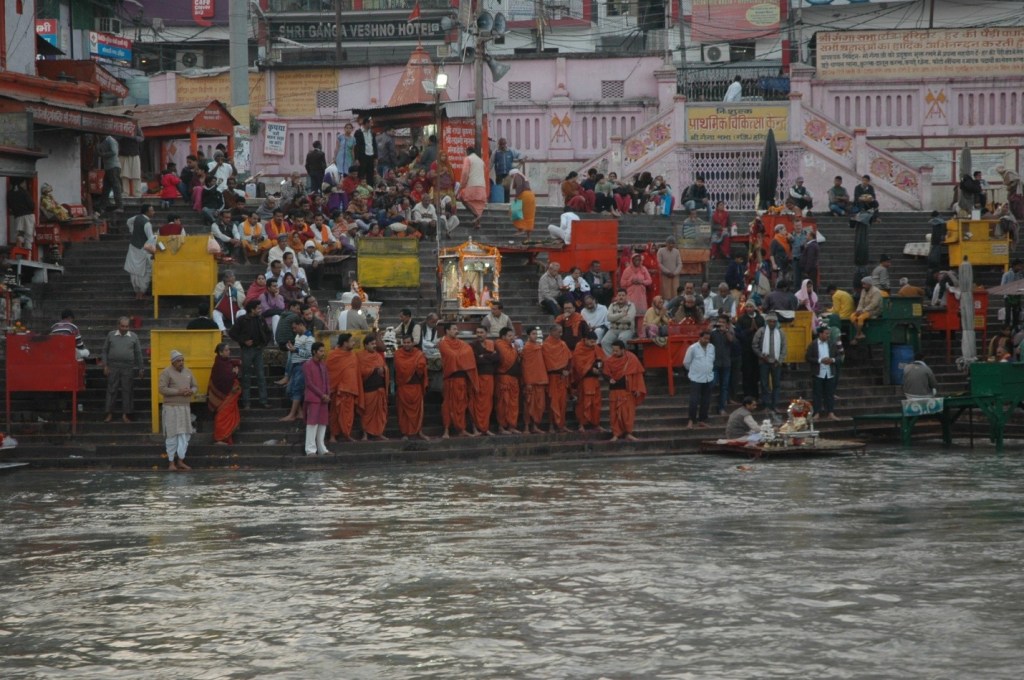
What does one do at night in Haridwar? Of course, go to the Har Ki Pauri Aarti sunset ceremony! So, along with hundreds of others, I move toward the Ganga riverbanks.
A word about Haridwar. Haridwar is important for a number of reasons. Approximately 130 miles north of Delhi, Gwami (sp?) drives me from Delhi to Haridwar, stopping to pay a tax upon leaving Delhi before the fairly easy drive to Haridwar. In Haridwar, the 1500-mile Ganga River leaves the southernmore foothills of the Himalayas as it enters the north Indian plains.
To use Diane Eck’s book title India: A Sacred Geography, Haridwar is important because of its “sacred geography.” As is true of so many places, “sacred geography” often derives from ancient Hindu texts. Regarding Haridwar, there are several Puranic stories. Since the expression “Har Ki Pauri” means “the feet of Vishnu”, the expression originates in the notion that Vishnu personally visited Haridwar.
In other stories, Garuda, Vishnu’s’ giant, eagle- like bird, is flying after the primeval churning of the ocean of milk to the serpents. He is offering them amrita, a magical potion offering immortality in order that they might free Garuda’s mother. As Garuda flies over Haridwar, he accidentally spills drops of the amrita. Oops!! However, Vishnu says to Garuda “Thousands of man’s sins get destroyed by the holy sight of the Ganges, and he becomes pure by the touch of the water of Ganges, by consuming it, or just by pronouncing ‘Ganga – Ganga.’”
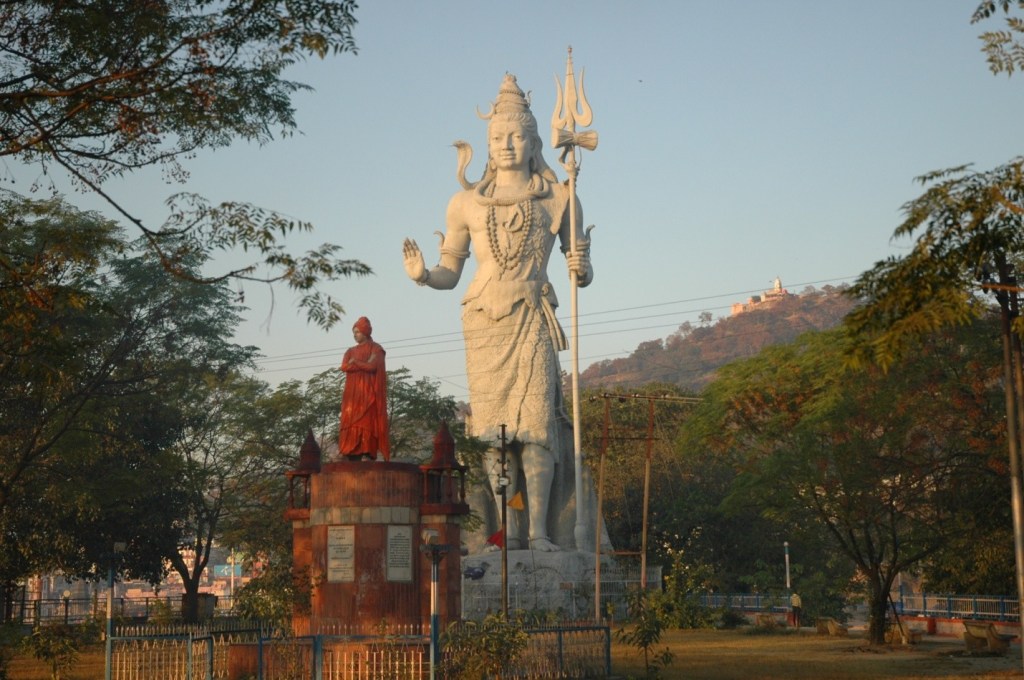
Besides stories associated with Vishnu, stories of Shiva are associated with Haridwar. When a king wants the divine Ganga River to help in his ancestors’ salvation, the Ganga pours from the heavens onto the earth; however, the force of the river threatens to destroy the world. Shiva steps in and allows the river to strike him first, absorbing the Ganga in his matted hair; thus, Shiva, by preventing the world’s destruction, is also known as the “”the holder or bearer of the Ganga.” It is no accident that the largest statue of Shiva that I’ve seen is here at Haridwar!
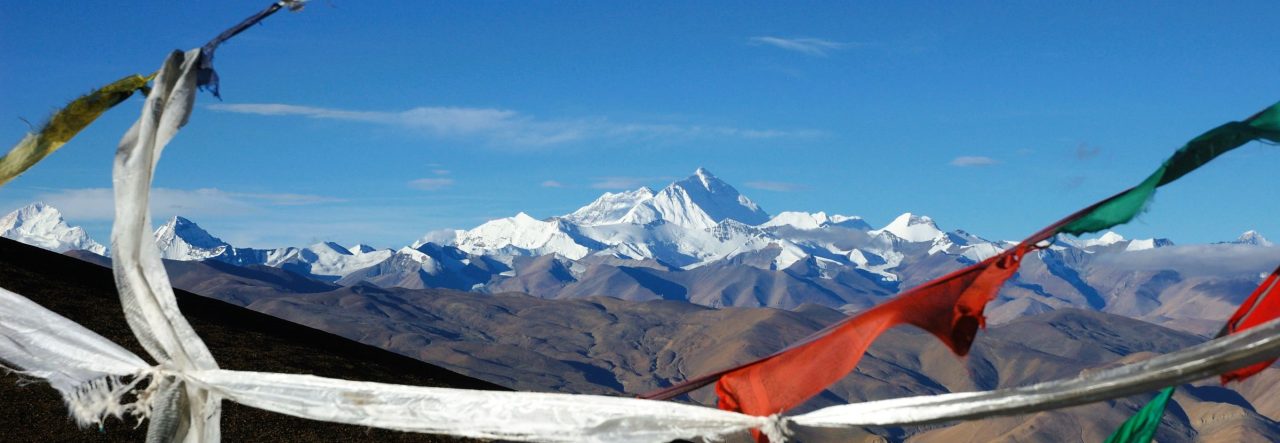
Whether the stories of Vishnu or the stories of Shiva, Haridwar becomes a key location in Hindu’s “sacred geography.” For Vaishnavites, pilgrims gather here every twelve years, Hindu pilgrims gather here for the Kumbha Mela, and every six years for the Ardh Kumbh Mela. For Shaivites, pilgrims start in Haridwar their journey to Mount Kailash, the home of Shiva.
On the first night, Chandra leads me to the aarti. The actual ceremony is a ceremony of fire, music, chanting, and lighting of small candles placed on leaves. As the leaves and candles drift down the Ganga River, the individual’s hopes and wishes rides on the water. To help facilitate the individuals, several individuals move through the crowds, giving people slips of paper upon which they write, and receiving money in return.
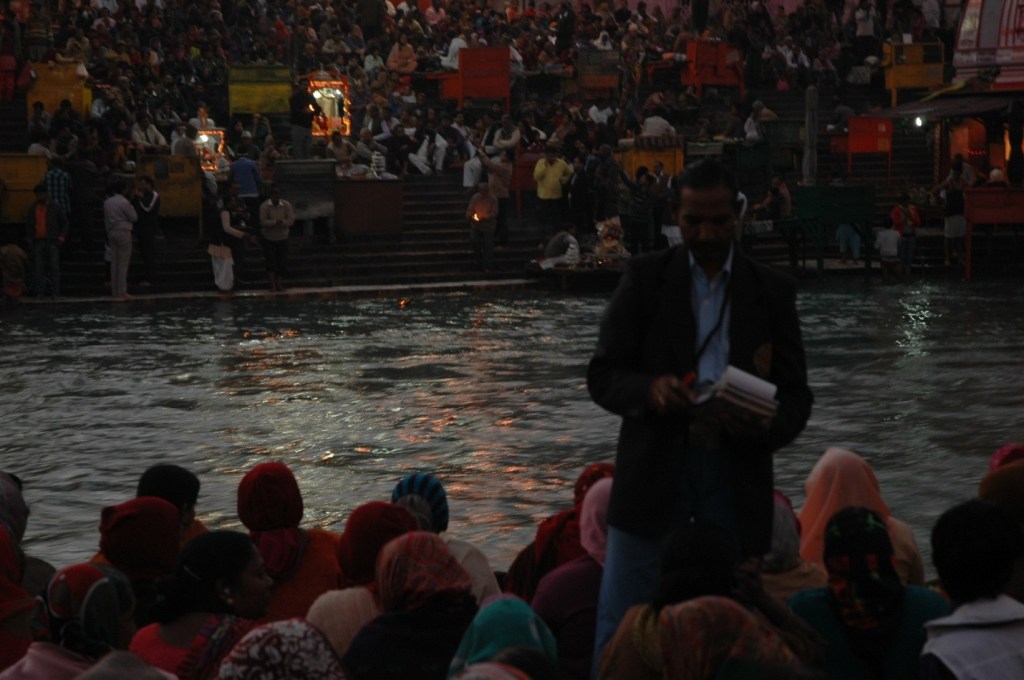
On my second night I attend the aarti alone. As one of these individuals approaches me, he asks rather aggressively, “Rupees?” No. “Don’t you want prayers to be given to the Ganga?” No. “Don’t you want to make a donation for the poor?” No. Sensing that I wasn’t giving in, he moved to another part of the crowd. Part of my cynicism emerges when I liken this to be moving through crowds collecting bets. Almost like betting at the Kentucky Derby or other races.
Despite my second night encounter, I marvel at how we attach importance to a place, and then adjust our behavior accordingly. These individuals in Haridwar aren’t alone in doing so!
 Journeys: Explorations in Body, Mind, and Spirit