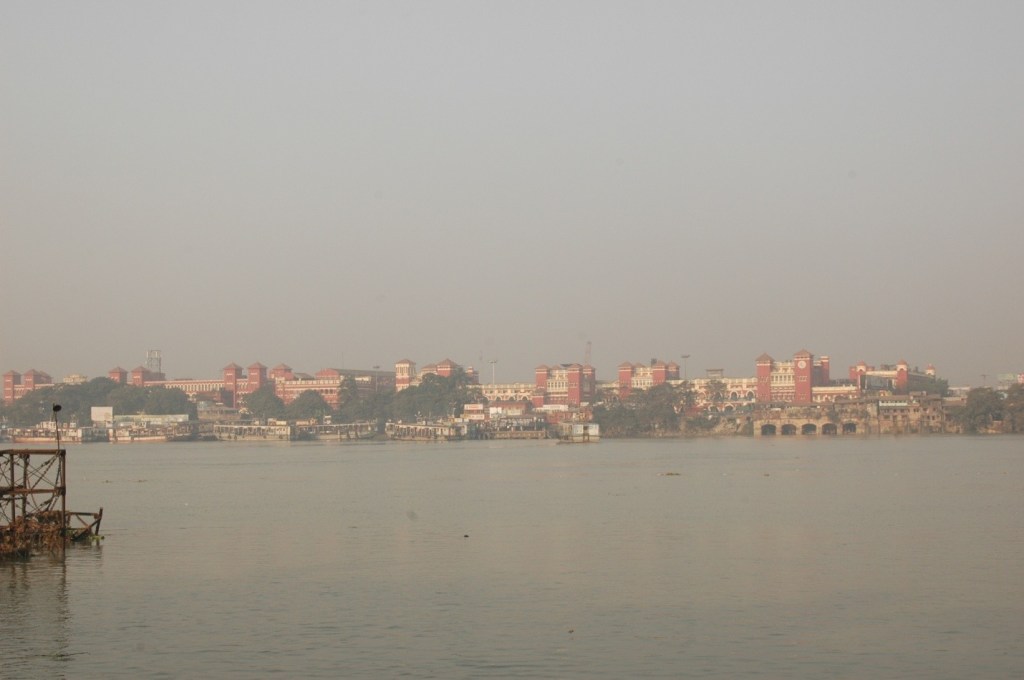
My 1990 visit to Kolkata occurs during a monsoon. Carl and I had to almost swim to get from one place to another. Not a great time to get around! This visit, no monsoon! As I want to see and learn about Kolkata, I figure what better way than with a tour!
Rikwick is my guide. Unlike my journal notes about other guides, I don’t have biographical notes about Rikwick. Given his passion to correct common Kolkata stereotypes, I guess that I shouldn’t be surprised. If the common Kolkata stereotype is that it is only an ugly, impoverished, soulless city where individuals only think about survival, then that the view of the city is not true. Rikwick’s underlying message is: “Don’t accept the usual stereotypes of Kolkata!”
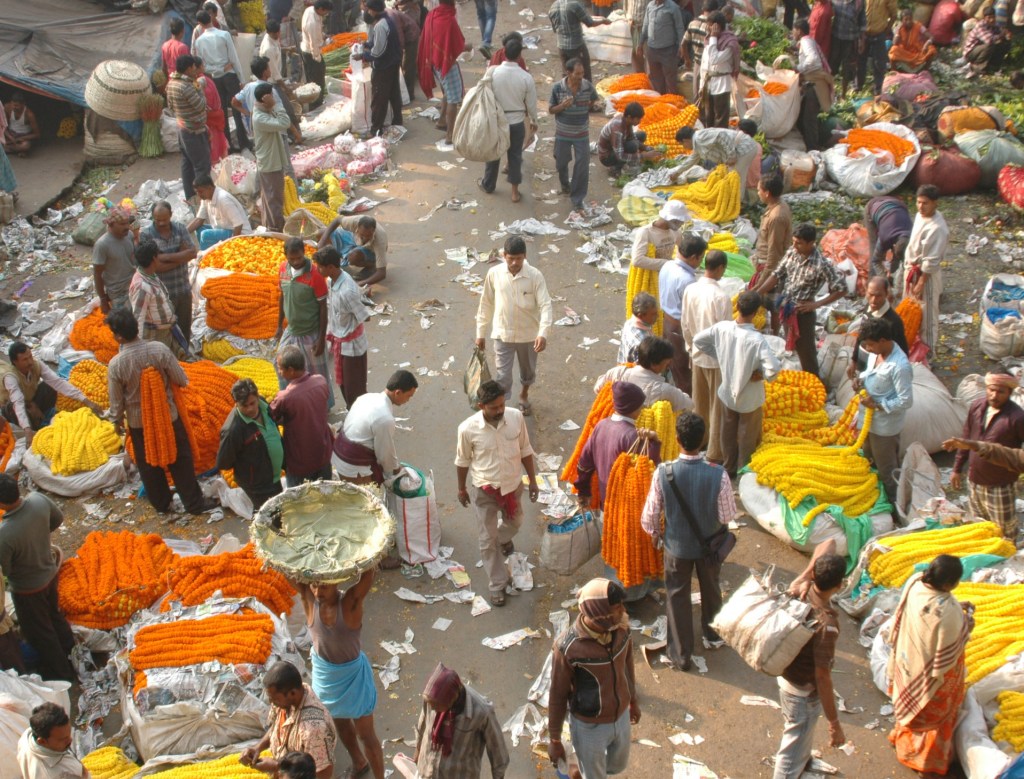
Kolkata is only an ugly city. Not true. Rikwick takes me to the “Flower Market.” Transported from the surrounding countryside, I see colorful flowers I recognize, the marigolds, gladiolas, chrysanthemums, roses, and all sorts of flowers that I don’t recognize.
Kolkata is a “soulless” city. Not true. We drive north along the Hooghly River to Belur Math. Belur Math is the headquarters for the Ramakrishna Mission founded by Vivekananda in 1898. As I walk around the large complex, Ritwick and I talk with several monks. One monk is translating Vivekananda’s writings into English. He is well-qualified. He is from the USA, and his mother lives thirty-miles from me in Marietta, Georgia!
Another monk and I have a more religious-philosophical discussion. Eager to distinguish the perspective of Ramakrishna from broader Hinduism. In his opinion, orthodox Hinduism so emphasizes Brahman that “Maya”, the “world of appearances”, our world, is neglected. To correct this deficiency, Ramakrishna recognizes that “the world of appearances” is “our world. “Don’t neglect it.” With this insistence, Ramakrishna wanted his followers to reform and improve the world around them. Another example of Hinduism changing in modern times.
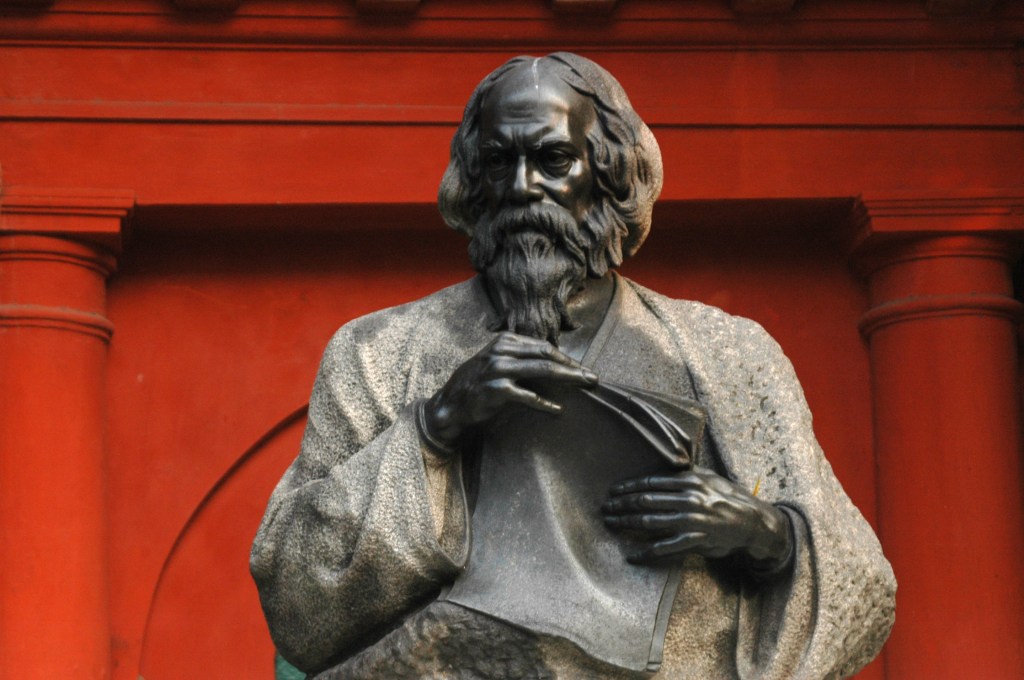
Kolkata is a city where people only think about survival. Not true. When we return to Kolkata, we stop for coffee in Albert Hall, a coffee shop for students. Drinking my best cup of Indian coffee, Ritwick talks about another famous, native-son of Kolkata, R. Tagore. In 1913 R. Tagore becomes the first Indian, and the first Asian, to win a Nobel Prize. His Nobel Prize is in Literature. Since then, three other native Bengalis, and one “adopted” Bengali (Mother Teresa), have received a Nobel Prize. All four have associations with Kolkata.
Watch out for stereotypes.
 Journeys: Explorations in Body, Mind, and Spirit