A question: who is Anjezë Gonxhe Bojaxhiu? Here is another clue: she is born on August 26, 1910. If you guess Mother Teresa, then you are correct.
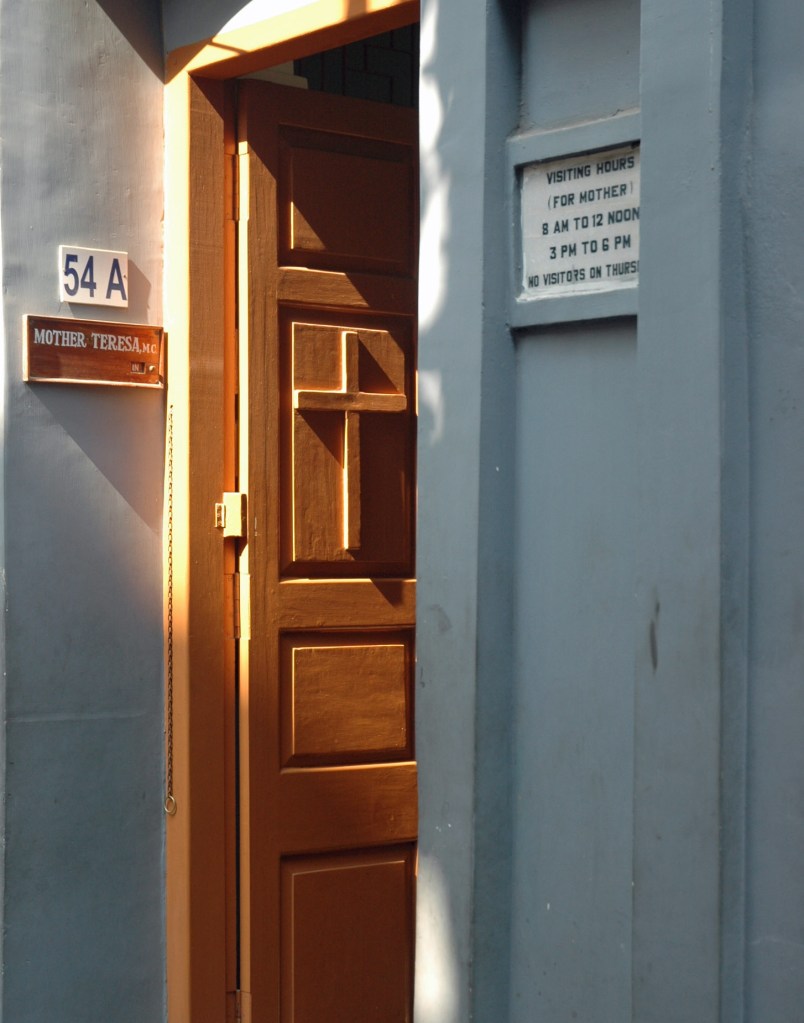
Although I have visited Mother Teresa’s Mother House, and talked with her briefly, I want to return to the “Mother House.”
A few brief notes about her life. She is raised in a devout Albanian Catholic family. At the age of 18, she joins the Sisters of Loreto and moves to Ireland. In 1929, she begins her work in India. At first, she teaches at a Darjeeling school where she also learned Bengali. From Darjeeling, she moves almost 400 miles to Kolkata. She both teaches and is the headmistress for the Loretto school in Kolkata.
After several years in Kolkata, she receives a “call within a call.” Disturbed by the conditions around Kolkata in general, and by the 1943 Bengali famine in particular, she feels called to do something more. With the Vatican approval, Mother Teresa establishes the Missionaries of Charity in 1950. Originally, this religious order serves “the poorest of the poor” in Kolkata; currently, the order has expanded globally to over 130 countries. Alongside other Reinhardt staff and students on a mission-trip, I work with the Missionaries of Charity sisters in Warsaw.
In many ways, she is a conservative, orthodox Roman Catholic. Using her position, she speaks against divorce, contraception, and abortion. When I meet her in 1990, she has recovered from a 1989 heart attack. Despite that heart attack, she returns to working with Kolkata’s needy. From her death on September 5, 1997, many people believed that she would be beatified and canonized quickly. On September 4, 2016, Mother Teresa of Calcutta became Saint Teresa.
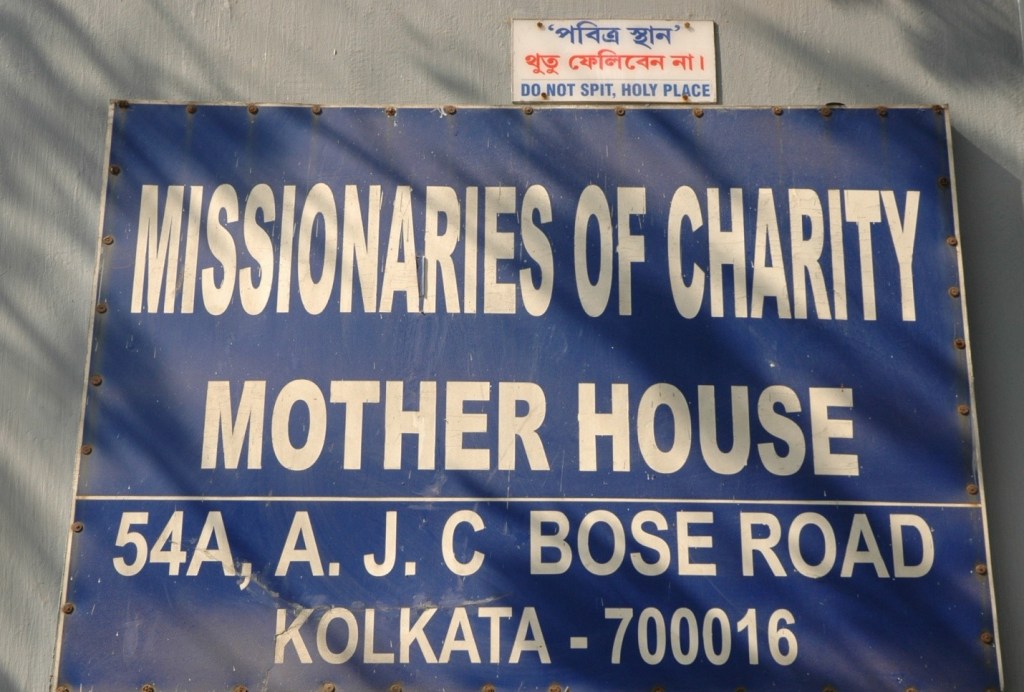
The Mother House is not an imposing structure. Before entering the building, I am surprised by a sign “Do not remove shoes.” As a sister welcomes me, she sees that I’m reading the sign, “Unfortunately, people who left their shoes outside have had their shoes stolen.” After entering and pausing in a large open area, I am shown to the right. Underneath a large concrete tomb, Mother Teresa is buried.
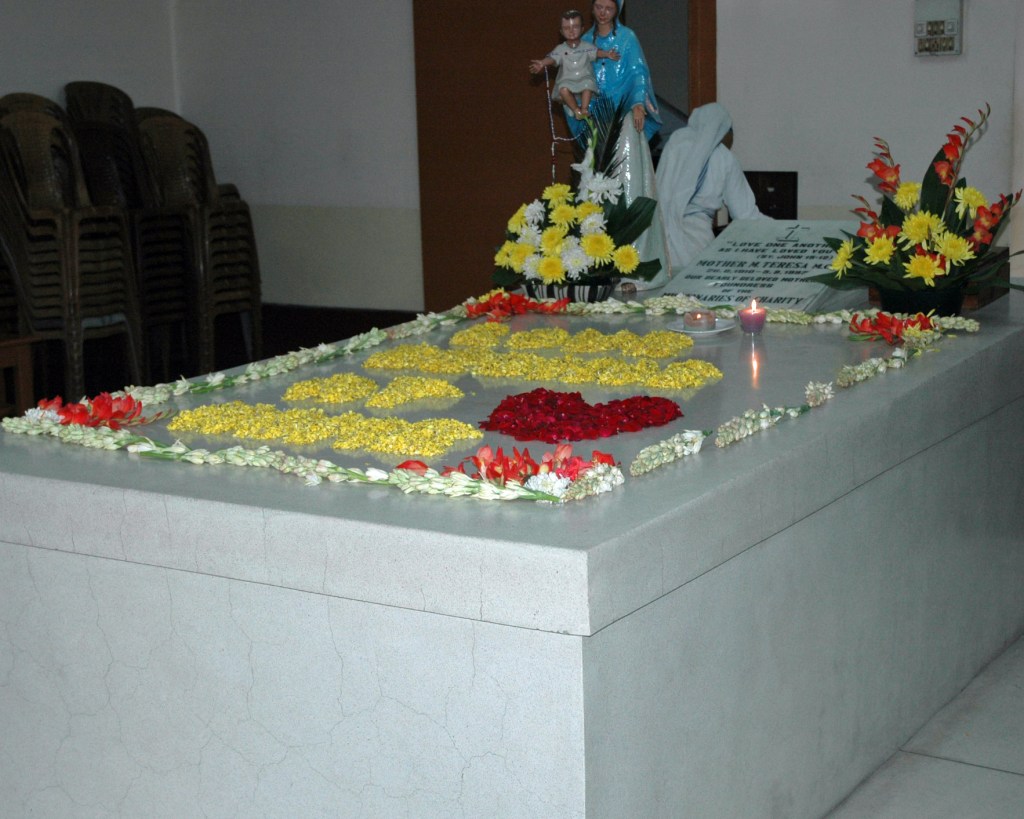
Like everyone else who enters that space, I pause and offer my own prayer.
Moving to another room, I view a variety of photos, letters, news articles about her life. Besides all the expected photos and information depicting her life, her family, her early life as a nun, her bending over a man on the streets of Kolkata, her laughing with children, her speaking to Pope John Paul II, I notice an object tucked away in the corner of a display case. It is her 1979 Nobel Certificate “”for work undertaken in the struggle to overcome poverty and distress, which also constitutes a threat to peace.” Acknowledged, but not highlighted!
Since my visit, I’m aware of reaction to her life as well as the disclosure of her own “dark nights.” Although we might assume that she is universally commended for her work, we are wrong. Some people criticize her work. As she sought to help Kolkata’s poor and dying, her work shows an ugly side of Kolkata. For some people, her work resulted in an unintended consequence. This “ugly side” of Kolkata became their only image of Kolkata.
Another erroneous view is that as a saint, Mother Teresa never had doubts. People assume that in her providing guidance and inspiration to others, she never faced difficulties. Again, not so. In her 2007 private letters published, there are several passages. In a 1955 letter to her spiritual advisor, she wrote “Such deep longing for God–and … repulsed–empty–no faith–no love–no zeal. –Heaven means nothing–pray for me please that I keep smiling at Him in spite of everything.” Later, she wrote, “In my heart, there is no faith. I want God with all the powers of my soul, and yet between us there is terrible separation.” A hypocrite for having such doubts? Not in my opinion and the opinion of many others. Mother Teresa displays honesty about herself, honesty about her life of faith. For her, God is big enough to handle her moments of darkness and doubt; God is compassionate enough to handle those moments of being human.
 Journeys: Explorations in Body, Mind, and Spirit