If a person has no familiarity with India, then that person might be surprised at the range of Christian communities in south India.
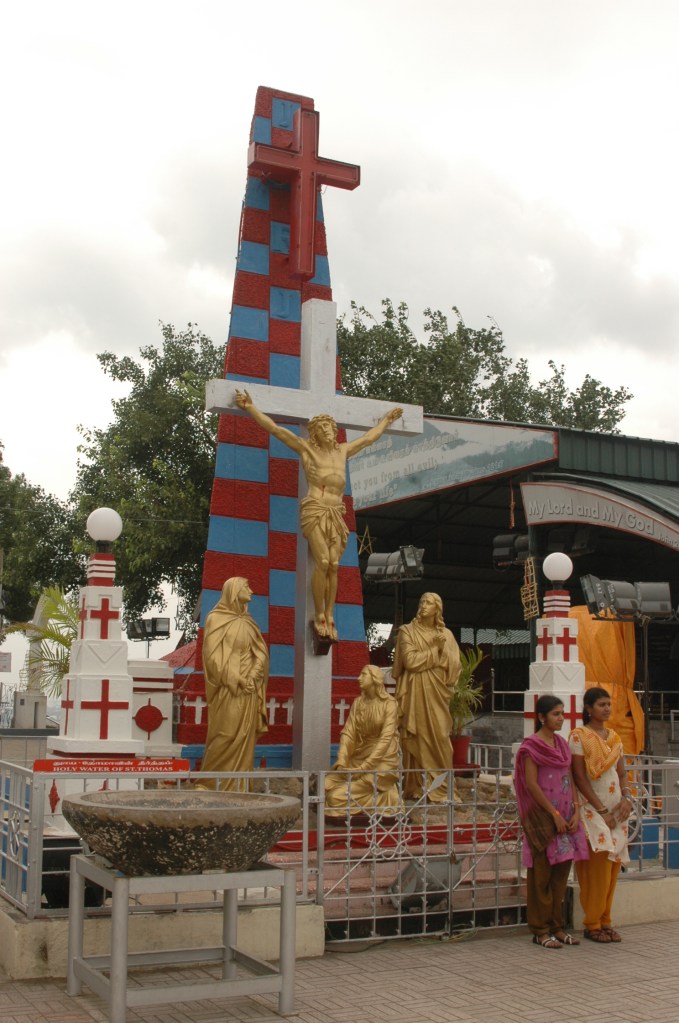
One morning, Annamalai drives me to St. Thomas Christian sites. Here is a quiz: How many, and where, do some Christians believe the Apostles’ relics exist? The answer is three. The sites are St. Peter’s in Rome (Peter), Santiago de Compostela (James the elder), and Chennai, India (Thomas). Legend has it that Thomas traveled to India. After evangelizing, he was murdered by Hindus outside Chennai.
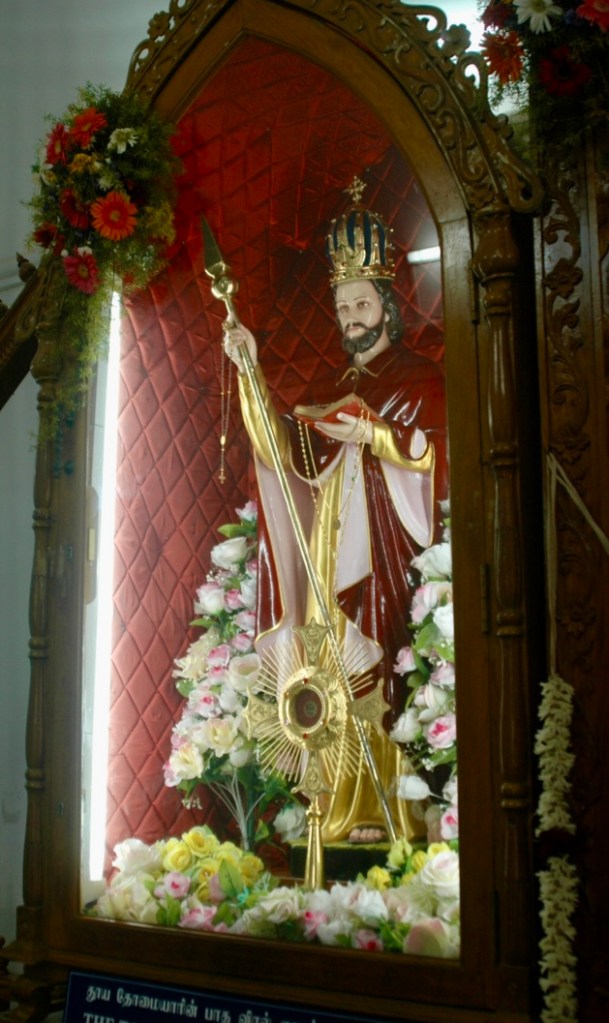
On a small “mount”, there is a church, a tomb, and a room for his relics. Besides his relics, there are legendary relics from another one hundred saints, relics from Bethlehem, and relics from Jerusalem’s Golgotha. As I learned on my long-distance European walks, some Roman Catholics may attribute a power to these relics as as they function as a “doorway” into the sacred. The relic allows a concentrated gaze into a specific story behind that relic, and into the broader Christian story, in a way that pure reading a story may not. Certainly, family resemblances to a basic view held by many Hindus!
A few words about Christian history in India. Historically, a separate St Thomas church influenced by Syriac Christianity, takes shape in India. At times, this church uses both eastern and western liturgical traditions. Two years after Vasco da Gama reaches the Indian coast in 1498, Pedro Álvares Cabral arrives with the first group of Franciscan priests and chaplains. They introduce a different form of Christianity, Roman Catholicism.When the Roman Catholic Portuguese consolidate their presence at Goa, the St Thomas tradition fragments. Some in the Thomas tradition align with Catholicism; some within the Thomas tradition remain a separate Orthodox tradition. A footnote: Although there is an Atlanta St Thomas church, I could never make connection with the priest to discover their particular tradition. A mystery remains.
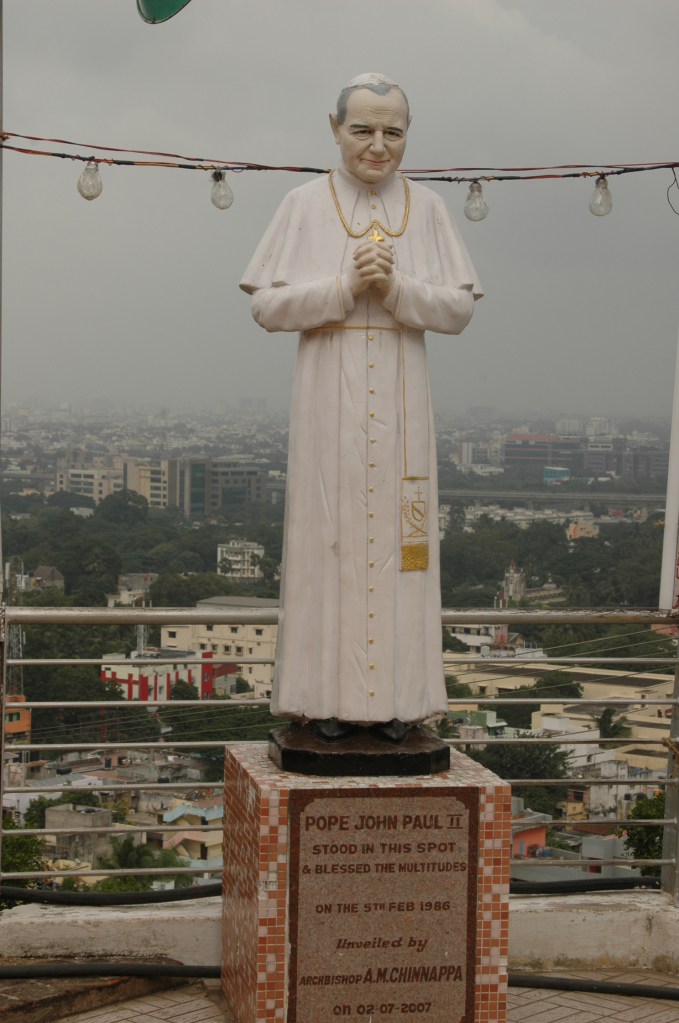
In time, the Roman Catholic Portuguese took control over this specific site. Even when it became part of the British Raj, the site remains Roman Catholic. In 1986, Pope John Paul II and Mother Teresa visit the site. Interesting!
I visit other locations in South India. One church that I visit is Christ Church in Tanjore. I feel as though I could be in London attending a Church of England service. The formers of this church certainly wanted to be reminded of home. Well, maybe not quite the same!
My most interesting stop is at Bede Griffith’s ashram. More about that in my next blog.

