To repeat myself from the previous blog. What does one do in Tamil Nadu? One visits temples! Not just me. I see young individuals, middle age individuals, and elderly individuals. I see single people, family groups, and large pilgrim groups. I see them early in the morning, midday, and late afternoon. I’m also sure that some visit at night.
From Tanjore, Annamalai drives me to a number of temples. I don’t know who is more excited, Annamalai or me! Although we stop at other small temples, I find the Ranganathaswamy Temple in Tiruchchirappalli (known less formally as Trichy) and the Meenakshi Temple in Madurai especially wonderful. We drive further south to the Ramanathaswamy Temple on the southern Bay of Bengal, and, eventually, returning to Chennai, we visit the Varadharaja Perumal Temple in Kanchipuram as we return to Chennai.
Questions run through my head. Who are these people? What do they do at the temples? Why are they here? Unavoidably using my own experiences of Protestant and Roman Catholic Christianity, I begin responding to my own questions. Gathering at a church, people from all ages are both welcome and present. However, except for the family visitors from out-of-town, most worshipers are local. No so at these temples. My guide tells me, and I can see from numerous pilgrim tour buses, that many people come from a distance. In probably every temple that I visit, there are pilgrims and pilgrims and pilgrims.
What do they do at the temple? Using my Christian perspective, I see them worshipping as traditional Vishnu or Shiva devotees. Okay, but rather superficial. I can confirm what Harold Coward asserts in his Mantra: Hearing the Divine in India, “unlike the Western practice of unified congregational activity, Hindu temple worship is an individual affair (24).” A person’s actions are public; the actions are social in that others may be engaged in the same silence before an image and making the same offerings. However, there is not as much social coordination. Individuals move around the temple at their own pace; individuals stop in front of certain shrines and not others. For Christians, worship is more of a “performative drama.” For traditional Hindus, worship is more like an individual painter and easel, sitting with a dozen of other painters and their easels. Yet, that painter paints in her own way and at her own pace as the other painters paint in their own way and at their own pace.
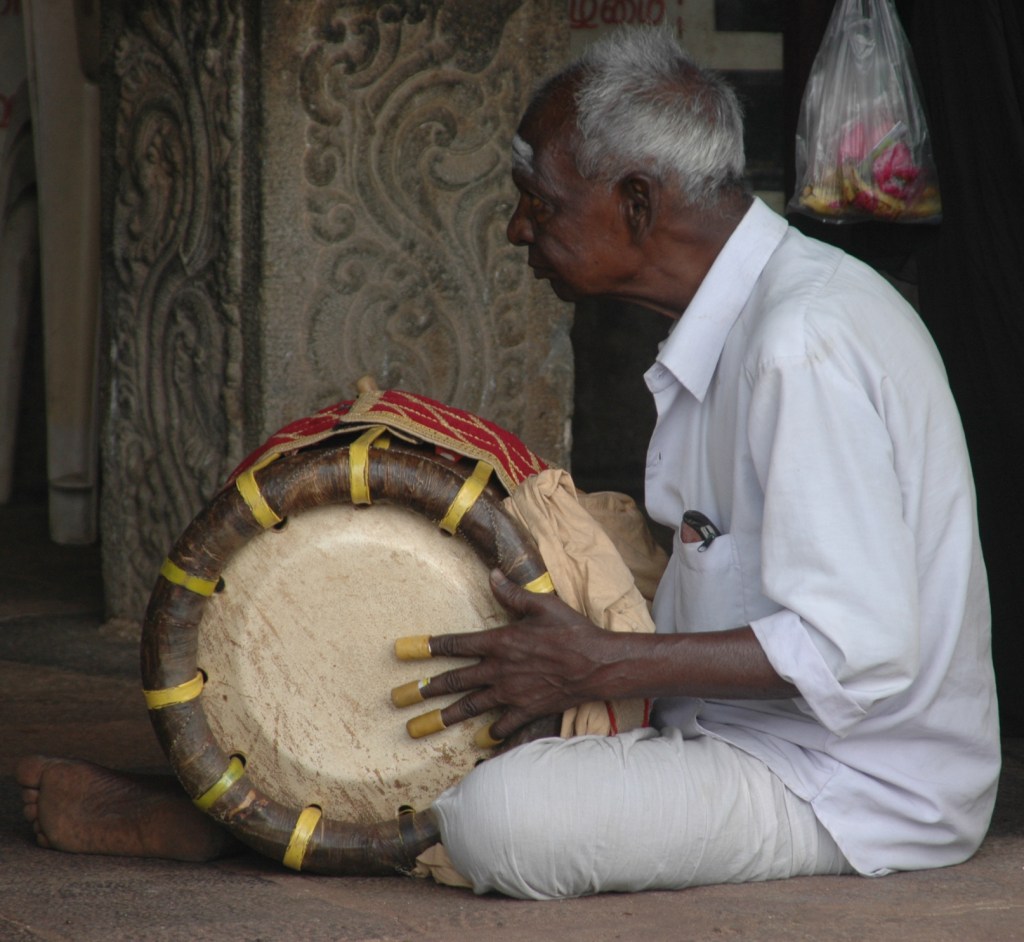
Why do individuals go to the temples? Pilgrims come to temples drawn by the opportunity for darshan, being “seen” by the deity, and for the sacred sounds. Obviously, I only see a few of the sacred images and statues of Vishnu, Shiva, Durga, and so many others, that pilgrims see. While a pilgrim sees these sacred images and statues, the pilgrim hopes to be seen by the deity. By being seen in this particular sacred space, the pilgrim senses their participation in that much larger sacred. Also, with sound. From a low murmuring to a louder chanting of Vedic texts, the pilgrim is constantly surrounded by sound. In some temples, I even saw a drummer. While the particular sounds may or may not be distinguishable, the pilgrim hopes that these sounds are part of the more primaeval origin of all sound “Om.”
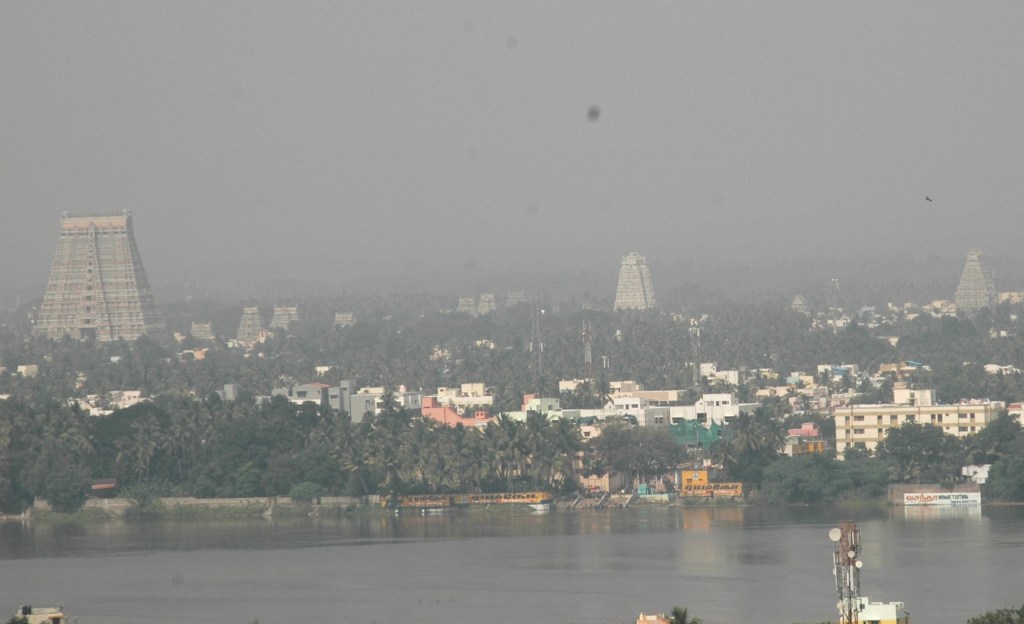
When I visit the Ranganathaswamy Temple, I’m struck by the size and complexity of the temple grounds. I’m able initially to view the size of the complex from across the river. My guide asserts that both that this temple is the largest temple in India and the one with the longest continuous life as a Hindu temple since the 8th century. Over 150 acres! Maybe, maybe not true! While definitely a large and old temple, I also know that guides are prone to exaggerate!
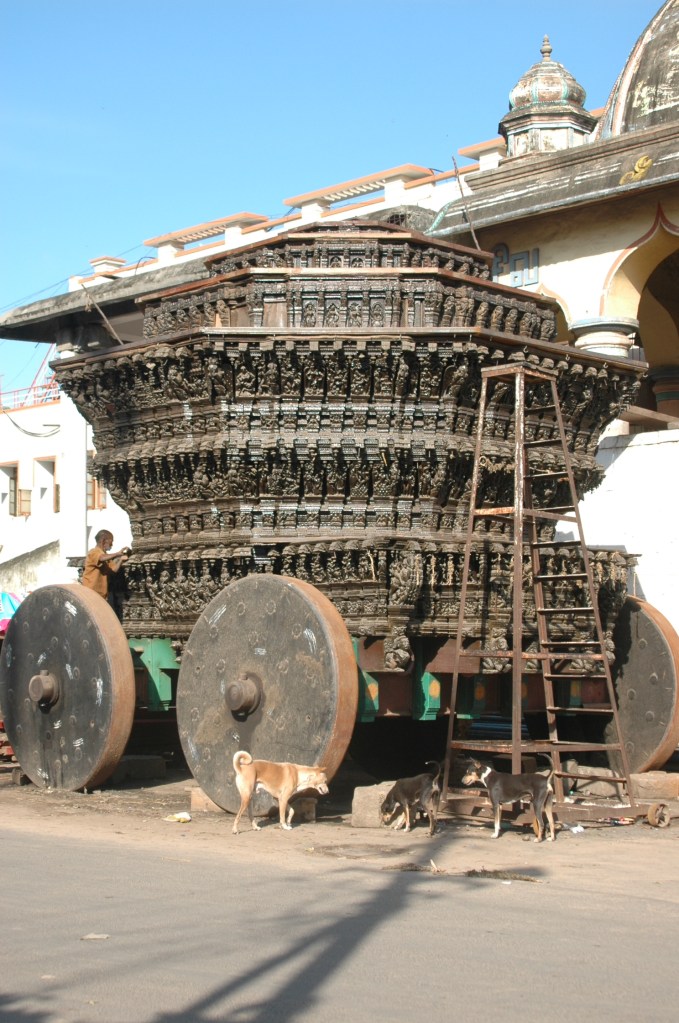
As I approach the temple area, the 17 major entrance towers appear like skyscrapers in downtown Atlanta. I see a festival cart at the entrance of a gateway.
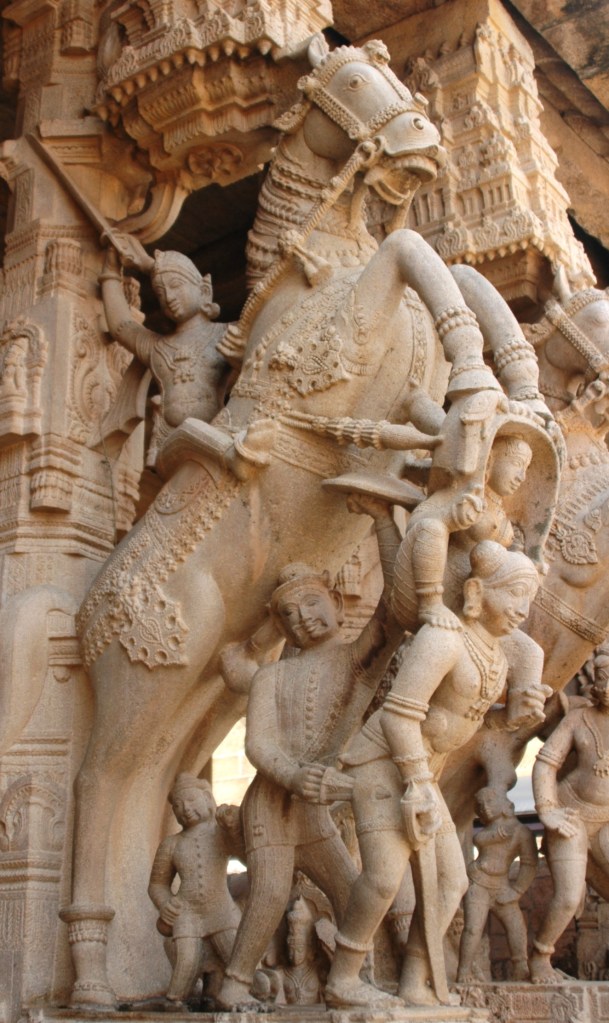
So much to see. Pavilions, shrines, long corridors, and numerous sacred pools. Within this area, the visitor walks through seven enclosures, each one smaller than the previous enclosure. Needless to say, I walk only a small part of the complex. Along one side of a hall, dozens of animals, usually rearing horses, with riders have been carved.
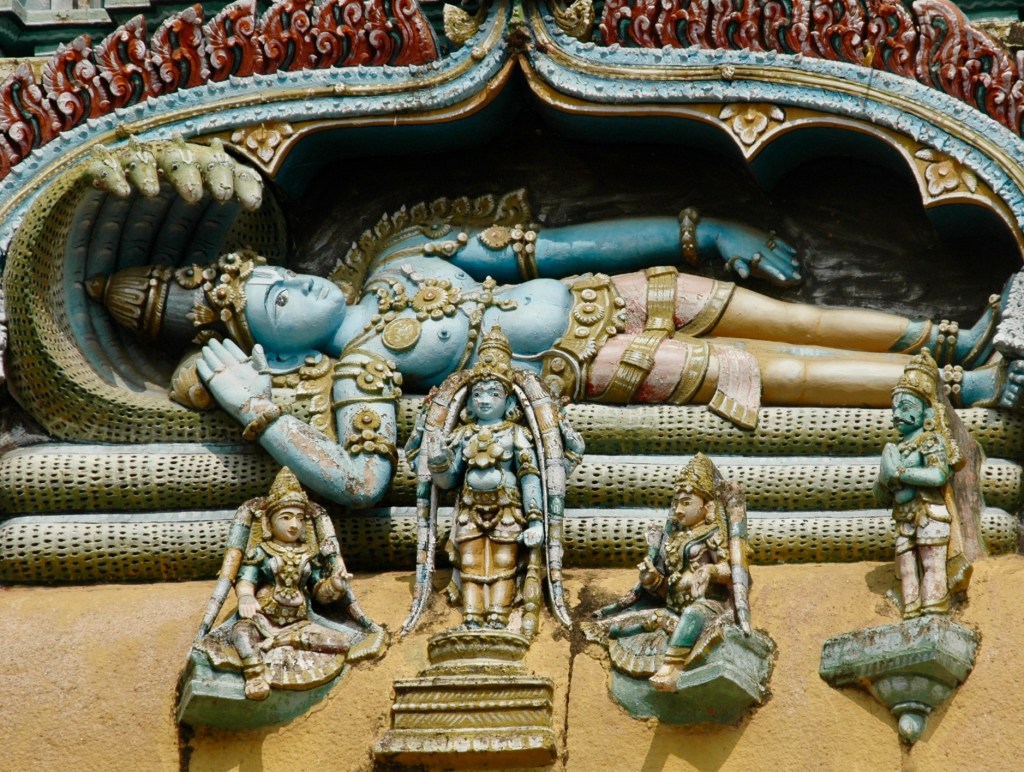
This temple is unusual. While Shiva is the main deity in most southern India temples, this temple’s main deity is Vishnu. I’m even more confused because Hindus consider this temple throughout all of India to be the foremost and primary of the “Divya Desams,” or “108 Beloved Places” devoted to Vishnu. Because of this Vishnu focus, I see Vishnu’s avatars. I see his identity portrayed in the great epics and classical literature. The temple is also unusual because of actual historical figures. The famed, medieval philosopher, and Vishnu-devotee, Ramanuja is claimed to have lived here, and saints of the Tamil Bhakti devotional movement sang and danced here. Once again, individuals come to this temple because of the legends and famous historical figures marking and making this temple sacred.
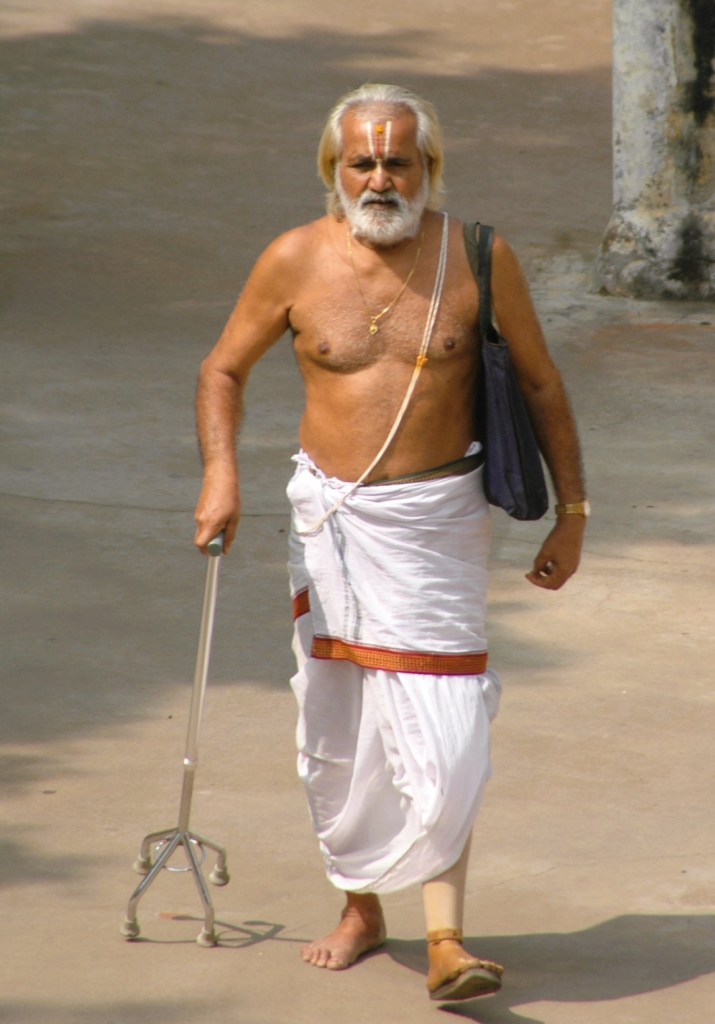
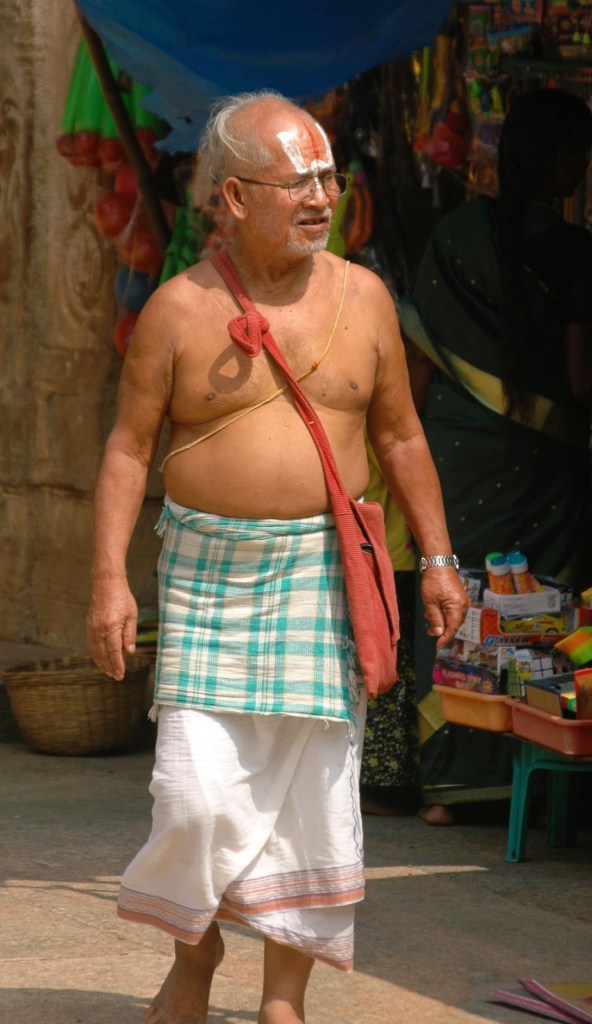
As I wander around the temple, I’m one of several hundred devotees. A number of them have the forehead marking of a Vishnu devotee. Some stop in front of the sculptures; some stop in front of the shrines; some walk more purposefully toward the inner sanctum; some seem to wander. Besides individuals, I see families and pilgrim groups. With the exception of only one or two other temples, I’m surrounded by more Hindu pilgrims than anywhere else on my temple visits.
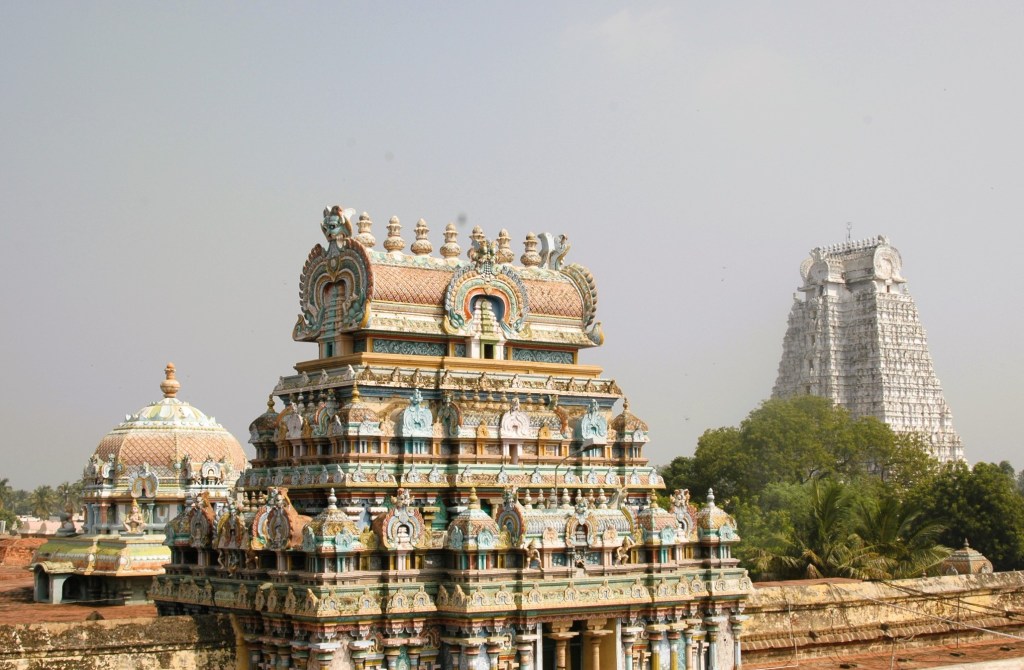
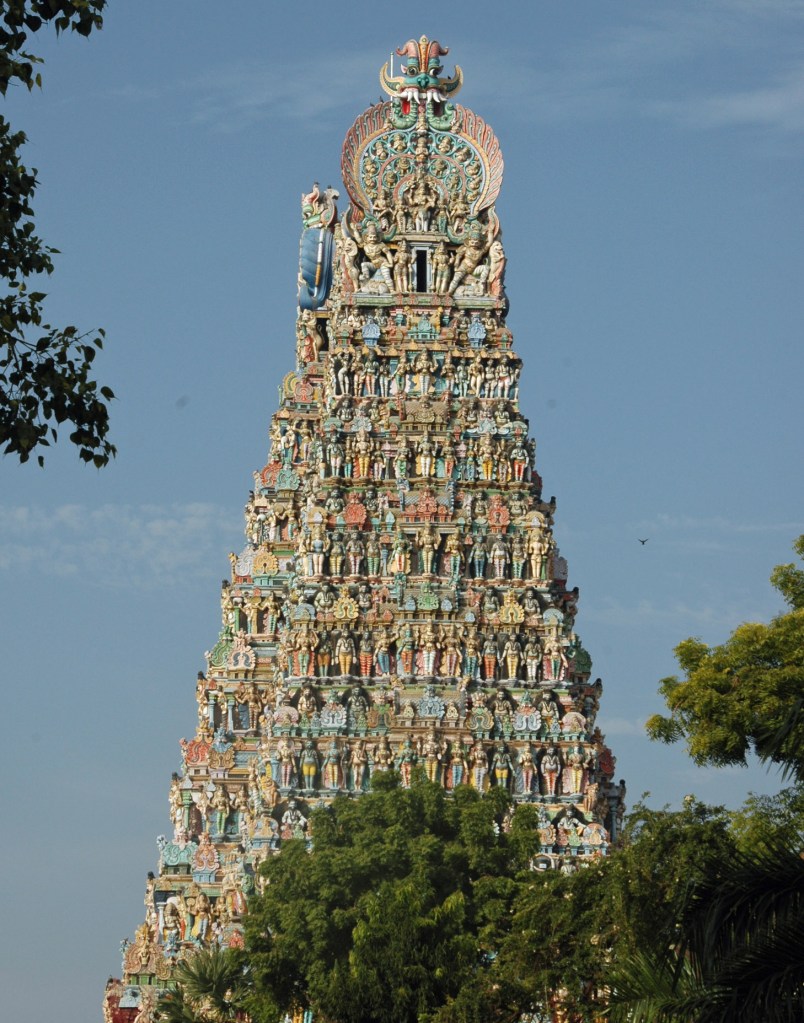
Driving to Madurai, I revisit one of the temple highlights from 1990, the Meenakshi Temple. I still see the brightly covered entrance towers. With innumerable figures (1,500 or so on the largest tower), I’m struck simply by color upon color upon color. I learn that the towers are repaired and repainted every twelve years. Nice!

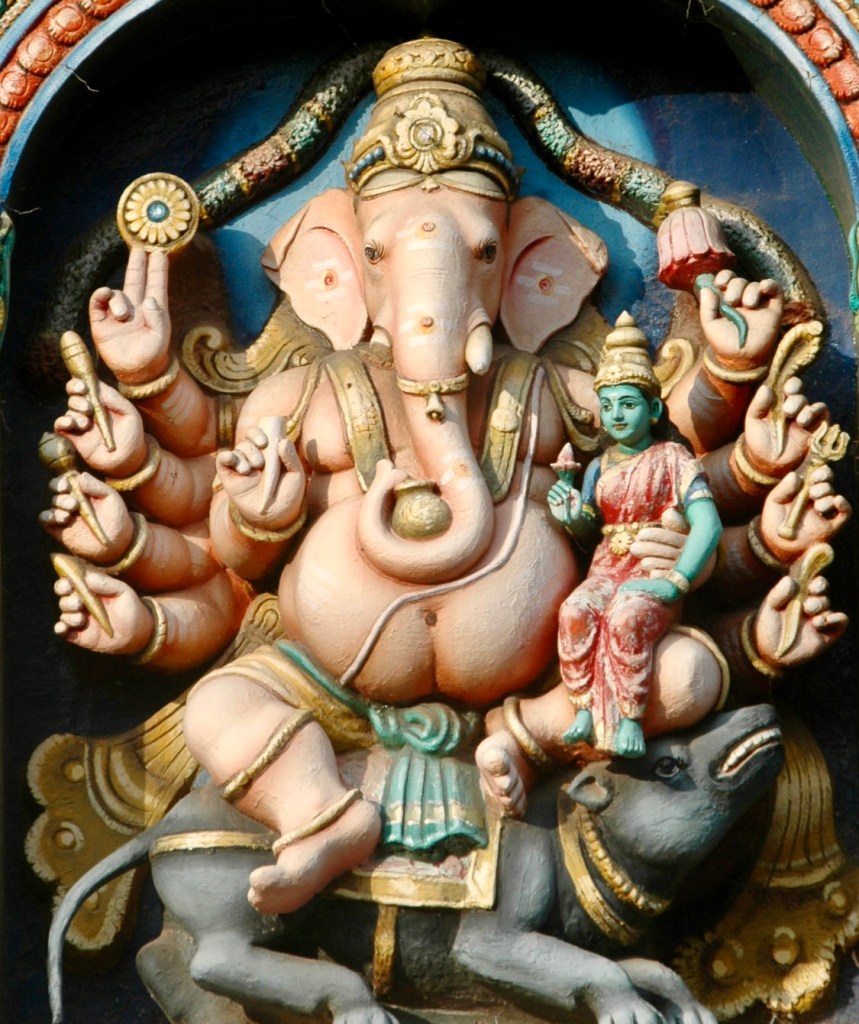
Meenakshi is a form of the goddess Parvati, Shiva’s consort. If you look closely, you’ll notice that the statue has three breasts. That needs an explanation! At birth, Meenakshi is auspiciously born with the third breast. Furthermore, it is prophesized that when she meets one who can defeat her in battle, then she will be that one’s spouse. Being fierce and independent, she defeats any and all male figures. Who defeats her eventually? Shiva! What happens? The third breast disappears as she becomes the loving spouse. Strange!
An evening ceremony revolves around a statue of Shiva carried to Meenakshi. The symbolic act reuniting the couple demonstrates an eternal union. Okay.
Although once again cameras are not allowed in the temple (and I don’t have a cellphone), my memories are brought back to life. The 1000 Pillar Hall (according to guidebooks really only 985). As I see lines of people waiting for darshan, to be “seen” by the deity, I remember that I barely saw the people in this same spot. During my previous visit, I remember the temple’s interior being very, very dark. One almost needed a flashlight in places. However, on this trip, the temple’s interior is very brightly illuminated by large neon lights. Modern phenomena of electricity to the rescue!
We drive on heading south. In addition to visiting several small temples on our drive to Rameshwaram, my main purpose is to visit the Ramanathaswamy Temple. Located on the coast, Sri Lanka is only ten or fifteen miles distant.
While this is a Shiva temple, the most popular story associated with this temple involves Rama, an avatar of Vishnu. A two-sentence condensation of this part of the Ramayana follows. Rama, as the designated to-be king, marries Sita. However, the strongest, living demon kidnaps Sita and takes her to Sri Lanka. To recapture Sita, Rama must build a bridge from the mainland to the island. Before doing so, Rama pauses and offers prayers and sacrifices at this spot. Spoiler alert: Rama does regain Sita. One has to love the stories attached to each temple!
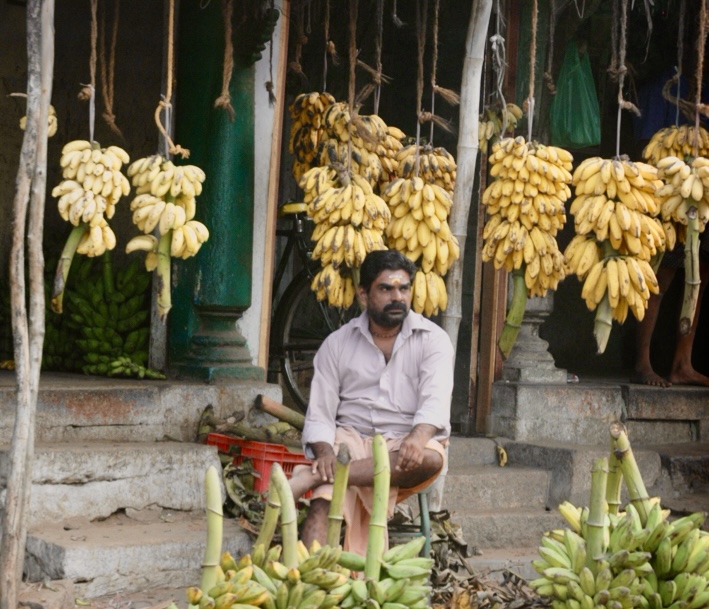
As I walk toward the temple, I see the usual prasad vendors selling fruit and flowers. The temple is large, probably 100 columns on each side of the temple, with walkways 30 feet wide, and a ceiling 30 feet in height. The corridors are described as the longest in a Hindu temple. The corridors provided the place for a strange experience. Although I know there are hundreds of people in the temple complex, for two or three minutes, I don’t see anybody, I don’t hear anybody! The only time in all of India that I feel solitude or a sense of momentary privacy. I never expected that sensation! Strange!
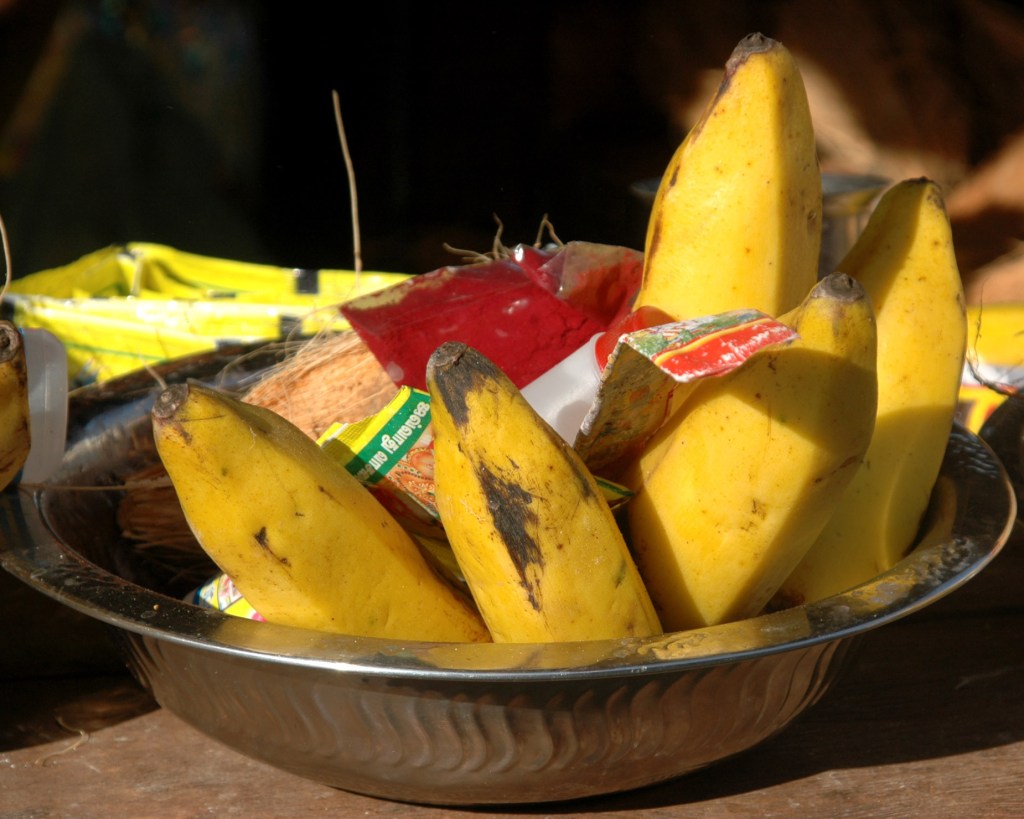
I join dozens of pilgrims, bearing their prasads, “gifts”, and making for the inner sanctum for darshan. The pilgrims’ gifts usually are fruit, sweets, or flowers. Once these gifts to the deity are blessed by a priest, the gifts are returned to the individual or shared with other devotees.
I’m aware of the ambiguity of offering gifts. It can appear to be simply a mechanical operation. “I give a gift; I get a gift in return.” Quite transactional. At their best though, every religious tradition stresses that the physical gift giving is only part of the more personal “heart-giving.” In the more personal giving, the individual offers reverence, devotion, humility, and gratitude. Of course, who am I to say, who is anybody to say, what “heart-offerings” are present in the more visible offerings of prasad.
This temple has special meaning for pilgrims. Some Hindus, once in their life, undertake a sacred pilgrimage to visit the four temples which represent the four corners of India. This temple represents the southernmost point. Once again, the “sacred geography” of India exhibited.
Outside I also notice one of the few “inspirational” signs in English. A quote by Vivekananda read ““He who sees Shiva in the poor, in the weak, and in the diseased, really worships Shiva; and if he sees Shiva only in the image, his worship is but preliminary.” Nice sentiments.
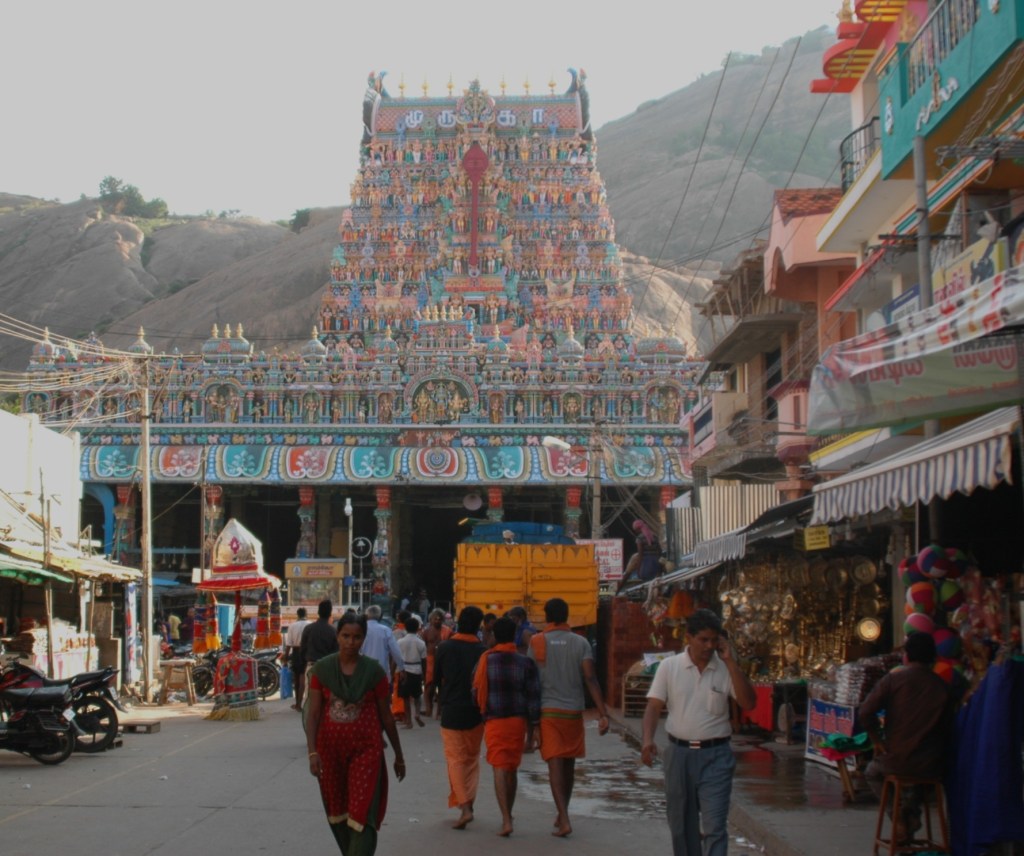
On our return to Madurai, I visit one more temple at Kanchipuram. The Kanchipuram temple, like my visits to Haridwar and Varanasi has a special status for Vishnu devotees. Kanchipuram, like these other visited places, is one of the seven tirtha, or “crossing sites.” In these special places where the ordinary and the sacred cross and meet, a person can obtain moksha, spiritual release, in a more immediate way than the slow, grind through the stages of reincarnation. Very appealing for many Hindus.
My enthusiasm for temples is waning. Not only do I allow a guide to attach himself to my side, but I also don’t have the energy to escape from another fellow giving me advice “take a picture here; take a picture here; take a picture here.” I obviously need to finish my touring of temples!
I’m sure that I’m like the Hindu pilgrims who try to visit temple after temple. Very tired, but extremely grateful of an opportunity to see the religious life of southern India.
 Journeys: Explorations in Body, Mind, and Spirit