
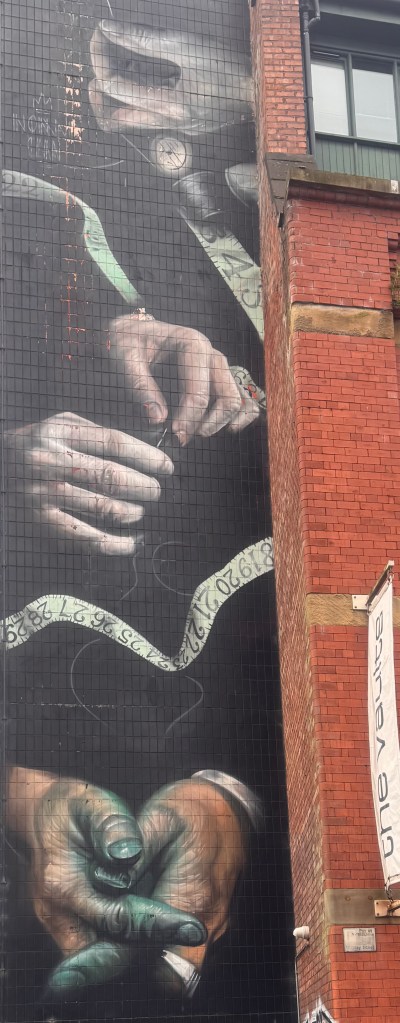
Let me show you around the Manchester People’s Museum. Who am I? I’m Tom Paine. Emmeline Pankhurst joins me.
Since you are a long-distance walker, you see a lot; however, your view is limited. You do notice ordinary people, especially their everyday features. Their work. Their modes of traveling. Their food. Their leisure time. Sure, English history includes the aristocracy. Sure, it includes the Royalty. However, the ordinary person is bedrock England. I’ll show you the ordinary English person in this People’s Museum. I should introduce myself. I wasn’t born in your colonies, excuse me, in the United States of America (a phrase that I helped popularize)! Instead, I was born in Norfolk, a county in eastern England. I moved to Philadelphia in 1774 with a letter of recommendation from Benjamin Franklin.
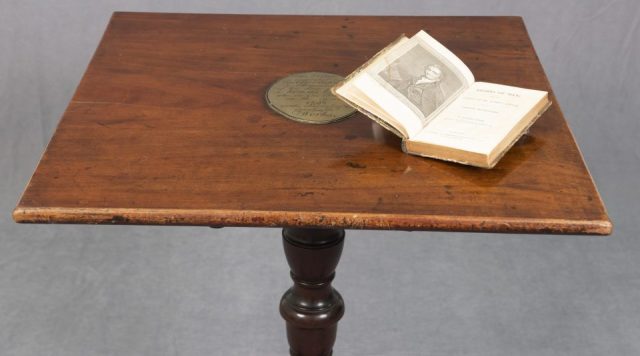
My 46-page pamphlet Common Sense help stir up support for your revolution. When I wrote The American Crisis in 1776, George Washington ordered the first sentences of that pamphlet read on Christmas Eve, 1776 as the troops prepared to attack Trenton. “These are the times that try men’s souls: The summer soldier and the sunshine patriot will, in this crisis, shrink from the service of their country; but he that stands it now, deserves the love and thanks of man and woman. Tyranny, like Hell, is not easily conquered….” Some people attack me because I also wrote an open letter about George Washington in 1796 declaring that he was an incompetent general and a hypocrite. I always spoke my mind as I did in my books The Age of Reason and The Rights of Man.
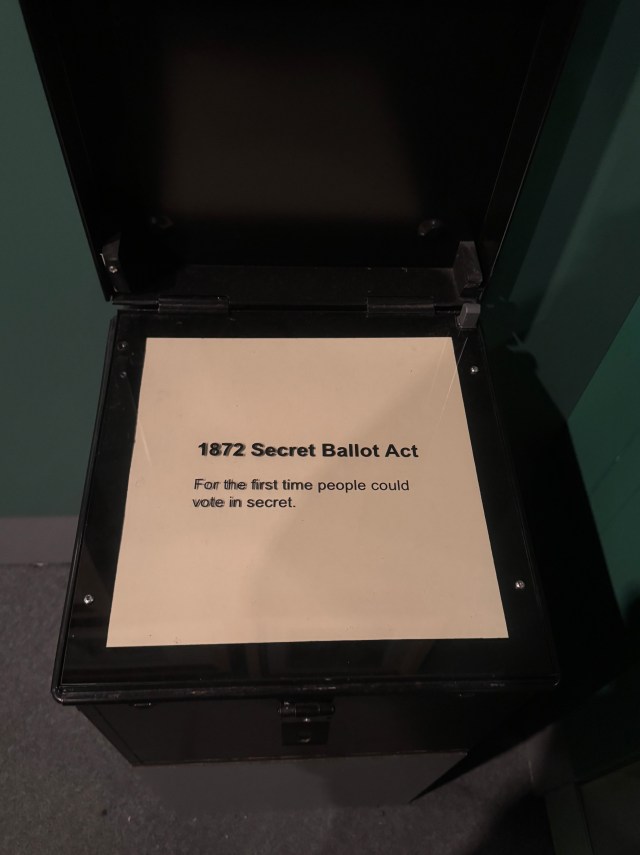
Needless to say, I have a commitment for the expansion of the right to vote here in my native country. You’ll see displays devoted to some of the major Parliamentary acts. We English have had to overcome severe restrictions upon who has the right to vote. The Great Reform Act of 1832 was a start, but just a start. Males who paid L10 in rent could vote; however, this act still only covered about 7% of the adult population. This Act did eliminate 56 “rotten boroughs” for the House of Commons. The wealthy and the aristocrats sometimes controlled voting boroughs even though less than ten men could vote in these boroughs. Disgusting! The Reform Acts of 1867, the Secret Ballot Act of 1872, and the Reform Act of 1884 also improved our situation. All of these acts extended the vote to working-class men in urban and rural area, or assured that voting occurred in secret. Finally, the 1928 Representation of the People Act finally granted women the right to vote on the same terms as men, finally achieving universal suffrage for adults over 21.
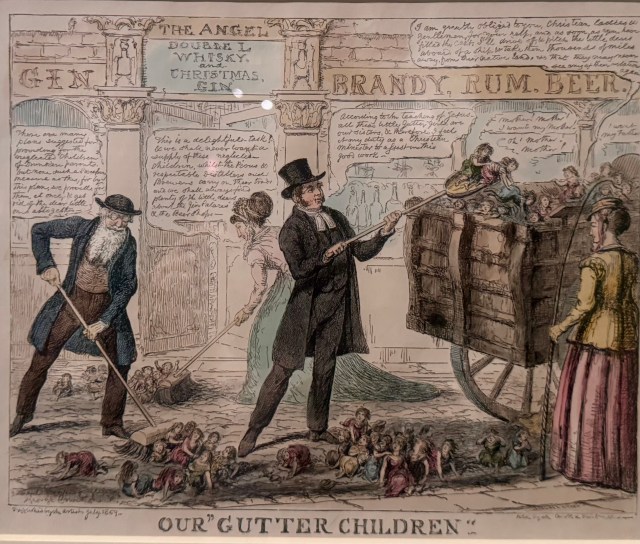
As I observed in the American Revolution, those with power and those who benefit from that power never give up easily. The People’s Museum’s narrative demonstrates that this progression toward expanding voter participation was neither painless nor automatic. Entrenched people resisted through books, political cartoons, threats, and religious language. You can see some of those cartoons in the displays.
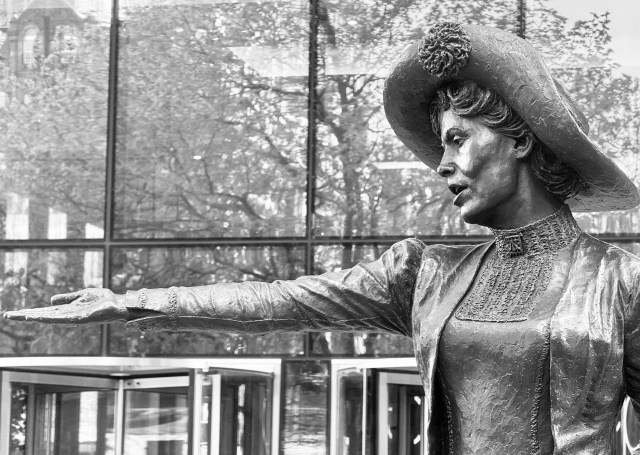
The People’s Museum also shows the history of improving working conditions. Let me introduce you to Emmeline Pankhurst who will guide you through that part of the museum. You may remember Ms. Pankhurst’s famous line “We are here not because we are law-breakers; we are here in our efforts to become law-makers. I would rather be a rebel than a slave!” Here is Ms. Pankhurst.
As a native of Manchester living in the mid and late 1800’s, I saw and knew hardships. After my husband died, I began to work with the Registrar of Births and Deaths office. Although I already knew the poor conditions of women, children, and working families, I became even more convinced that conditions had to improve. My drive to enable women to vote gained new impetus from these experiences.
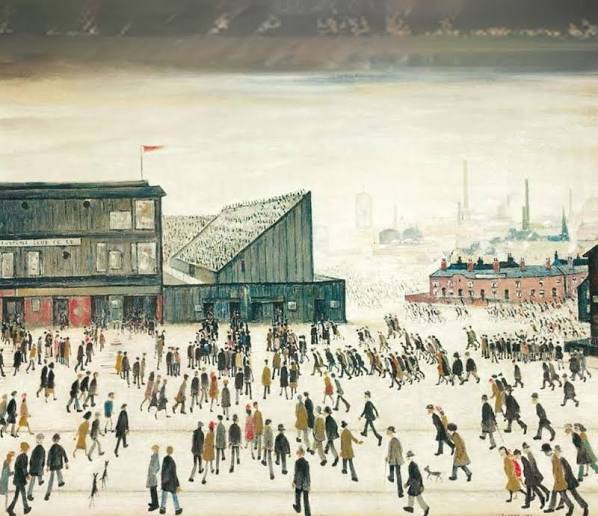
Working conditions had to improve. You probably take for granted a five day work week, a 40-hour work day, child labor prohibition. While we know that these didn’t always exist, you would be amazed at the slow progress toward these goals.
Here are some of the important dates. The 1833 Factory Act finally stopped children under 9 from working in textile mills. A government office created to enforce these limits. The 1844 Factory Act finally began to protect women. It restricted their working hours, and supposedly restricted operating dangerous machinery. The 1847 Factories Act limited the workday to a maximum of 10 hours for women and young persons in textile mills. Thankfully, this limit gradually expanded to other industries. Finally, during the 1840’s and the 1850’s the factory owners and reformers, such as the Early Closing Association, fought each other over the appropriate number of weekend work hours. Reformers pushed to finish work early on Saturday in addition to their Sunday day of rest. By the late 1890s, they won! The “Saturday half-day” established the weekend. Be sure to look at the exhibit showing the relationship between workers and soccer. With the ability to attend Saturday afternoon soccer games, more sports clubs were created. An explosion of soccer’s popularity!
The People’s Museum is focused on expanding the right to vote and improving ordinary folks working life. As I moved through the museum, I can’t help reflect on the current climate in the USA. With Trump and MAGA constantly alleging voter irregularities, with his sending dozens of alleged “voting abuse” cases to the courts, with his supporters trying to redistrict states so that fewer minorities have representation, the assurance of an expanding electorate is never to be taken for granted. What can be taken for granted is that there are those who attack such progress and who carefully calculate how to resist.
Also, given the current economic uncertainties and the resulting labor uncertainty for the middle-class, we see again the need for continued vigilance regarding our means for making a living. Both major political parties are avoiding issues such as AI and our economy. The fear of AI eliminating jobs is real. An Emory physician who helps supervise young medical students told me, “Even my med students are afraid for their future!” Medical students afraid for their future!! Wow! Manchester People’s Museum. History relevant for today.

