
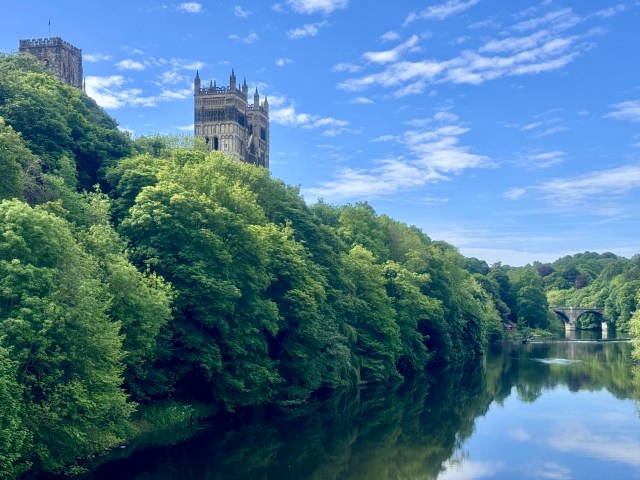
I’m not alone in loving Durham Cathedral. As I cross the bridge from my lodging, I see the cathedral’s towers above the River Wear. What a setting!
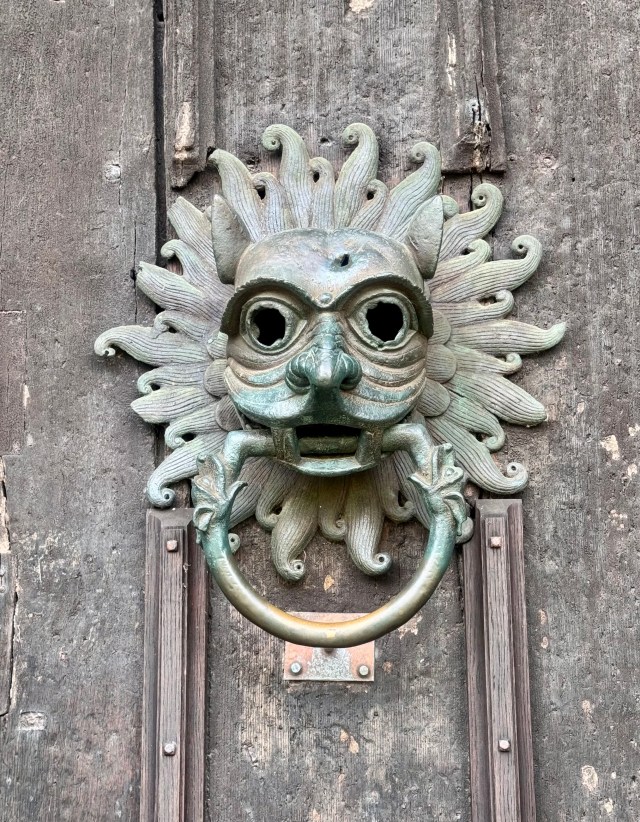
I walk through the old city, past the old castle, and arrive at the cathedral’s entrance. I notice not just any cathedral door knocker, but a large, impressive knocker, the “Sanctuary Ring.” While the present knocker is a replica of the 12th century bronze original, it features a lion devouring a man and a snake biting his feet. Striking! The knocker had a dual role. On the one hand, the symbolism is to frighten evil spirits. On the other hand, when sounded, the cathedral monks would allow a person to enter the cathedral complex. Even more, that person could be given sanctuary for 30 days while lodging in a separate cell in the cathedral complex, free from any surrounding king or sheriff officials. For centuries, the use of this “Sanctuary Ring” meant that history could be altered, even if only for 30 days! Nice!
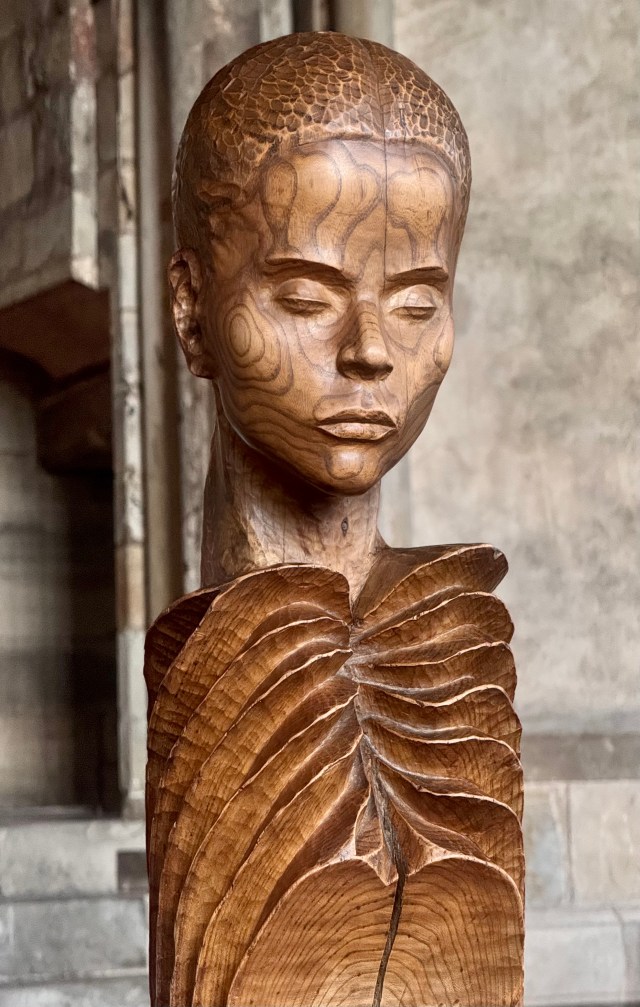
On this trip, I seem to notice how there are features of the cathedral which blur the lines of history. There is an insertion of a “living awareness” of time. As I enter the cathedral through the Galilee Chapel, I recognize that not only is Venerable Bede buried there, but also there is a wood carving of a young, Mary of Nazareth. Attention getting in its simplicity. Striking in that she appears African!
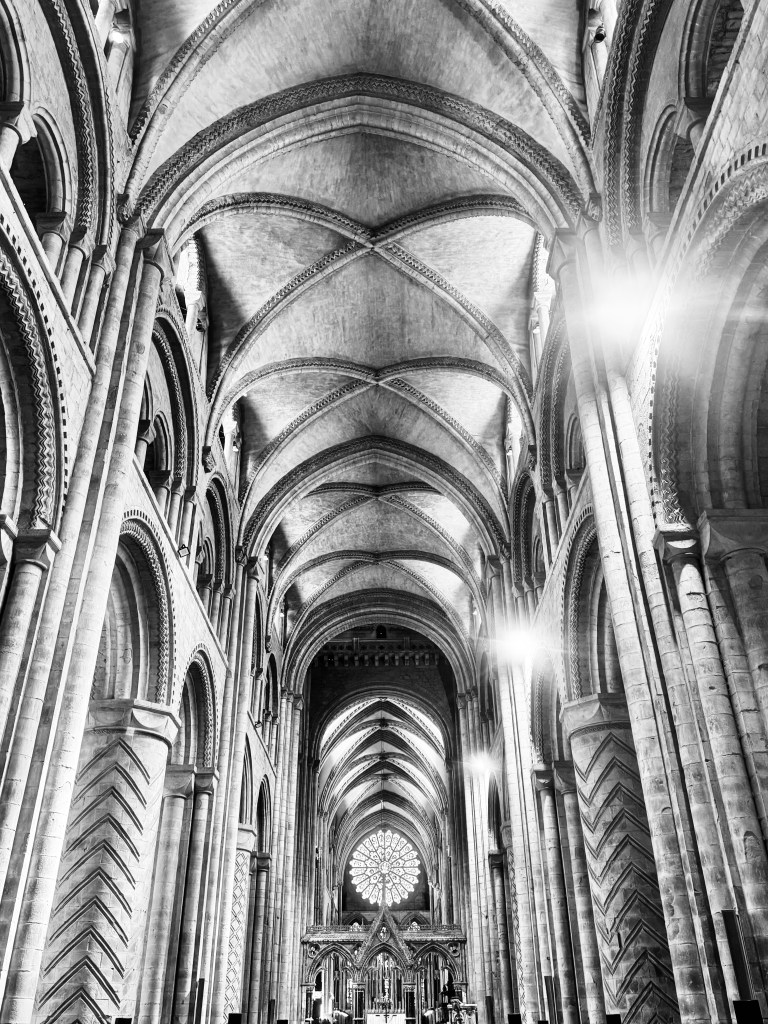
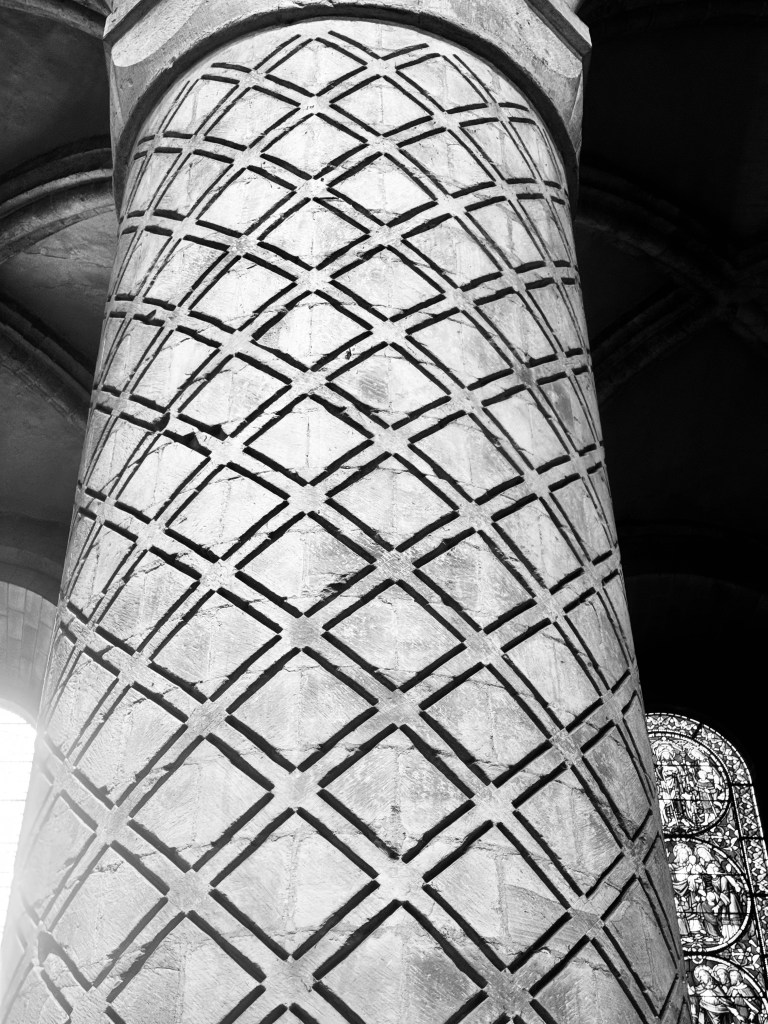
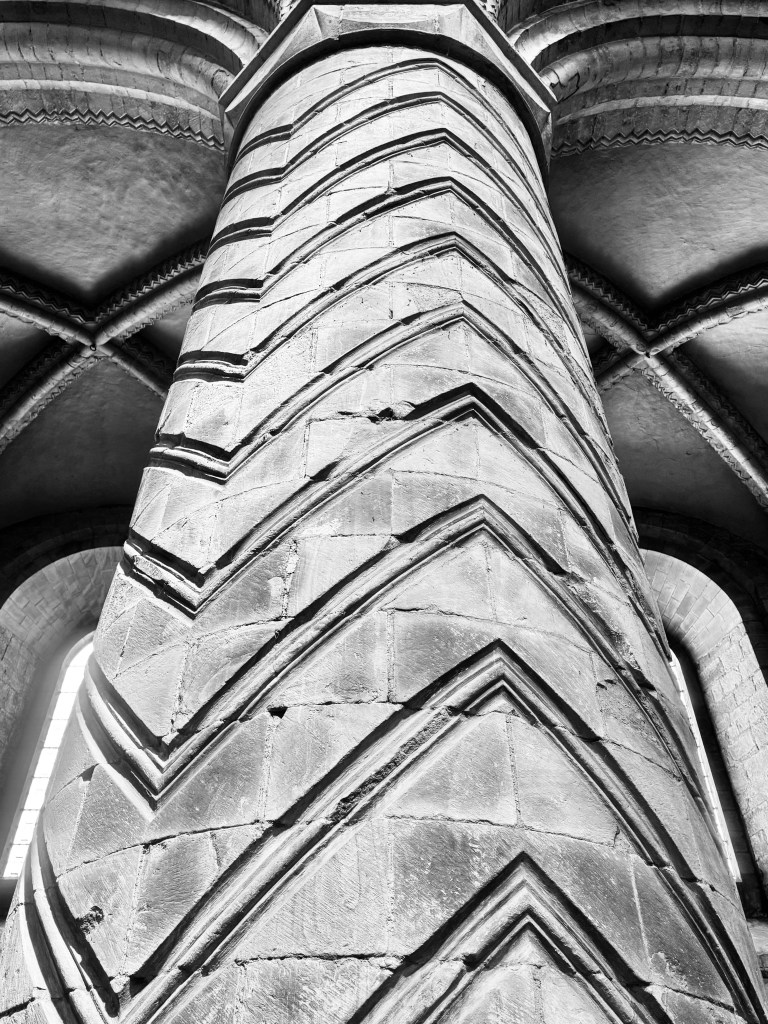
Entering the nave, I see an early cathedral of Norman, Romanesque design. The walls are thick, the windows are narrow, and the columns are massive. This interior immediately shows me something that I’ve never seen in a cathedral. It isn’t the size. Lincoln is larger. It isn’t the stain glass. York is more impressive. It isn’t the graffiti. Norwich has more. Instead, the columns gain my attention. Each paired column has geometric designs, zigzags, carved straight lines. It is almost as though I’m returning to the Grand Mosque in Cordoba and its double-arches and alternating color lines on the columns. Again, there is an insertion of a living awareness of other styles into this classic cathedral.
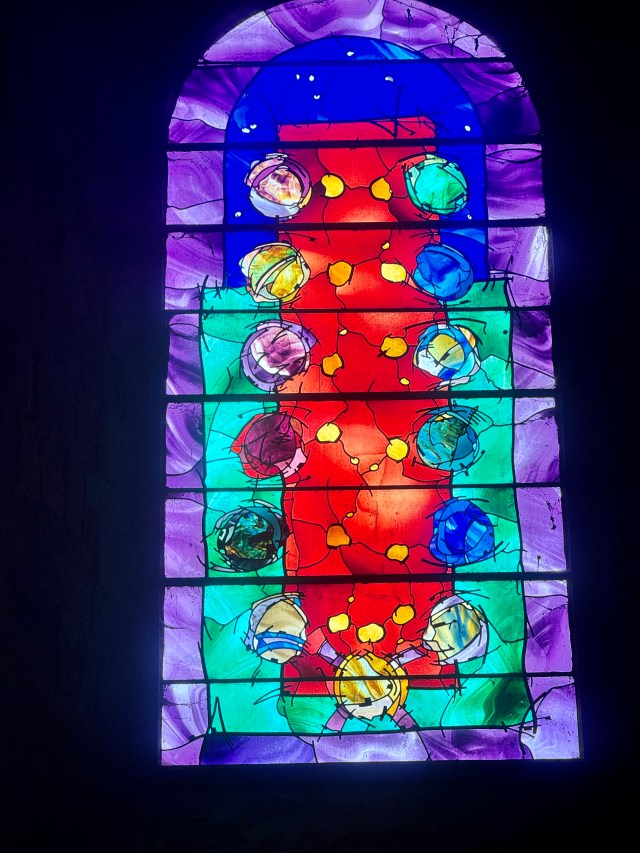
Even more, I realize that there is more to the nave than simply a solemn, somber space for traditional worship. There are four stain glass windows which help alter the space. What is the simple, multi-color, modern window? The Daily Bread Window installed in 1984 shows Jesus and the twelve disciples at the Last Supper as though one is looking down on the figures. From above, each disciple’s head is a different color. A perspective somewhat reminiscent of Salvador Dali’s Christ of Saint John of the Cross.
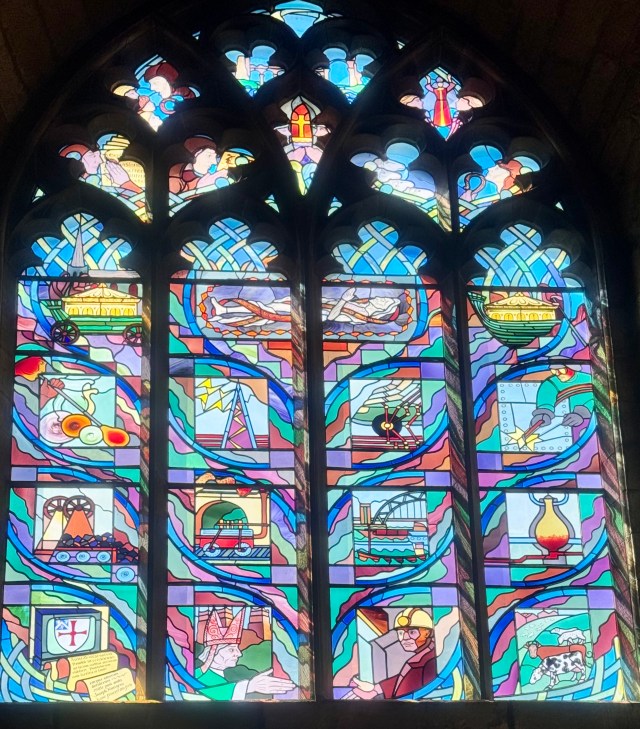
Another window in the south Transept dedicated in 1997 celebrates the 1000 years of St Cuthbert’s shrine, the Millennium Window. In a traditional fashion, it honors St Cuthbert, but there is more. The window depicts Durham’s history since Cuthbert. Miners. Iron-workers. An early steam engine (the Rocket?). Cattle. Even a computer with a Celtic cross on its screen! Again, an awareness of living history.
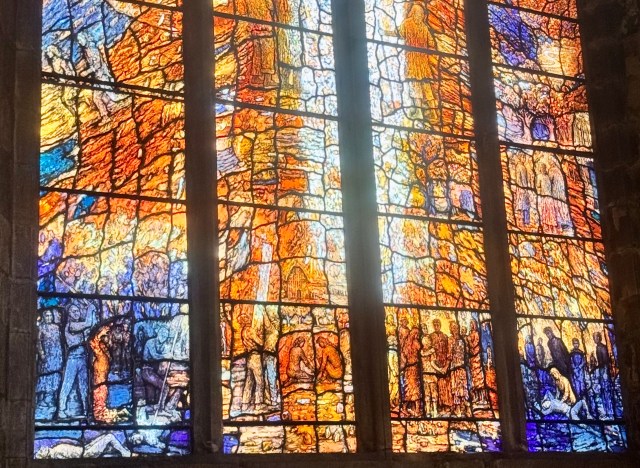
A third window, the Transfiguration Window. This window includes traditional Biblical narratives such as a large figure of an outstretched Risen Christ and pilgrims walking to Durham Cathedral. This striking window is dedicated to Michael Ramsey, much-loved onetime Bishop of Durham and Archbishop of Canterbury. A brochure tells me that one of the window’s pilgrims to Durham Cathedral is none-other than Michael Ramsey. What wonderful colors! What difficult-to-see, detailed scenes! Another insertion of modern history.
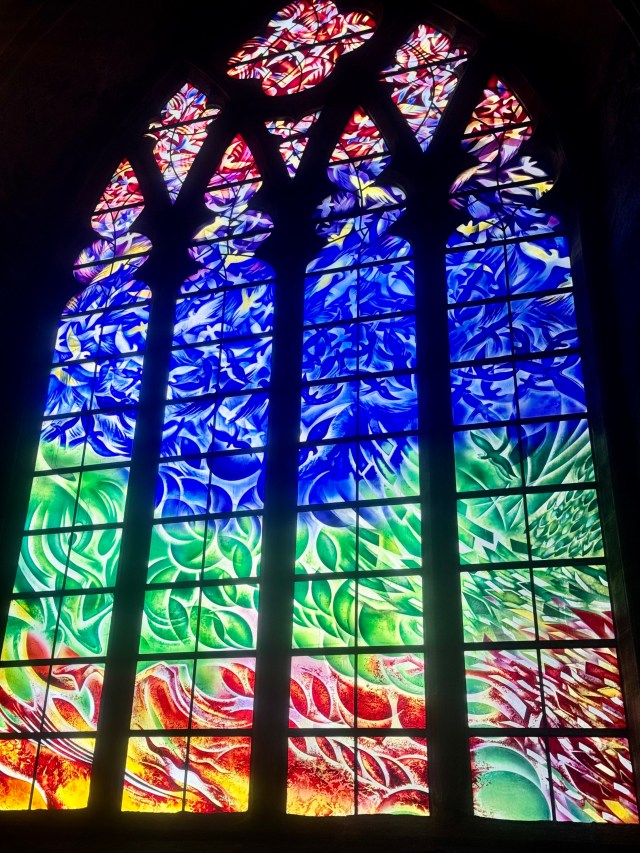
A final window, the Illumination Window. Sara Pilkington, a Durham University art student, suddenly died in 2012. Remembering her, the stain glass has swaths of bold colors hoping to capture her “bright and dynamic personality.” Such a way to remember a vibrant life.
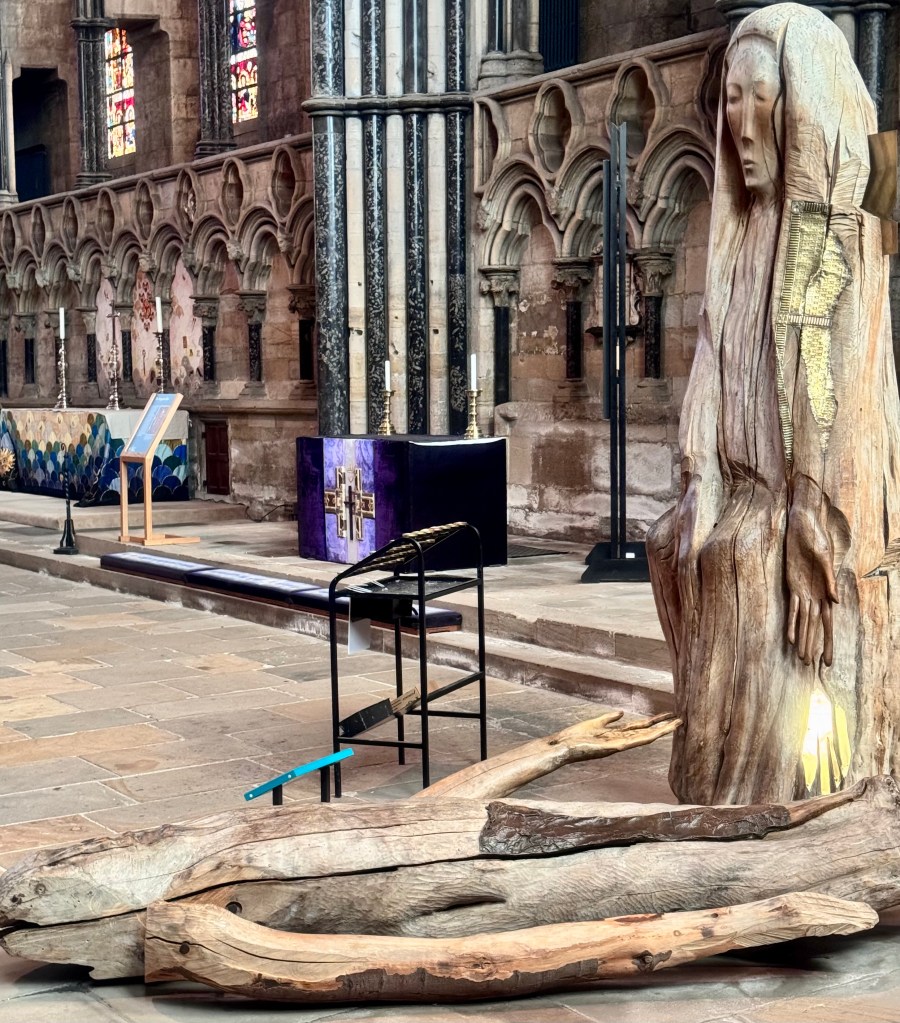
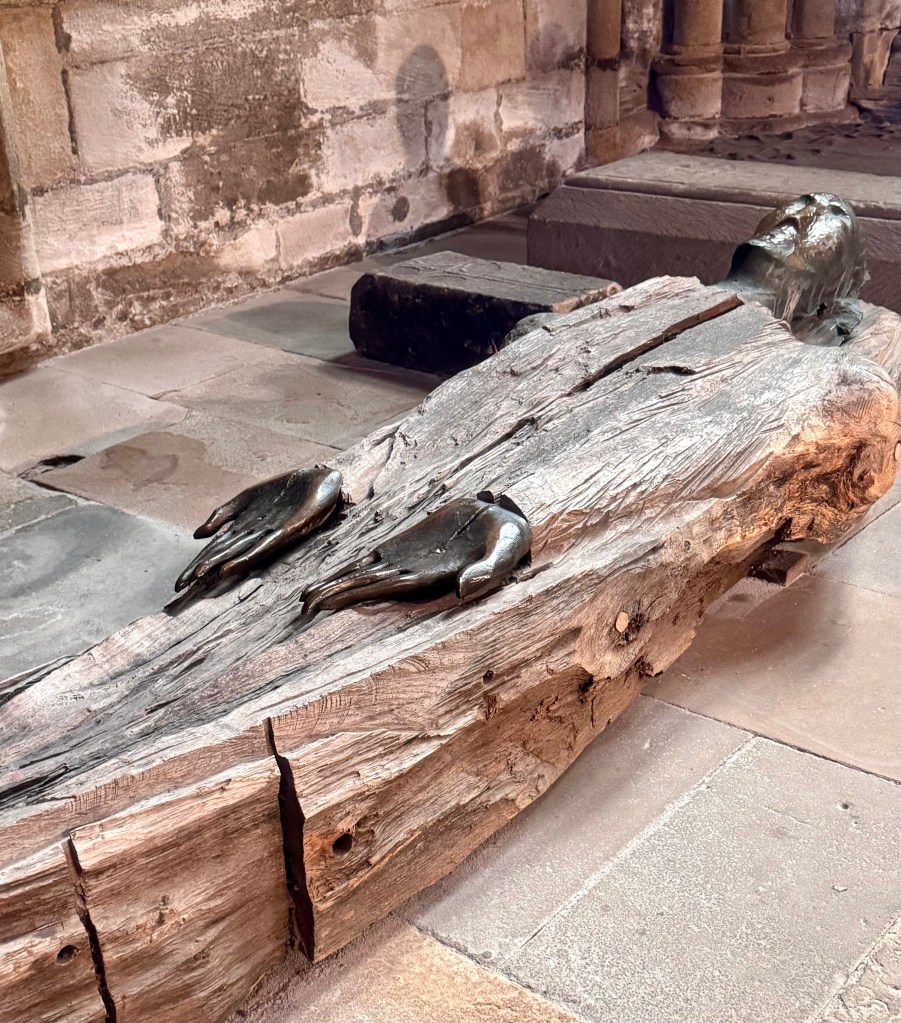
Two other pieces of sacred art. As in other cathedrals such as Michelangelo’s Pieta in the Vatican, Durham Cathedral includes a pieta. Rather than stone, this wood-carved Pieta stands six feet tall. But it shows scars, burn marks. Why? While being exhibited at York Minster, the Pieta was burned in the York Minster’s tragic 1984 fire. Upon recovering the burnt pieta after the fire, the artist faced a decision. Retain the burn marks or remove the burn marks? The artist decided to leave the marks to emphasize the sadness and the brutality of the crucifixion story. Next to the Pieta is another piece of sacred art, a wood chainsaw carving “Christ in the tomb” depicting Jesus in the tomb. Unique as far as my experience, this rough wood shows the savageness of death, but the artist caste Jesus’ head and hands in timeless bronze to symbolize the resurrection. Nice!
xTwo other pieces of sacred art. As in other cathedrals such as Michelangelo’s Pieta in the Vatican, Durham Cathedral includes a pieta. Rather than stone, this wood carved Pieta stands six feet tall. But it shows scars, burn marks. While being exhibited at York Minster, the Pieta was burned in the York Minsters 1984 fire. Rather than removing the burn marks, the artist decided to leave the marks to emphasize the sadness and the brutality of the crucifixion story. Next to the Pieta is another piece of sacred art, a wood chainsaw carving “Christ in the tomb” depicting Jesus in the tomb. Unique as far as my experience, this rough wood shows the savageness of death, but the artist caste Jesus’ head and hands in bronze to symbolize the resurrection. Nice!
A cathedral’s space can seem overwhelming. Sometimes the cathedral seems timeless. Sometimes a cathedral seems to transport us back hundreds and hundreds of years into the past. Sometimes the stain glass windows of Biblical stories and figures amaze us even now hundreds of years after their creation. Such beauty. Such human creativity and skill. But. But. But nothing more.
A cathedral’s worshipping community feels more. Beyond a sense of timelessness, beyond a sense of the past, beyond the appreciation of such human creators in the present, a cathedral’s community can find ways to insert a living awareness of time. Those who actually lived and worshipped in this space feel something different. Celebrating a much-loved Bishop, remembering an art student, acknowledging the appropriateness of a Pieta with burn marks. For these community members, the One Up Above, the One who Centers the world and life, is not perceived as Timeless, as a nice set of beautiful phrases and colors and windows. For these worshipping members, the people insist that as life continues, that life can be brought into the Living One’s Presence.
In a strange way, people of the cathedral see God, or more aptly in Christian language the Holy Spirit, not only still “hanging-around”, but God, the Holy Spirit, still at work in this place, or, even more appropriately said, in the life of the people and the world surrounding those people. Amazing.

