
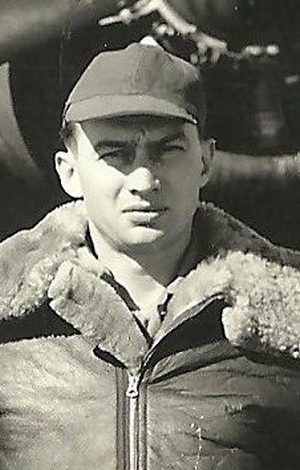
During WWII, Dwight Parken, Mary’s father, served as a tail-gunner for a B-17. Although he seldom talked about his experience, not only did he talk to one of my Reinhardt classes, but also he wrote a short “Recollections, Reactions, and Reflections on WWII.” For years, Mary and I have talked about visiting East Anglia to see where he was stationed. Along with our son Dwight, his namesake, we finally make it.
Dwight’s writing orients us. After being transported on the Queen Elizabeth (along with approximately 21,000 other soldiers), his crew disembarks at Glasgow and is immediately on a train to East Anglia. Bovington Air Base, near the present Duxford Imperial War Museum, is the first stop, and Snettishan, close to “the Wash” for gunnery practice, is the second stop. Finally, Glatton about ten miles south of Peterborough, becomes their third and final stop as the crew joins the 457th Bomber Group.
In joining this group, Dwight writes “We didn’t realize it at the time but this bomb group had arrived and started flying only six weeks before, and here we were already replacing somebody.” He continues “Our corrugated iron Quonset hut had all of the charm and appearance of a hog barn in Kansas, but could be made reasonably livable with a little effort.” Whether he and others know the purpose of the 8th Air Force then, or only realize the purpose later, he writes that they are “to destroy the basic resources for making war. Oil production and storage was a high-priority target.” They did bomb other targets, and he realizes that civilians often get injured or killed; however, “I presume that many of those civilians had a chance to get into a safe place before the bombs came down.”
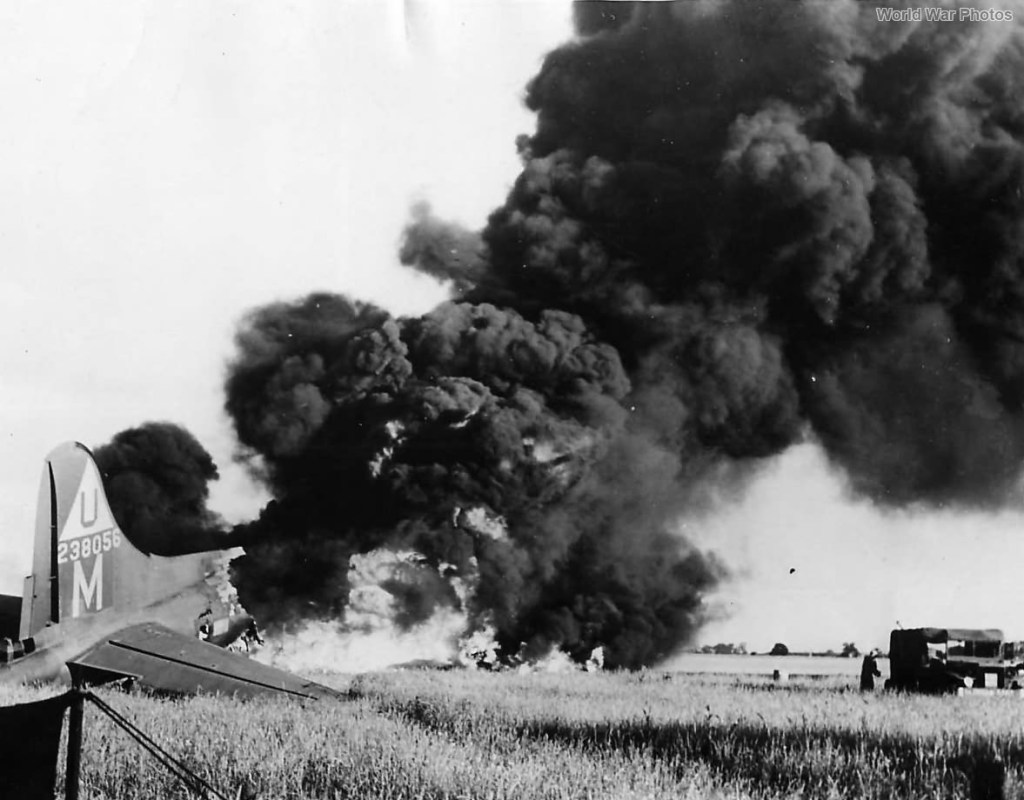
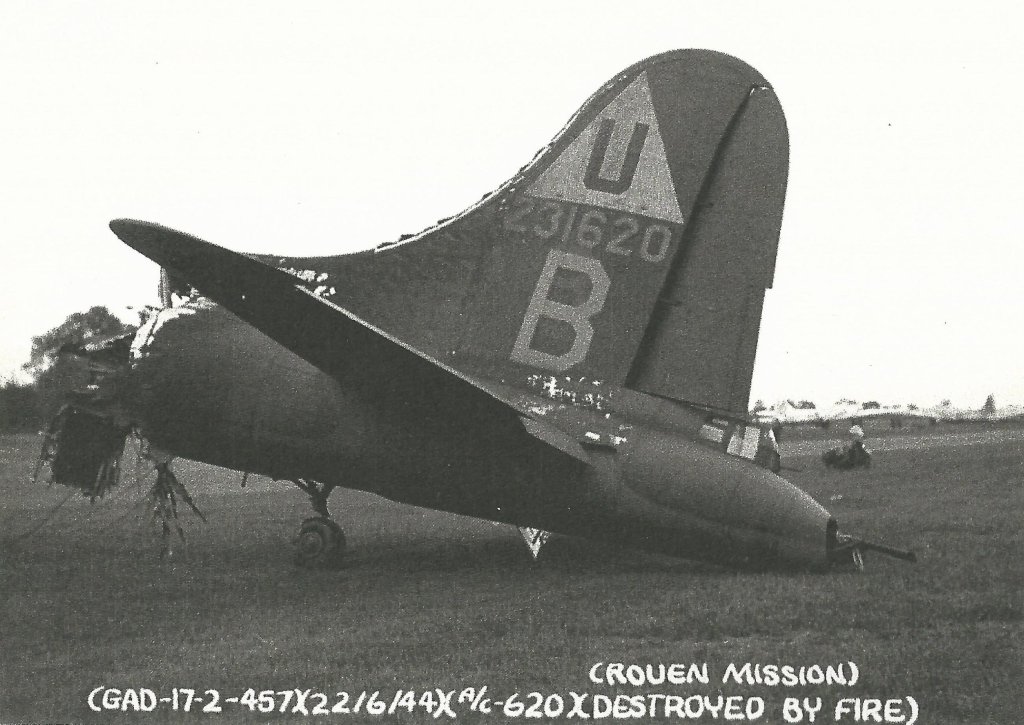
He writes about “close calls” and the “the question.” “What is our chance for survival? What are the mathematical odds? For heavy bomber crews, the Air Force helped by setting a limit of twenty-five missions, later increased, and then we could go home.” Of the six replacement air crews from Texas, four were missing in action after three months. Despite one crash landing, their crew make it back to the states. Probably only 50% of the crews do.
The “close calls” are harrowing. On one flight, enemy fire bounces off one of their 500 lb bombs, cutting his oxygen line. On another flight, he sees the B-17 next to theirs take a hit, go into a spin, and explode. He counts parachutes. Only five chutes for the ten-member crew.
He acknowledges that movies depicting conflict and anti-aircraft fire (flak) are “realistic enough to give me the shakes.” On a raid over Berlin, the plane takes heavy fire resulting in dozens of holes. During that raid, “I got slammed in the back by a piece of steel the size of my thumb. That flak jacket most certainly saved my life.” On another Berlin raid, he recounts the 2000 planes in the air at one time with the German Luftwaffe trying to destroy the planes. “From my window it looked like a swarm of angry bees over a bee hive. In just one instant I counted one! Two! Three! Four! Five! Six! Seven! B-17’s spinning down in flames.”
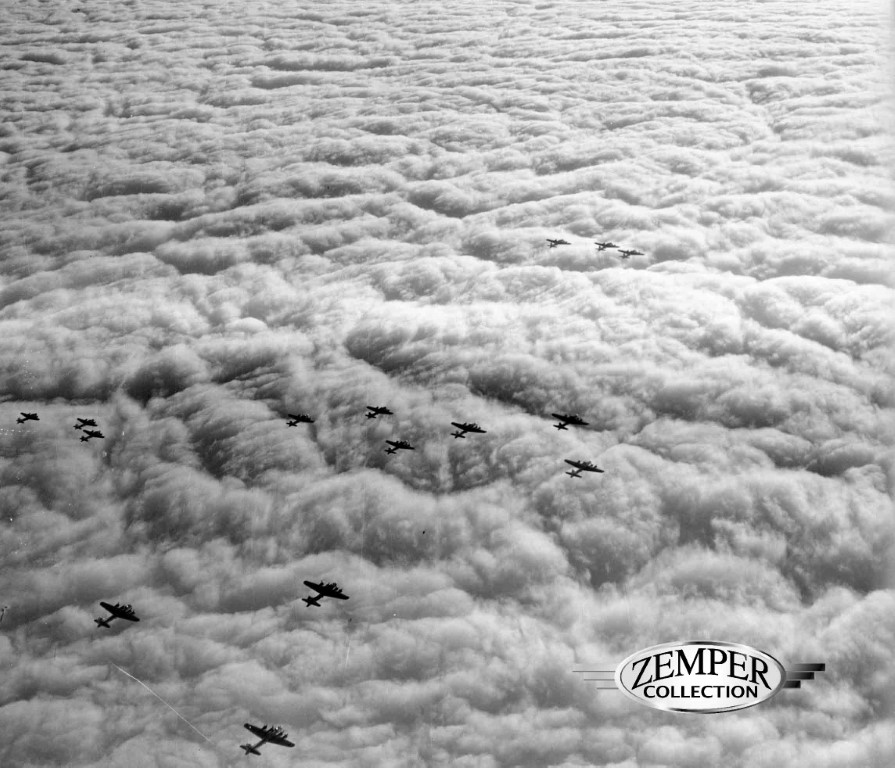
In a letter to his mother and sister about D-Day, he writes: “You want to know all about the invasion huh? On June 5th we were alerted and restricted to the area. It sure looked like something was cooking all right…We took off at 4:50 o’clock. The sky was filled with planes, around us and below us.” At their height, there were dense clouds. “There we were participating in the greatest assault in history and the clouds completely obscured the ground. We couldn’t see the coast but we could see where it was by the trails of smoke bombs and black billowing smoke and dust coming above the clouds all the way from Cherbourg to Le Havre.”
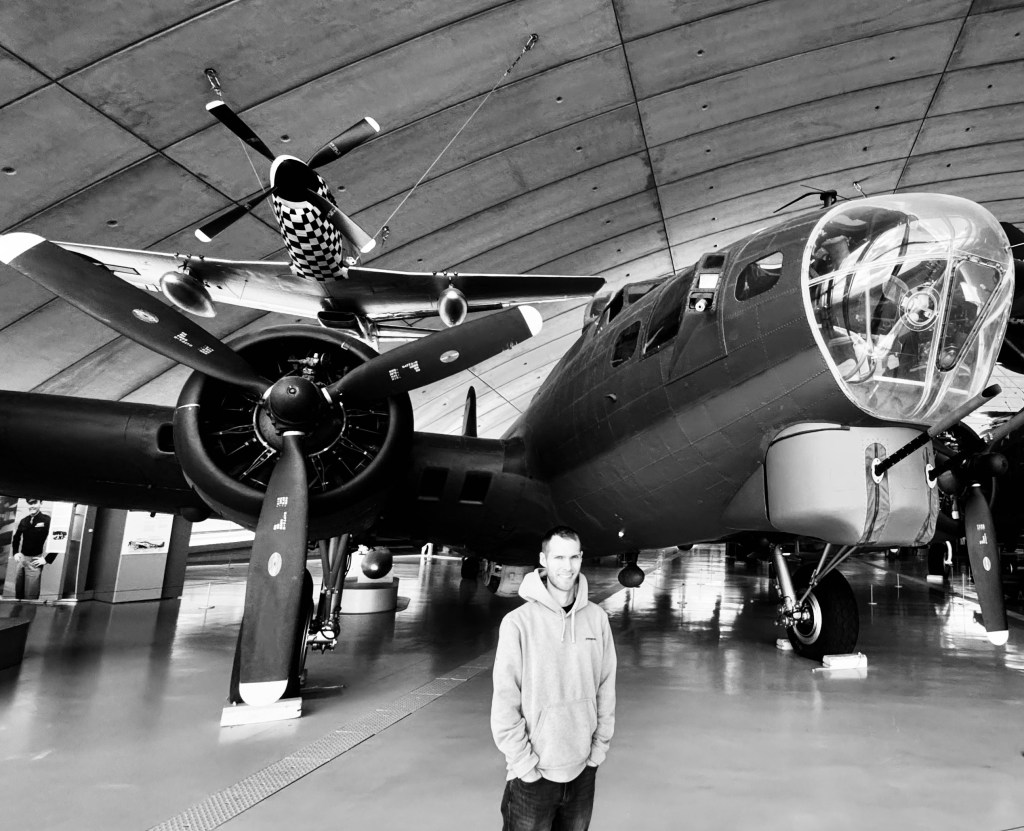
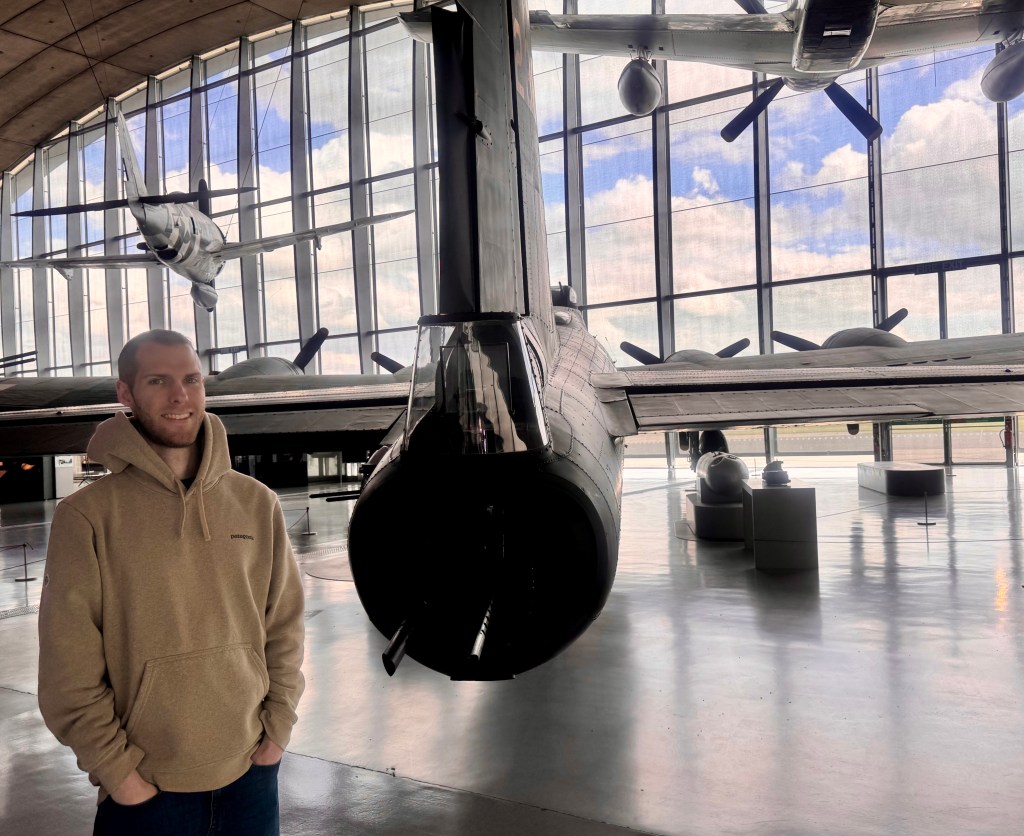
As Mary, our son Dwight, and I visit the Eighth Air Force Museum at Duxford, we constantly shake our heads at the air crew’s experiences. While looking massive and lethal, the B-17 on display reminds us of the vulnerability of the B-17 and crew. The skin of the plane is thin to eliminate weight. The lack of a pressurized cabin means the temperature at 25,000 feet is extremely cold. The B-17 engines could easily cease operating; fortunately, if one or even two engines ceased working, depending upon the weight load, the pilot could still fly the plane. Yikes! Our young Dwight comments on the very, very cramped quarters of the tail gunner “I bet that he could get cramps easily.”
We learn about the air force personnel. Not only are there airmen from the USA, but also volunteer air crews from Poland and Czechoslovakia. Most of the airmen are in their 20’s. As I mentioned, many don’t return home. Approximately 30,000 USA airmen are killed.
We didn’t make it to the 457th base. It, like almost all of the other bases, has been converted to farm land, to civilian airports, or to other commercial uses. Although Dwight never returns to the Glatton base after the war, he and Estelle, Mary’s mother, do return to England for his 45th reunion. When he writes his recollection, he describes “a bond of friendship that has survived the war and still endures some 47 years later.” Life goes on.

