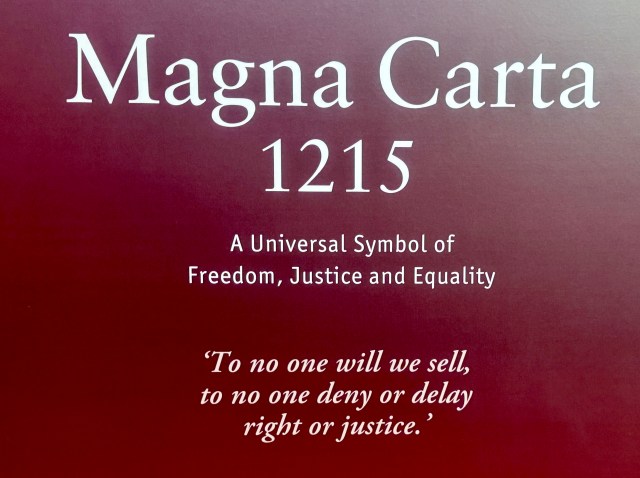
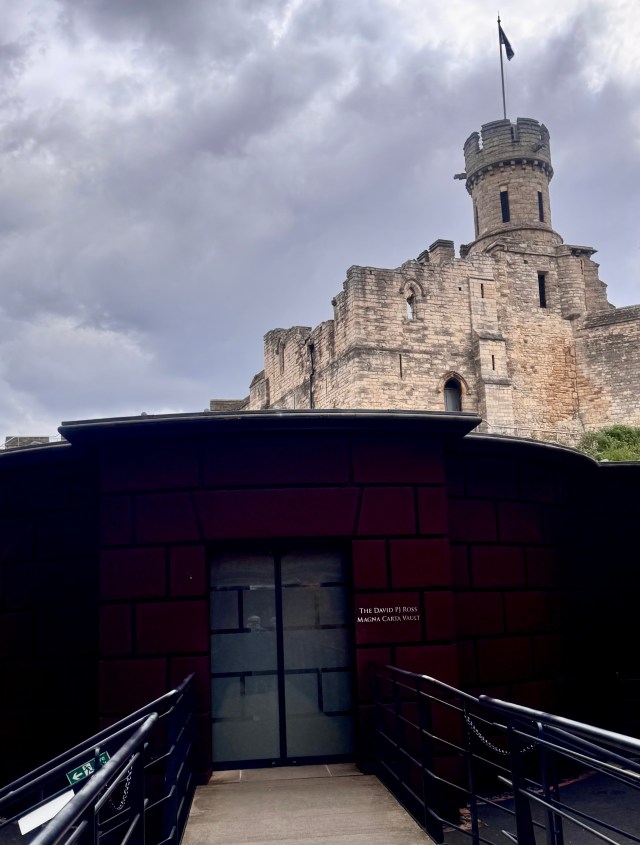
It isn’t Fort Knox. It isn’t the entrance to the White House. Yet, because it has its own separate building and vault, I know that the building in front of me houses Lincoln’s Magna Carta. Last year, I view Salisbury’s Magna Carta; this year, I’ll also see the British Library’s Magna Carta. Lincoln’s copy is special because that 1215 document is paired with the 1217 Charter of the Forest.
The historical details aren’t particularly difficult to understand. King John attempts to hold onto ancestral land in France. Raising men for the army, feeding those men, assuring they have weapons, providing transportation for them, cost a “pretty penny.” At times, he resorts to seizing property and taking bribes from his barons. Eventually, he has to raise taxes. Besides taxes on “movable property” such as farm produce, wool, farm tools, and household property, he levies “unpredictable and crippling fines for inheritances, lawsuits, and even for a widow to avoid being forced to remarry.”
The barons have enough. With an army larger than King John’s army, the barons take control of London. Realizing that his situation is dismal and that civil war might erupt, John meets with the barons at Runnymede outside of London. There he agrees to a 3,500 word document and its 63 clauses on simple parchment.
As we look at the document, the guide asks: Why is the document written in very small Latin letters tightly placed next to each other? His answer: “so no additional words could be falsely inserted later! Lack of trust even back then! I’ll return to the content in a moment.
Despite King John’s placing his seal on the document (he didn’t sign the document) on June 15, 1215, he soon asks the Pope to annul it. As a political favor, Pope Innocent III voids the document in August 1215. Approximately a year later, King John dies in October 1216. Good ole’ Divine Providence!
The French are still a threat. King John’s son, Henry III, assumes authority and power. His regent and the barons lead the English forces and defeat the French. This is the occasion when the 1217 Charter of the Forest becomes important.
The Charter reverses policy under several kings of grabbing approximately one-third of southern England. These “Royal Forests” became open to commoners. Commoners now have legal rights “to graze animals, collect firewood, and forage for food in these woodlands, while ending cruel punishments like mutilation or death for poaching.” The Magna Carta impacts the barons; the Charter of the Forest impacts the ordinary “free men.”
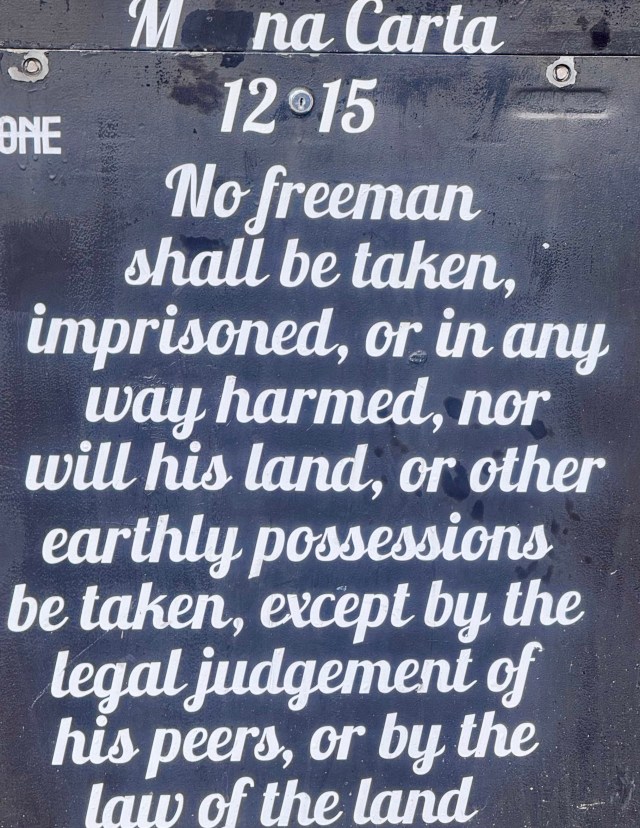
Returning to the Magna Carta. Most of the clauses deal with feudal issues. For example, if a baron died, then his heir would not have to pay an arbitrary fee to assume the land and title. If a baron died without an heir, the King could not, as guardian of the land, take a number of actions such as despoiling the land or arbitrarily selling the land. Or, if her husband died, then a widow was not forced to remarry and could retain her husband’s land and property.
Clauses 39 and 40 are the most relevant clauses today. Clause 39, the “due process” clause states: “No free man shall be seized, imprisoned…except by the lawful judgment of his equals or by the law of the land.” Clause 40, the “access to justice” clause states: “to no one will we sell, to no one deny or delay, the right of justice…” In their setting, these clauses did not apply to everyone. The barons are not establishing a form of “universal rights.” The barons are protecting their own rights only. However, while they are protecting their own status and rights, they do establish a precedence for limiting the authority of the king by claiming these other barons had “rights.”
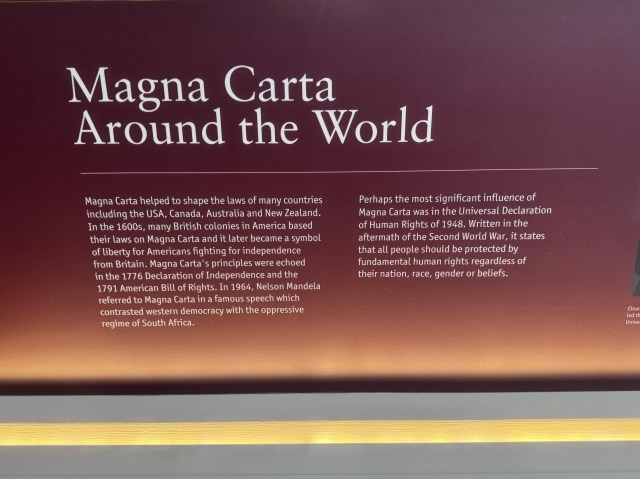
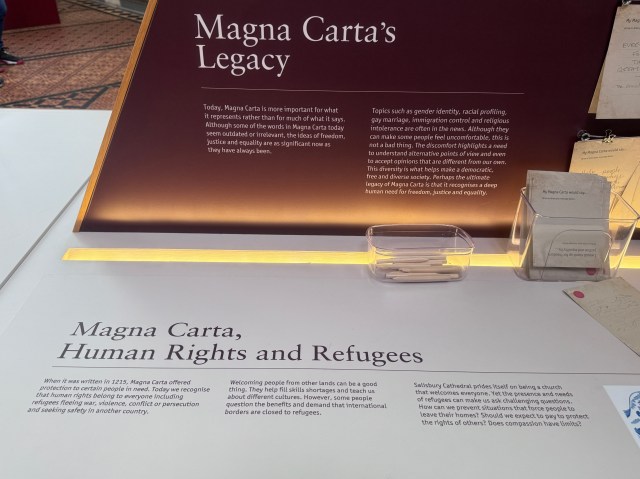
What is the legacy of the Magna Carta? It certainly is continually evoked in historical discussions of a governmental leader’s power. A king does not have unlimited scope of action. A king is not above the law.
More recently, there are two contradictory evocations of the Magna Carta. On the one hand, the “No King” rallies certainly lead to King Trump compared to King John. Trump seeks funding for his proposals through executive privilege rather than the usual channel of Congressional approval. Trump uses a “Department of Vengeance” to target political rivals or adversaries. Trump and his allies hoped to assert that they have “executive immunity.”
On the other hand, a google search shows that during the last several decades, there has been an opposite appeal to the Magna Carta. The twist is that rather than opposing tyranny, this new appeal seeks “to argue that the American constitutional tradition rests on resisting government and judicial overreach rather than expanding expansive new rights.” Severely prune government bureaucracy. Drastically slash government programs. DOGE acts according to the principle of the Magna Carta!
The Magna Carta. I’m neither lawyer nor legal scholar; yet, I’m fascinated by a document that has an impact even in our day. Similar to other documents, individuals and groups seek to use the Magna Carta in all sorts of ways.