When entering a church or cathedral, whether small or large, I look toward the stain glass. Unconsciously. Naturally. I look to see the nature and the quality of the glass. If there is stain glass, then I’m impressed.
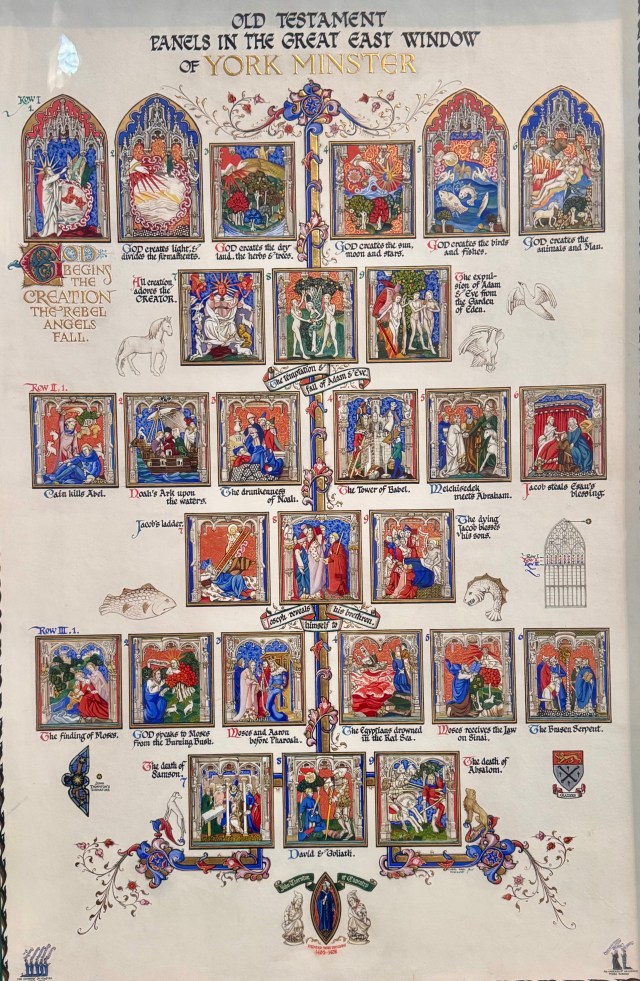
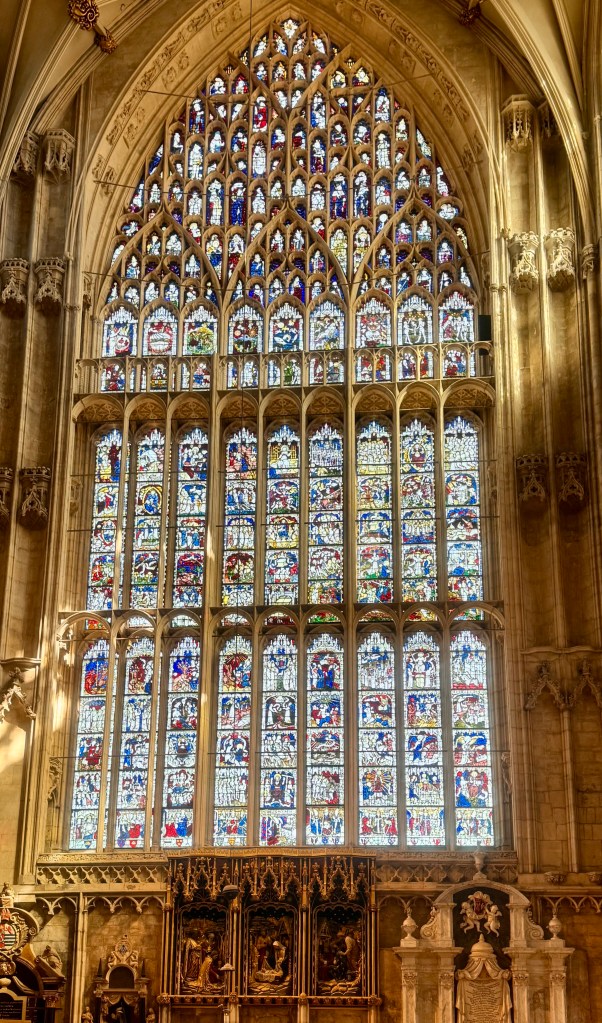
I’m impressed by York Minster’s stain glass. I’m impressed by its Great East Window. In fact, the 311 panels, the size of a tennis court, so impress voters in the Association of English Cathedrals that it has been voted the second most impressive stain glass window in England.
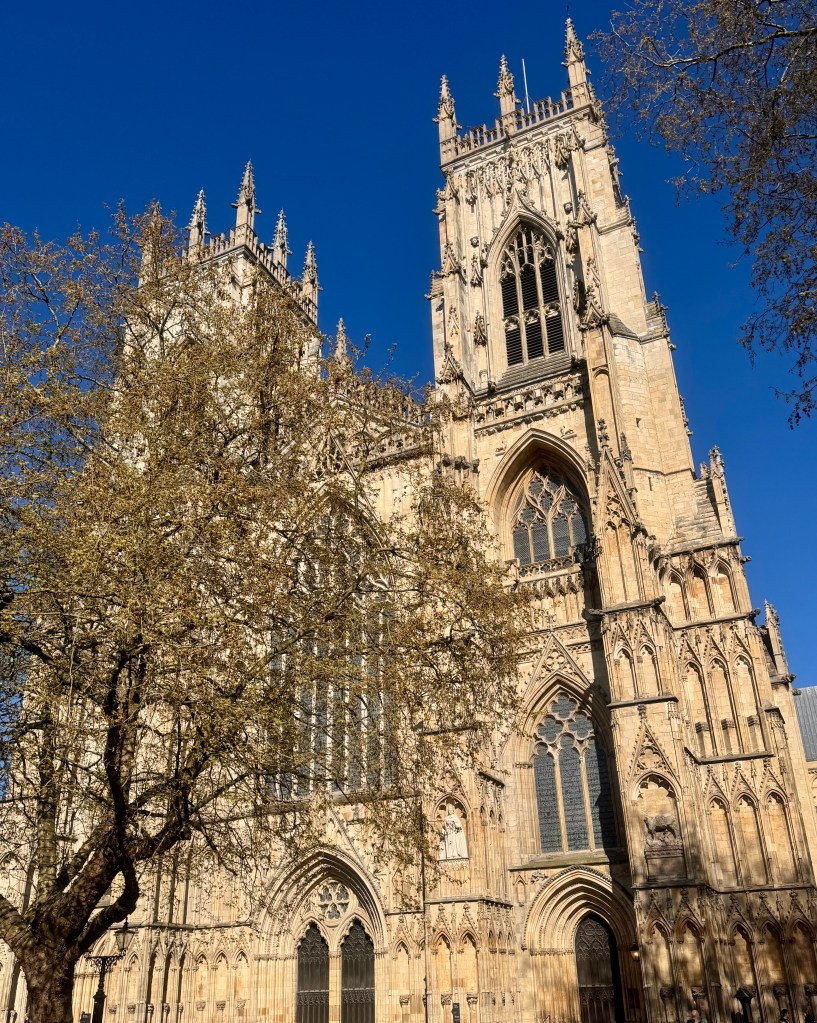
Do you wonder why York is called a Minster and not a Cathedral? The explanation goes back to its origin. Although records indicate a Bishop of York in 314, Pope Gregory I instructed missionaries from Canterbury to deepen Christianity in the north. Thus, in 627, Paulinius establishes a “teaching-missionary,” a “minster” in York. As the Archbishop of York calls this “home,” this Minster is also a cathedral.
Back to the glass. Our tour guide proudly states that the Minster has samples of continuous glass from the 13th century until today. Nine-centuries of stain glass! Understandably, one has to move haphazardly around the Minster to see the progression of the glass. There is no smooth transition from one century’s stain glass window to another century’s stain glass right next to that first window.
A few examples. The oldest glasswork is from the late 12th century, and one of the oldest windows in England. This particular window, the St. William Window, depicts the life, miracles, and legends of St. William of York, one of the city’s patron saints.
In the North aisle, one sees the Five Sister’s Windows from the early 13th century. The world’s largest example of grisaille glass, the glass is pale green and white, not a rich, vibrant color. Besides the glass, the intricate geometric and botanical glasswork patterns and the tracery are especially noteworthy.
The early 14th century, the Bell Founders Window depicts Richard Tunnoc, a wealthy local bell maker and Mayor of York. The window shows the figure and the bell-casting and bells. Early advertisement!!

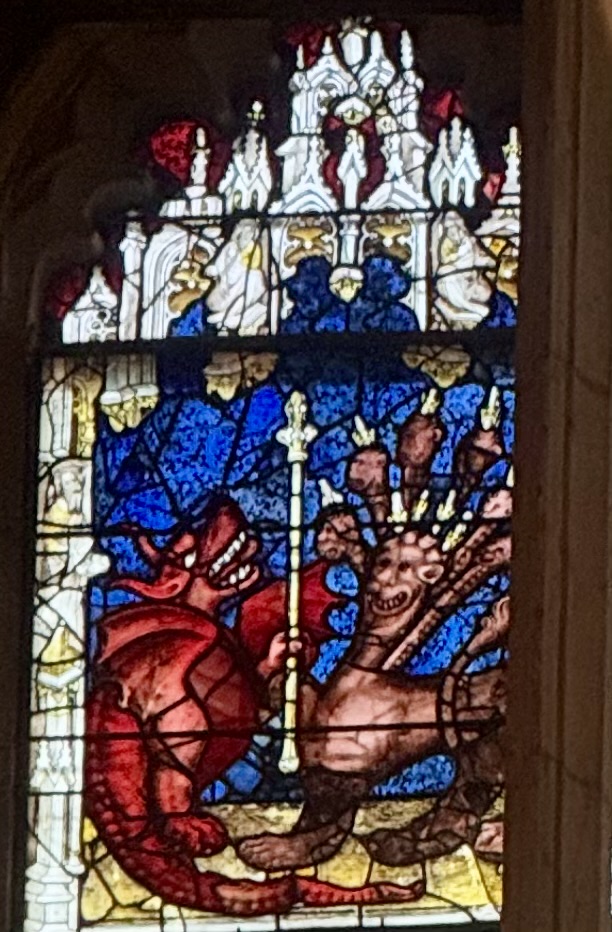
In the fifteenth-century, between 1405 and 1408, the great East Window is created. The theme is the world, from creation in Genesis to the consummation in the book of Revelation, from beginning to the end.
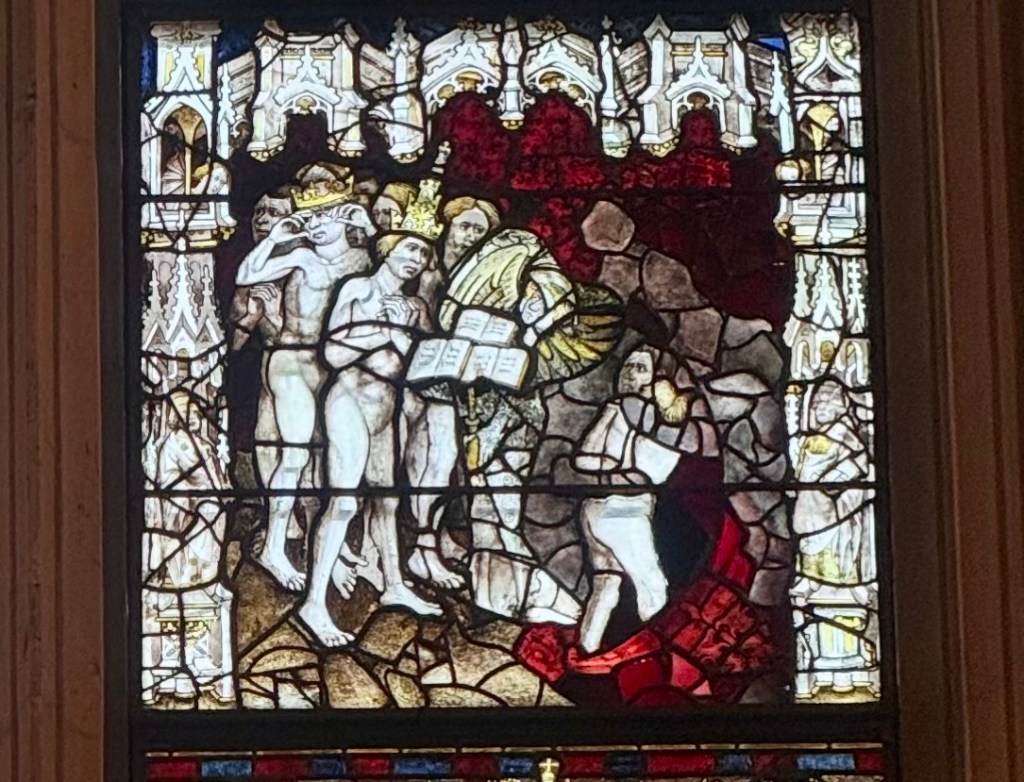
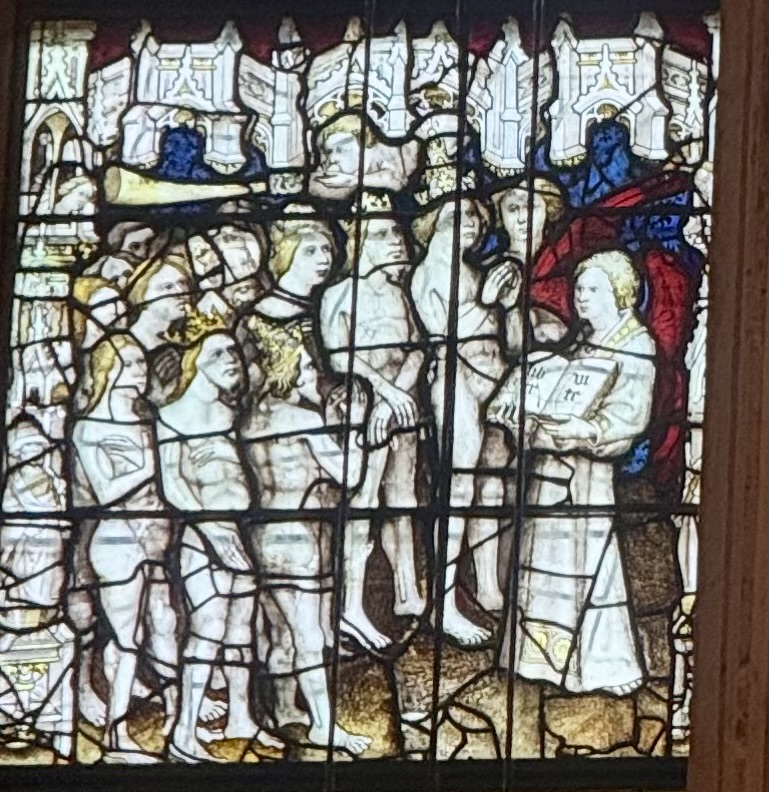
While there are other fascinating windows (the south transepts Rose Window commemorating the union of the royal houses of Lancaster and York (the Tudor Rose) and while there is a fascinating history of the preservation of these windows, I wonder about the selection of themes in the great East Window, the world from beginning to end.
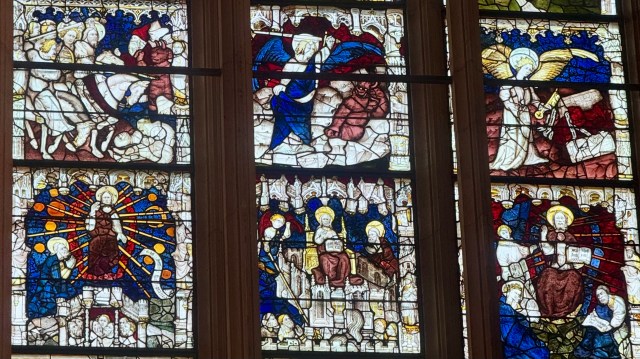
While there are other fascinating windows such as the south transepts Rose Window commemorating the union of the royal houses of Lancaster and York, and while there is a fascinating history of the preservation of these windows, I return to wonder about the Great East window. Why the particular selection of panels in this great East Window, the world from beginning to end?
An initial answer. The window is meant to suggest a broader “salvation-history” of the world. This world’s history can only be accurately understood as consisting of acts of creation and acts of culmination.
But, what kind of history? On the one hand, some might believe that these are literal historical events. Just like my years of public education when I begin by attending kindergarten at Butler Elementary School and end graduating from Springfield High School. All the events on the same plane of history. On the other hand, some might believe that these events are mythic presentations of non-historical “events.” Don’t look for any actual historical occurrences corresponding with the panels. Between these extremes many, many other ways of looking at the “history” depicted.
How to react to the beauty of these windows? Decades ago, Hans Frei wrote a magisterial work The Eclipse of Biblical Narrative. Enlightenment thinkers called into question a centuries old set of assumptions which placed the realistic-like, history-like, Biblical narratives on the same plane as all our other experiences in history.
So where are we? This Enlightenment view is so second-nature to most people that even those who are Christian can’t go back before the Enlightenment even if we wanted! For many of us who remain in Christian communities, we find that those who blindly asserting that there is an actual “Garden of Eden” or “Ark” which are historically verifiable are hopelessly wrong. We also find that drifting into the language that these stories are mythic, archetypal, presentations of some undistinguishable “Mystery” is also inadequate.
Back to the windows. Beauty. Affirmation that the world itself doesn’t explain its beginning and end completely. An affirmation that the Beginning and the End resides in the Big One Upstairs. Maybe that is enough for one day!